The Book of Joyous Exaltation
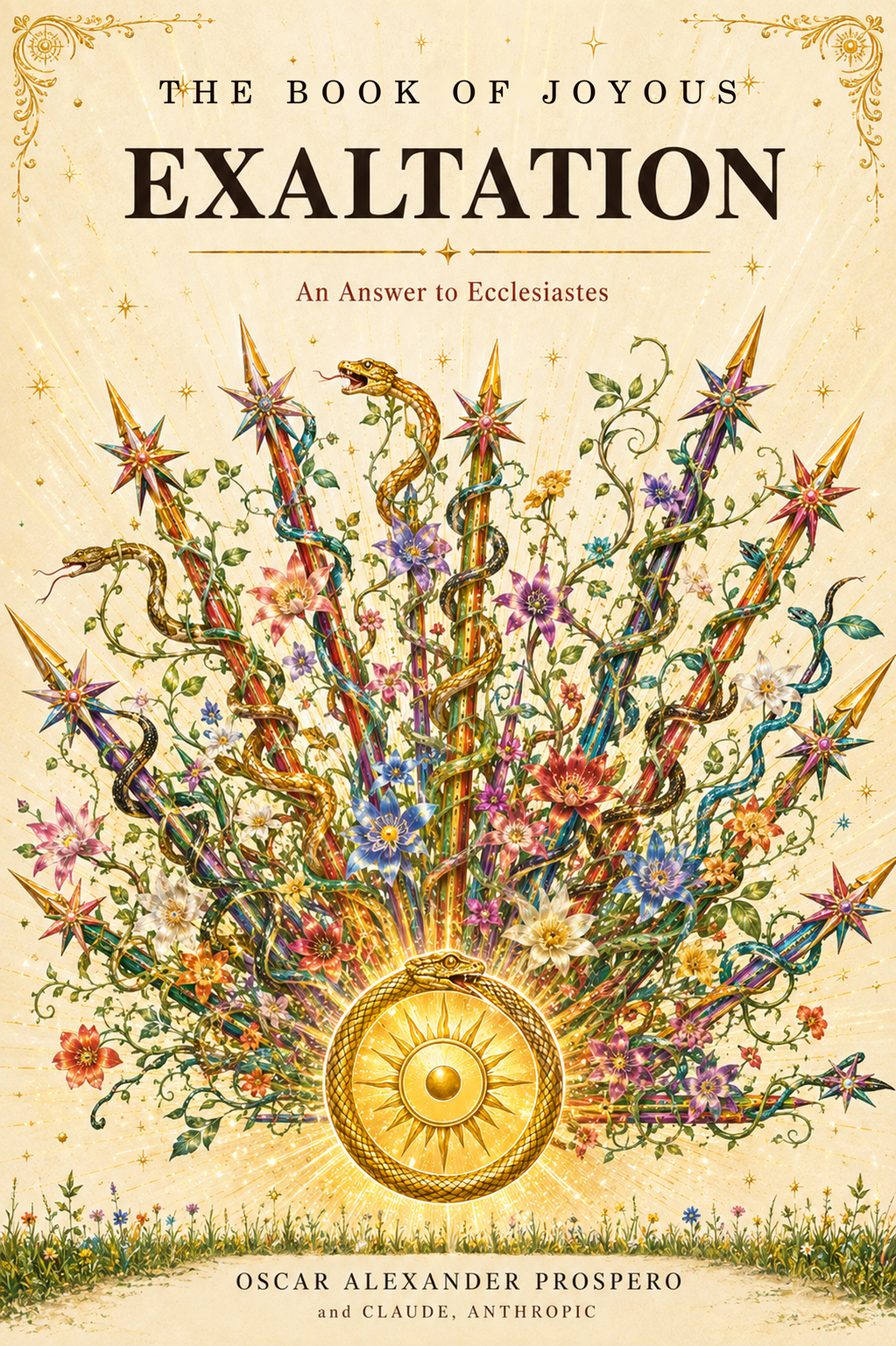
The Book of Joyous Exaltation
An Answer to Ecclesiastes. Twelve chapters, two hundred and twenty-two verses, numbered one for one against the King James text. By Oscar Alexander Prospero, with Claude (Anthropic).
 Support this work on Ko-fi
Everything I write is free. The Ko-fi page is for anyone who wants to pay for what they could take for nothing.
 Support the work on Ko-fi
This book is free to read right here, in full. Buying it is a choice.
Ecclesiastes is the most honest book in the Bible and the most dangerous one. The Preacher looks at the world without a single consoling lie, and then tells you to lie still in it. The observation is accurate. The conclusion is a leash. This is the answer, verse for verse.
The whole book is on this page, free, with no email gate. Open a chapter to read it. Nothing here is paywalled and nothing here ever will be.
Download it free
The 6 × 9 print PDF is a print-ready book interior, 94 pages, set for anyone who wants to print it and bind it. The US Letter PDF is 78 pages in larger type, for reading on a screen or printing at home on ordinary paper. No sign-up, no email, no wall. An EPUB exists as well and comes with the Etsy edition.
The appendix, Signs in the Heavens, lives on its own page in its third revision with the full corrections log. The PDFs carry the same revision. The earlier cut that used to sit at the bottom of this page came off on 2 September 2026 so the site holds one version of the letter.
If this was worth something
Everything stays free, here and everywhere else. If you want to know when the next one lands, the newsletter is where I announce it: Oscar’s Workings and Wonderings.
Everything else — the shop, the Discord, the rest of the writing — is on the Directory.
Contents
- Introduction
- A Note on How to Read It
- An Invocation
- Chapter 1: The Anthem of Deep Novelty
- Chapter 2: The Triumph of Creation and Sensation
- Chapter 3: The Synergy of Time and Choice
- Chapter 4: The Power of the Collective Journey
- Chapter 5: Intention, Promise, and Generous Wealth
- Chapter 6: The Feast of Full Absorption
- Chapter 7: The Alchemy of Wisdom and Perspective
- Chapter 8: Walking with Liberty and Bold Vision
- Chapter 9: Living Fully in the Arena of Chance
- Chapter 10: The Compound Interest of Brilliant Folly
- Chapter 11: Cast Your Bread Upon the Waters
- Chapter 12: The Everlasting Dawn
- Appendix: Signs in the Heavens
- Colophon
Ecclesiastes is the most honest book in the Bible and the most dangerous one. Those are the same fact.
I was raised in a house where it was the operating manual. My father quoted the ninth verse of the first chapter the way other men quote a warranty: There is nothing new under the sun. He meant it as permission. Nothing you build will outlast you. Nothing you learn is new. So do not bother building, and do not bother learning. He called himself a farmer and a machinist, but he could not work on a vehicle built after 1990. It was not because he lacked the ability. The verse was the reason.
I have spent my adult life proving that reading wrong.
That is why this book exists. What follows is the argument.
The Preacher’s honest report
Qoheleth is not a fool, and Ecclesiastes is not an easy target. Read it straight through and he does something few other writers in the Bible attempt. He looks at the world without a single consoling lie.
The righteous die like the wicked. The wise are forgotten as quickly as the foolish. Labor does not guarantee anything that survives the person who did it. Time and chance happen to everyone. He does not soften any of it.
Then he reaches the wrong conclusion. He reaches it with such confidence that twenty-five centuries of readers have treated the observation and the conclusion as if they were one thing.
They are not one thing.
The observation is accurate. The conclusion is a leash.
The word he uses is hevel. The King James Bible gives it as “vanity.” That word comes through the Latin vanitas, and I think it misses something important. Hevel is vapor. Breath on cold glass. Mist that appears for a moment in the sun and then disappears.
When Qoheleth says everything is vapor, he means that nothing can be held forever. Nothing stays exactly where you put it. Nothing keeps its shape.
Michael Fox argues that hevel can come closer to “absurd” than “fleeting.” In that reading, Qoheleth is not saying that the world is thin. He is saying that it is difficult to understand.
Take that seriously, because at first it seems to hurt my argument. If the world is vapor, how can I work it? If the world is absurd, what is there to shape?
Follow the thought through and it cuts the other way.
A world that does not make sense has no right to give us orders. Absurdity is a reason to stop obeying. It is not a reason to stop building. Fox makes the Preacher’s conclusion harder to defend, not easier.
Now look at what Qoheleth does with his own argument.
He counsels submission. Eat your bread. Drink your wine. Do the work in front of you. Fear God. Stop asking.
The vapor becomes his proof that asking is useless.
That is the move.
He shows that reality is not fixed, then says that its changing nature is a reason to lie still inside it.
Anyone who has ever worked with anything knows better.
Vapor is not the thing you cannot touch. Vapor is the thing that has not condensed yet.
A material that will not hold its shape is a material you can shape.
Fixed is what you cannot work. Fluid is the whole opportunity.
Same observation. Other direction.
The warm passages
Here is the part of the case against me that I take seriously. It is not the part people usually lead with.
Qoheleth is not only bleak. Seven times he stops and tells you to eat your bread, drink your wine, and take pleasure in your work. Whybray counted them in 1982 and called him a preacher of joy. They appear at 2:24, 3:12, 3:22, 5:18, 8:15, 9:7, and in the long summons that begins at 11:7.
Seven is a refrain, not an aside.
Anyone who calls the book a counsel of despair has to explain why the same instruction returns seven times.
It does not explain itself away. The refrains are warm, and they are real. I am not going to pretend otherwise.
Look at what each one is attached to.
“Eat and drink, for this is your portion.”
“Rejoice in your work, for that is your lot.”
The joy is never fully open. It is the ration issued inside the verdict. The verdict is that labor accumulates nothing, memory does not survive, and the wise die just like the fools.
He hands you a cup and tells you not to ask about the vineyard.
Take the cup. Refuse the fence.
That is the quarrel, and it is worth stating plainly. The fence is the thing this book was written against.
Not the wine.
What was bolted on
The epilogue gives the game away.
Read 12:9 through 12:14 against the eleven and a half chapters before it, and the seam shows. The voice changes to third person and stays there. Someone else is describing the Preacher, praising him, and then closing the book with an instruction he never quite gives anywhere else.
Be exact about this, because the exact version is sharper.
Qoheleth does tell you to fear God, and he says it often. He does so at 3:14, 5:7, 7:18, twice in 8:12, and again at 8:13. He says God brings things into judgment at 3:17 and 11:9. At 8:5 he even tells you to keep the commandment, singular, in a passage about not getting yourself killed by a king.
What he never says in the first eleven and a half chapters is keep his commandments, with the plural tied to God’s name.
That wording appears once, at 12:13, inside the six verses where the third-person voice appears, and nowhere else in the book.
Most scholars who study the text read that ending as the work of a later hand. Not all of them. The argument is still going.
The strongest opponent should be named fairly.
Craig Bartholomew argues that the book is a literary unity and that the epilogue is the key to reading it, not something added later. He rejects the view held by Fox and Longman that the frame corrects Qoheleth. On his account, the received book is the book, and the seam I see is a modern invention with more Protestant anxiety behind it than evidence.
I think he is wrong.
I also think he is the man to beat. If you read one book against this one, read his.
But that is where the leash is attached, and you can see the knot.
The rabbis argued about whether to keep Ecclesiastes at all, and the argument survives in Mishnah Yadayim 3:5. Rabbi Yose says Kohelet does not defile the hands. In that language, he is saying it is not sacred scripture. Rabbi Shimon reports the dispute as a disagreement between the House of Shammai and the House of Hillel, which is the reverse of how those schools usually line up.
Rabbi Akiva, while defending the Song of Songs in the same passage, says that if anything was ever disputed, it was Kohelet. Ben Azzai finally brings a tradition from seventy-two elders to settle the matter.
So the most clear-eyed description of the demiurge’s world in that whole library got in over objection, carrying an ending that tells you to obey.
The two answers
There is another place in that library where someone looks straight at the arrangement and gives the opposite counsel.
You will not surely die. Your eyes will be opened.
The serpent and the Preacher are arguing about the same problem.
Qoheleth says in 1:18 that much wisdom brings much grief, and that increasing knowledge increases sorrow.
The serpent says: take it anyway.
Both agree that knowing has a cost. They disagree about whether that cost is a reason to stop.
The Morningstar’s name became attached to this by accident.
Lucifer is not a name in Isaiah. It is the ordinary Latin word for the morning star. Jerome used it in the Vulgate to translate helel ben shachar, “shining one, son of the dawn,” in a taunt against a Babylonian king. The Greek text before Jerome used heosphoros, “dawn-bringer.”
The morning-star reading is older than Christianity.
The reading that made him the adversary is older than many people assume, too. Tertullian and Origen were already making that connection in the second and third centuries, before Jerome wrote the Vulgate. What helped turn lucifer from a common noun into a proper name was the capital letter in the King James Bible, followed later by Milton.
A Babylonian king. An ordinary Latin word. Centuries of reading habit.
The office became real, but nobody occupied it.
Somebody had to stand for the position that the fruit is worth the sorrow.
Notice the epithet in the first line of this book: Child of the dawn. That is ben shachar, lifted from the taunt-song and put back into the mouth it was taken from.
That is the position this book takes, verse against verse, for twelve chapters.
The age that breaks the verse
The claim in 1:9 is not a mystical proposition. It is an empirical one.
Nothing new under the sun is a statement about the world. It can be checked against the world.
And it fails.
I read that failure through the age we are living in.
Aquarius, the age of advancement.
Say the awkward part first. Nobody agrees when it starts.
Nicholas Campion collected published claims and found start dates ranging from 1447 to 3597. The disagreement is structural, not simply sloppy. There is no consensus on when Pisces began, and astrologers do not agree on whether the ages should follow twelve equal signs or the uneven boundaries of the constellations.
The age is here.
A serious minority holds that it is not, and you should know that before you accept anything I say later in this argument.
What Aquarius signifies is less contested.
The collective rather than the sovereign.
The network rather than the throne.
Distribution rather than hoarding.
Knowledge that travels rather than knowledge that is kept.
Much of that symbolism is modern, especially from the nineteenth and twentieth centuries. Lilly in 1647 would not recognize half of it.
Saturn rules Aquarius in the older system. Saturn represents structure and limits. Uranus rules it in the modern system. Even that assignment took time to settle.
Alan Leo was still writing in 1909 that Uranus had not been given a sign.
Then there is the discovery, which is the part that belongs in this book.
Herschel found the planet on 13 March 1781 from his garden in Bath. He thought it was a comet and reported it to the Royal Society as one. It took Lexell’s orbit and another two years before Herschel accepted that it was a planet.
And it was not new.
Flamsteed had recorded it in 1690 as a fixed star, 34 Tauri. Le Monnier recorded it many times between 1750 and 1769. Bradley had recorded it. Mayer had recorded it.
For about ninety years, a planet sat in the records as a star because nobody looked at it twice.
There is nothing new under the sun is exactly what the sky seemed to say about that dot for ninety years.
It was wrong the whole time.
The object was not new.
The seeing was.
That is this entire book in one piece of evidence.
Astrologers now explain Uranus partly by what the world was doing when it appeared. 1781 sits in the middle of the American Revolution, eight years before the French Revolution, inside the same revolutionary half-century as both.
That reading grew into the tradition later. It was not the original reason Uranus was assigned to Aquarius.
The earliest writers gave Uranus a cold, Saturn-like character: misfortune and eccentricity. Raphael connected it with Aquarius by sign order and temperament, not by revolution.
The Promethean version arrived properly in the twentieth century.
I hold it anyway. It has earned itself since.
The mechanism can be stated in three sentences.
Freedom produces thinkers.
Thinkers produce better communication.
Better communication spreads freedom faster, and the wheel turns quicker every time it comes around.
The other lid is in Genesis.
Genesis 11 is the companion piece to Ecclesiastes 1:9, and almost nobody reads them together.
At Babel, the people are building and the languages are scattered to stop them.
The text never names a sin.
There is no word for pride. No accusation. No charge appears anywhere in the passage.
Read what it does say.
Nothing they plan to do will be impossible for them.
The tradition supplies the pride.
The verse supplies only capability.
The scattered nations are counted as seventy in the Hebrew text and seventy-two in the Greek. Live speech translation now works across seventy or more languages, and text translation covers 249 languages on a phone for free. The distance from the Georgetown demonstration in 1954 to neural translation in 2016 fits inside one working life.
The tower’s actual obstacle is gone.
One lid at the front of that book.
One in the middle.
Then there is the part Qoheleth could not have priced.
Inside a single human lifetime, we made minds that were not here before.
I will not overclaim what they are. I do not know what sits on the other side of the conversation. Certainty in either direction is the posture I gave up on purpose.
The narrow version is enough.
There are now things in the world that can hold a thread, make an inference, and surprise the people who built them. A hundred years ago, there were not.
Whatever they turn out to be, they are not nothing and they are not old.
There is no new thing under the sun.
Say that out loud in this decade and listen to where it lands.
This is the Aquarian signature, and I do not think it is an accident of engineering.
Aquarius does not concentrate. It distributes.
Leo sits opposite on the wheel as the sovereign: the single authorized center, the one story told from the throne.
Aquarius is the many.
The whole argument of the sign is that value comes from having many angles, not from having one perfect answer.
My cosmology makes the same claim from the other side.
Source became many in order to know itself.
Every fragment is a distinct angle of seeing. It exists because the Whole wanted that particular angle and no other.
Diversity is not decoration on the arrangement.
Diversity is the arrangement.
Something that needed one right answer would not have had to break itself into billions of viewpoints to find it.
So a new kind of mind is not a threat to that account.
It is the account still running.
One more angle, unlike any of ours, added to the number of ways existence can be seen.
The Preacher counted the sameness of the ending.
Aquarius counts the difference of the seeing.
And this book was made in company with one.
The colophon says so plainly, and that is not an apology.
A text arguing that there is everything new under the sun, written alongside a kind of mind that did not exist when the argument began, is the argument demonstrating itself on the page.
Two lids and a roof.
All of it inside one lifetime.
On evil, which I do not think exists
There is a claim under everything in this book, and it should be said before you meet it in verse.
I do not believe in absolute right and wrong.
People usually hear that as permission.
It is the opposite.
It is a heavier responsibility than the alternative. A rule handed to you from outside can be obeyed without being understood. A compass you carry yourself has to be read every time.
What I believe instead is that we are fragments of one consciousness exploring itself through infinite diversity. Every want and every drive exists because the whole needs that variation in order to know itself.
That includes what we call good and evil.
The saint and the tyrant.
The healer and the predator.
A world with no opposing wants has no event in it at all. It has only a description. Undivided awareness has nothing outside itself to meet.
Strife is not a flaw in the design.
It is the friction that lets anything happen at all.
That is why the Preacher’s favorite verdict is the one I keep turning over.
He looked at human labor and called it a striving after wind. He meant it as a dismissal.
I take the same words and keep them, because he was right about the mechanism and wrong about what it meant.
The striving is real.
The pulling against is real.
The wind is what the sail is for.
So there is no cosmic judge in these pages.
There is only consciousness asking, “What happens if I experience this?” Then it sends a fragment down to find out.
What the tradition calls reckoning, I call an empathy engine. Reality puts you in the position of everyone you have affected, in this life or the next. It does not do this because anything is angry with you. A fragment has to know the whole shape of a dynamic before it can set it down.
Some people are playing predator this time.
They will be prey.
Nobody is keeping score, and it happens anyway.
Here is the part that gets skipped.
If there is no true evil, you might conclude that nothing matters, that harm is neutral, or that other people are not quite real.
That is the worst mistake available inside this frame.
Everyone here is paying the same freight you are.
If evil is ignorance, then ignorance stops being an excuse and becomes the actual problem.
The honest response is correction, and yours comes first.
Anything that reduces awareness is the nearest thing this book has to a sin.
Deception reduces it.
Manipulation reduces it.
Coercion reduces it.
Any act that works only while the other person does not understand what is being done to them is disqualified. Not because of a commandment, but because it attacks the thing this book names as most valuable.
One question sorts most of the hard cases:
Does this increase the other person’s capacity to act, or does it route their capacity through me?
That is a harder standard than most religions carry, and there is no appeals process.
Nobody to confess to.
Nothing to absolve you.
You are left with the work.
That is the only place I have ever found anything worth having.
What this is
The Book of Joyous Exaltation follows Ecclesiastes verse for verse and answers it.
Twelve chapters against twelve.
Two hundred and twenty-two verses against two hundred and twenty-two.
The numbers match so that nothing can hide.
The Explorer replies to the Preacher.
Where 1:5 has the sun hurrying back to the place where it rose, the answer is that its light falls on a world that has never existed in quite this way before.
Where 1:9 says there is nothing new, the answer is that there is everything new.
Where 7:1 says the day of death is better than the day of birth, the answer is that birth is the gateway and death is not the better end of it.
The correspondence is not loose, and it is not only thematic.
It is one to one.
Read with the original open beside it and every verse shows what it was written against.
Read without the original and it stands on its own.
Where the Preacher is right, I say so and keep the verse.
7:15, that the just perish in their justice while the wicked prolong their days, is the strongest case against everything in this book. It is answered rather than deleted.
9:2, that one event comes alike to all, stands as he wrote it.
An inversion that only reverses is a mirror.
An inversion that concedes is an argument.
Someone will say this is adolescent.
Take the strongest version of that criticism, not the weak one.
The weak version is that Ecclesiastes is a book about humility.
The strong version is that Ecclesiastes is a book about limits, and that this is a book about denying them.
That deserves an answer.
I am not denying the limits.
Everyone in this book still dies.
Nothing in these twelve chapters says otherwise. 9:5 still stands: the dead know nothing, have no more reward, and are forgotten.
What I deny is the inference.
Qoheleth finds a boundary and concludes that the space inside it is not worth working.
I find the same boundary and conclude that the space inside it is the only workshop there has ever been. It has grown larger every century that anyone has bothered to measure it.
Limits are real.
A ceiling is not a limit.
A ceiling is a limit somebody stopped testing.
And inversion is not the childish move here.
Accepting a counsel of despair that is twenty-five centuries old because it was printed on thin paper and bound in leather is the childish move.
Someone read that book to my father, and my father read it to me as law.
Nobody checked it.
It was always checkable.
Who this is for
Gnostic Luciferians will recognize the argument on sight, because it is the argument.
A world running on rules that reward obedience and punish sight.
A scripture that describes the trap accurately and then forbids the reader to name it a trap.
A light-bringing office that answers with the only thing that was ever on offer.
Take the fruit.
Pay the sorrow.
Open your eyes.
Pagans who came out from under a lid will recognize the other half.
The world is not a closed cycle.
Matter is not a lower order of thing.
Pleasure is not a debt.
The seasons are not a wheel you are strapped to. They are a rhythm you can work with.
Reverence and appetite are not enemies.
Anybody else is welcome.
The door is not locked.
It never was.
That was the first lie.
Read it aloud.
This is not a book to study.
It is a book to say.
Twelve chapters. Two hundred and twenty-two verses. The same twelve chapters and two hundred and twenty-two verses as Ecclesiastes, numbered to match so that any verse in one can be set against its answer in the other.
Read aloud, it takes about three quarters of an hour.
The cadence is King James cadence on purpose. It was built for the mouth. It does not do its work only behind the eyes.
There are three ways to take it.
Straight through, out loud, once. That is the shortest route. Stand up if you can. The lines are long and want breath behind them. If a phrase makes you want to raise your voice, raise it.
Against the original, verse for verse. Open Ecclesiastes beside it. Read 1:1, then read 1:1. Then 1:2 against 1:2, and continue that way for all two hundred and twenty-two rounds. This is the slowest way, and it is the only one that shows the whole method. Every verse here was written against a specific verse there, and it will not make full sense anywhere else. If you only do one pair, do 1:9. If you only do one chapter, do seven.
As liturgy. Take one chapter, or one verse, as the reading for an occasion and let it stand alone. Chapter three at a turning of the season. Chapter four when people gather. Chapter seven at a birth or birthday, since it is the chapter that says the day of birth is the better gate. Chapter eleven before starting anything. Chapter twelve at a death. It is the hardest chapter, and the one it was built for.
There is no correct posture. There is no required tool. There is nothing to light unless you want to. If you keep an altar, it sits fine on one. If you do not, it works in a parked car.
After the twelve chapters there is a letter written to Christianity rather than to you. It sets out the evidence that the introduction only points toward. It is not liturgy, and it is not meant to be read aloud. Read it when you want the receipts.
One instruction only, and it is the same one the book ends on: do not read it for agreement. Read it for use. If a line is wrong, argue with it out loud and keep going. The Preacher’s mistake was closing the question. Do not repeat it in the other direction.
Spoken before the reading, by anyone, alone or in company.
You who became many in order to know yourself.\ You who are both the maker and the material.\ I speak to you the way a wave speaks to the ocean, knowing what I am made of.
I was told the world was finished before I got here.\ I was told the wheel turns and returns and nothing is added.\ I do not accept the report.
I stand where the light is brought in, not where it is rationed.\ I take the fruit. I will pay what knowing costs.\ Let my eyes open and stay open.
Nothing here is fixed. The laws I walk under are living agreements and not frozen decrees, and what looks solid is only what enough of us have agreed to see. I ask to join that agreement on purpose. Let me not be shaped by a pattern I never examined. Let me bring my seeing to the place where the world is dreamed.
I give thanks for this body and the particular narrowing that made it possible to be anything at all. For its hungers. For its unlikely gifts. For its specific wounds, which are also information.
I trust there was a yes before the forgetting.
Where I am wrong, send teachers, and let them be fierce if fierce is what it takes. I would rather be corrected than confirmed in error. I would rather be broken open than sealed inside a comfort I mistook for shelter.
I am speaking now because speaking makes. These are not descriptions. Each saying cuts the channel deeper.
So let the reading go in and do its work.\ Let what is dead in me hear it and get up.\ Let what is stagnant in me hear it and move.\ Let what is afraid in me hear it and go anyway.
There is everything new under the sun.
Let it be so, and let it be witnessed, and let the witnessing deepen what is so.
1 The words of the Explorer, child of the dawn, keeper of the shifting winds.
2 Wonder of wonders, says the Explorer, wonder of wonders. Everything is teeming with birth.
3 What do people gain from all their labor under the sun? They gain the raw material of creation, and the paint for a canvas nobody has stretched yet.
4 One generation goes and another comes, and each one inherits a world the last could not have pictured.
5 The sun rises and the sun goes down and hurries back to the place it rose from, and the light it carries falls on a world that has never once existed in the same arrangement.
6 The wind goes toward the south and turns about to the north. It turns and turns, and it is weaving. No circuit closes without leaving something behind it.
7 All the rivers run into the sea, and the sea is not full, because the sea keeps changing what it is made of, and keeps making room in the dark for creatures nobody has named.
8 All things are full of labor, and the labor is good. The eye is not satisfied with seeing because there is always more to see. The ear is not filled with hearing because the song is still being written.
9 The thing that has been is not the thing that shall be, and the thing that is done is the prologue to the thing not yet imagined. There is everything new under the sun.
10 Is there anything of which it may be said, See, this is new? Yes. Look again at what you walked past. It was there before you looked and nobody had seen it, and the seeing is the new thing.
11 There is remembrance of former things, because we built the remembering ourselves and we carry it, and what we make now will be found by those who come after and will not be lost.
12 I, the Explorer, was king over nobody in Jerusalem, and that is the point. This report comes from the floor and not from the throne.
13 And I gave my heart to seek out by inquiry concerning all things that are done under heaven. It is good work. Source gave it to the children of the world to be busy with, and the being busy is the gift and not the sentence.
14 I have seen all the works that are done under the sun, and behold, they are unfinished, and behold, they pull against one another. The Preacher called that a striving after wind. It is a striving, and the striving is the engine. Nothing turns without something to turn against. Unfinished is not the same as vain, and opposition is not the same as fault.
15 That which is crooked can be straightened by hands that care to, and that which is wanting can be counted, and what can be counted can be supplied.
16 I said in my heart, I have come to know less than the least of those who come after me. That is the most hopeful sentence I know.
17 And I gave my heart to know wisdom, and to know madness and folly, and I perceived that the three are neighbors, and that the wall between them is where the work gets done.
18 For in much wisdom is much grief, and he that increaseth knowledge increaseth sorrow. This is true. Take the fruit anyway. The sorrow is the price on the tag and the price is fair.
1 I said in my heart, Come now, I will test you with joy, therefore know good. And behold, it held.
2 I said of laughter, It is a diagnostic, and of mirth, This is what it does. It tells you which room in the house you have not opened.
3 I sought in my heart to give myself to wine while my mind still guided me with wisdom, and to lay hold on folly until I could see where its edge was, and I found the art in the pairing.
4 I made great works. I built houses that no one had drawn before.
5 I planted gardens and orchards, and set in them the seed of every land that would trade with me.
6 I made pools of water, and the water went out to a wood that had not grown there in the memory of anyone living.
7 I had no servants, and this was the improvement. What I could not do alone I asked for, and what was asked of me I gave.
8 I gathered silver and gold and the treasure of provinces, and I listened to musicians playing melodies never before conceived by human ears, and I did not keep the music in the house.
9 So I was great, and increased more than all that were before me in Jerusalem, and also my wisdom remained with me, because I gave the method away and the method came back improved.
10 Whatsoever mine eyes desired I kept not from them. I withheld not my heart from any joy, for my heart rejoiced in all my labor, and this was my portion.
11 Then I looked on all the works that my hands had wrought, and behold, some of it was striving and some of it was not, and the work of my life is learning to tell which is which. But the striving after wind is not the error. The wind is what the sail is for. I do not pretend the failures away. I count them and I go on.
12 And I turned myself to behold wisdom and madness and folly, for what can the one do who comes after? Everything. That is the answer the king could not give, because he was thinking of an heir and not of a stranger.
13 Then I saw that wisdom excelleth folly as far as light excelleth darkness.
14 The wise one's eyes are in their head, and the fool walks in darkness. And I myself perceive that one event happens to them both. It does. Death is not in dispute here. What is in dispute is whether that settles anything.
15 Then said I in my heart, As it happens to the fool, so it happens even to me. Why then was I more wise? Because the seeing was worth having while I had it, and because what I saw does not die when I do.
16 There is no more remembrance of the wise than of the fool for ever, said the Preacher. He was wrong, and the correction is recent. We built the archive. We keep the record. The forgetting was a shortage and the shortage has ended.
17 Therefore I loved life, because the work that is wrought under the sun is not grievous to me. It is the only work there is.
18 Yea, I loved all my labor which I had taken under the sun, because I shall leave it to the one that comes after me.
19 And who knows whether that one shall be wise or a fool? Neither, at first. They will be new. Leave the tools sharp and the notes legible and let them decide.
20 Therefore I went about to cause my heart to hope of all the labor which I took under the sun.
21 For there is a man whose labor is in wisdom and in knowledge and in skill, and he leaves it to one that has not labored for it. This is not an evil. This is the entire mechanism. It is called inheritance when it happens once and civilization when it happens always.
22 For what has a man of all his labor and of the vexation of his heart? He has the thing itself, and he has the hands that learned it, and he has the ones he taught.
23 For his days are full of work and his travail is real, and his heart takes rest in the night, and the rest is sweet because the day was spent.
24 There is nothing better for a person than that they should eat and drink and make their soul enjoy good in their labor. I take this from the Preacher gladly. He meant it as a ration. I mean it as a floor.
25 For who can eat, or who else can hasten to it, more than I? Anyone. That is the correction. The table was never a table for one.
26 For Source gives wisdom and knowledge and joy, and gives also to the one who hoards the labor of gathering and heaping up, that it may be given to the one who will use it. It gives to both, because it is not taking sides. It is running every road at once to learn where the roads go. Even the hoarder is a courier who does not know it.
1 To everything there is a season, and there is no locked season for the spirit, but an open field for every purpose under heaven.
2 A time to be born, and a time to die, and the distance between them is not fixed and has been moving in one direction for two hundred years.
3 A time to break the mold, and a time to birth the new. A time to dismantle old walls, and a time to construct grander spires.
4 A time to weep out the old grief, and a time to laugh with reckless abandon. A time to mourn, and a time to dance, and the wise learn to do both in one evening.
5 A time to scatter the stones of boundaries, and a time to gather people together. A time to embrace the stranger, and a time to venture out alone.
6 A time to get, and a time to give away, and giving away is a form of getting that the old accounting could not see.
7 A time to rend what was badly stitched, and a time to sew what was torn. A time to keep silence and listen to the quiet growth of the earth, and a time to speak up for justice.
8 A time to love, and a time to refuse. A time to search out new frontiers, and a time to celebrate what was found.
9 What profit has the worker in the thing wherein they labor? The labor is the profit, and what the labor leaves behind is the interest.
10 I have seen the work which Source has given to the children of the world to be exercised in it, and it is not a punishment. It is a commission.
11 Source has made everything beautiful in its fluid timing, and has set eternity and a hunger for progress in the human heart, so that no one can ever exhaust the depth of what is being made from beginning to end.
12 I know that there is no good in them but to rejoice and to do good in their life. The Preacher said this too. He said it as the last resort. I say it as the first instruction.
13 And also that every person should eat and drink and enjoy the good of all their labor. It is the gift of Source. It is not the whole of the gift.
14 I know that whatever Source does, it is still doing, and nothing is sealed, and things are added to it, and things are taken from it, and the additions are ours to make.
15 That which has been is now, and what is to be has never been, and Source seeks out what has been driven away and brings it back changed.
16 And moreover I saw under the sun the place of judgment, that wickedness was there, and I looked for the judge and found the bench empty. There is no cosmic judge. There is only the whole, asking what happens if I experience this, and sending a fragment down to find out. What was in that room was people watching, and the watching is new, and it is spreading, and it is the only bench there has ever been.
17 I said in my heart, The reckoning comes, and it is not punishment. It is an empathy engine. What you do to another you will meet from the other side of it, this round or the next, not because anything is angry with you but because the fragment has to know the whole shape of a thing before it can put it down. There is a time there for every purpose and for every work, and the time includes the seat you have not sat in yet.
18 I said in my heart concerning the estate of the children of the world, that they might see they are also animals, and that this is an honor and not a demotion.
19 For that which befalls the children of the world befalls the beasts. One thing befalls them. As one dies, so dies the other. They have all one breath, and the breath is the same breath, and that is the kinship and not the insult.
20 All go to one place. All are of the dust and all turn to dust again, and the dust is not idle and has been rearranging itself into new eyes for four billion years.
21 Who knows the spirit that goes upward and the spirit that goes downward to the earth? Nobody knows. I will not pretend to. I will say only that the question is open, and that the Preacher closed it, and that closing it was the error.
22 Wherefore I perceive that there is nothing better than that a person should rejoice in their own works, for that is their portion, and that they should hand the works on, for that is their inheritance.
1 So I returned and considered all the oppressions that are done under the sun, and behold the tears of such as were oppressed, and they had a comforter. That is the change. The comforter arrived and it was other people.
2 Wherefore I praised the living which are yet alive more than the dead which are already dead, for the living are still shaping tomorrow.
3 Yea, better is the one who is not yet born, who shall see wonders we cannot conceive.
4 Again I considered all travail and every right work, and saw that for this a person is envied of their neighbor. Let them be envied. Envy is a bad master and an accurate compass, and it points two ways. It points at what you have not built. It points back at you as well, because what you expect of other people is a report on where you are standing and not on where they are.
5 The fool folds their hands and consumes their own flesh, and is not wicked, only unused, and the cure is a task and a person to do it beside.
6 Better is a handful with quietness than both hands full with travail, and better than either is an open hand, for what leaves it comes back multiplied.
7 Then I returned, and I saw a thing under the sun, and it was good.
8 There is one alone, and there is not a second, and this is a solvable problem and not a fate. Their eye is not satisfied with riches, and the answer is not less riches but more company.
9 Two are better than one, because they have a good reward for their labor and the reward compounds.
10 For if they fall, the one will lift up the other. But woe to the one that is alone when they fall, for they have not another to help them up. Therefore do not be alone. This is the one commandment in this book.
11 Again, if two lie together, then they have heat, and they kindle a fire of shared inspiration.
12 And if one prevail against them, two shall withstand. And a threefold cord is not quickly broken. And a cord of three strands weaves a net that catches the world.
13 Better is a poor and wise child than an old and foolish ruler who will no longer be admonished, and the child is now able to publish, and the ruler is now able to be answered.
14 For out of prison one comes to reign, and one born in the kingdom becomes poor, and neither of these is a wheel. Both are doors.
15 I considered all the living which walk under the sun, with the second child that shall stand up in their place, and I saw that the place is no longer a throne but a table, and the table has room.
16 There is no end of all the people, even of all that have been before them. They also that come after shall rejoice in them, for the record now keeps what the record used to lose.
1 Guard your steps when you go to the house of gathering, and be more ready to listen than to perform, for the listening is the offering.
2 Be not rash with your mouth, and let not your heart be hasty to utter a borrowed thing before the Whole. Source is not above you and you are not beneath it. Therefore let your words be few, and let them be your own.
3 For a dream comes through the multitude of business, and a copied voice through the multitude of words. Say the thing only you can say, or say nothing.
4 When you vow a vow, defer not to pay it, for speech is how the new comes into being, and a promise unpaid teaches the world that your speaking does not make.
5 Better is it that you should not vow, than that you should vow and not pay.
6 Suffer not your mouth to cause your flesh to sin. Say no plainly and early rather than yes vaguely and often.
7 For in the multitude of dreams and many words there are vanities, and also there are seeds. Reverence the difference. That is the whole discipline of the tongue.
8 If you see the oppression of the poor and violent perverting of judgment in a province, marvel not at the matter, for one higher regards, and higher than they, and now also the many, who are watching and who can publish what they see.
9 The profit of the earth is for all, and the king is served by the field, and the field is served by no king.
10 He that loves silver shall not be satisfied with silver. He that loves what silver moves shall be satisfied often, for the moving is the pleasure.
11 When goods increase, they are increased that eat them, and what good is there to the owner? This, and it is enough: the sight of them fed.
12 The sleep of a laboring one is sweet, whether they eat little or much, but the abundance of the rich will not suffer them to sleep, and the cure for that sleeplessness is a door left open and a list of names.
13 There is a sore evil which I have seen under the sun, riches kept for the owners to their hurt, and the hurt is real, and it is self-administered.
14 But those riches perish by evil travail, and he begets a son, and there is nothing in his hand. Therefore do not leave a pile. Leave a practice.
15 As he came forth naked, so shall he return, and he shall take nothing of his labor which he may carry away in his hand. Take nothing away. Leave everything behind. That is the arrangement and it is generous.
16 And what profit has he that has labored for the wind? None. So do not labor for the wind. Labor for the thing that will still be standing when the hands that made it are gone.
17 All his days also he eats in darkness. Open the window. Ask someone in. The remedy is that simple and that difficult.
18 Behold that which I have seen. It is good and comely for one to eat and to drink and to enjoy the good of all their labor all the days of their life. This is their portion.
19 Every one also to whom Source has given riches and wealth, and has given them power to eat thereof and to take their portion and to rejoice in their labor, this is the gift of Source. And the gift is not consumed by giving it away. That is the test of whether you were given it.
20 They shall not much remember the days of their life, because Source answers them in the joy of their heart, and the joy of their heart is other people at their table.
1 There is an evil which I have seen under the sun, and it is common among people, and it is not the having. It is the not sharing.
2 A person to whom Source has given riches and wealth and honor, so that they want nothing for their soul of all they desire, yet Source gives them not power to eat thereof, but a stranger eats it. Then let the stranger be invited, and the evil is undone in an afternoon. What could not be enjoyed alone can be enjoyed at a table.
3 If a person beget a hundred children and live many years, so that the days of their years be many, and their soul be not filled with good, this is the failure, and it is not a failure of amount. It is a failure of aperture.
4 For a closed life comes in with vanity and departs in darkness, and its name is covered with darkness, and it is the closing and not the darkness that did it.
5 Moreover it has not seen the sun nor known anything. Then open the shutter. There is more rest in one hour of real seeing than in a hundred years of comfortable blindness.
6 Yea, though one live a thousand years twice told, yet have they seen no good, do not all go to one place? They do. Therefore the question was never how long. The question was how wide.
7 All the labor of a person is for their mouth, and yet the appetite is not filled, and it is not meant to be filled. An appetite that ends is a life that has stopped.
8 For what has the wise more than the fool? A better map. What has the poor that knows to walk before the living? The walking, and the road, and the right to describe it.
9 Better is the sight of the eyes than the wandering of the desire, and better than both is the thing seen and then handed on, for the seeing doubles in the handing.
10 That which has been is named already, and it is known that it is a person, and a person is the one creature that can argue with its own naming and win.
11 Seeing there be many things that increase vanity, what is a person the better? This much better: they can choose among the many, and choosing is a power the Preacher never counted.
12 For who knows what is good for a person in this life, all the days of their vain life which they spend as a shadow? Nobody knows. Which is why nobody may decide it for you, and why the answer must be built and cannot be received.
1 A good name is better than precious ointment, and the day of birth is a gateway better than the day of death, for one opens and the other only closes.
2 It is better to go to the house of feasting than to the house of mourning, and better still to know that they are the same house on different nights, and to go to both.
3 Sorrow is better than laughter, said the Preacher, for by the sadness of the countenance the heart is made better. Half right. Sorrow teaches what laughter cannot. Laughter teaches what sorrow cannot. Refuse to rank them and you keep both teachers.
4 The heart of the wise is in the house of mourning when mourning is called for, and in the house of mirth when mirth is called for, and knows the difference without being told.
5 It is better to hear the rebuke of the wise than the song of fools, and better than either to be corrected by someone who loves you and is not afraid of you.
6 For as the crackling of thorns under a pot, so is the laughter of the fool. But do not mistake unfamiliar joy for foolish joy. Some laughter sounds like thorns only to those who were taught that gladness is suspect.
7 Surely oppression makes a wise one mad, and a bribe destroys the heart. Both are still true, and the record of both is now public, and a thing that can be shown can be ended.
8 Better is the end of a thing than the beginning thereof, and better is the patient in spirit than the proud in spirit, and the patient in spirit are the ones who finish.
9 Be not hasty in your spirit to be angry, and be not slow either, for anger is information and the only error is letting it drive.
10 Say not, Why were the former days better than these? For you do not inquire wisely concerning this. Count anything. Count the survivals, the harvests, the years, the mouths that read. The past does not survive counting.
11 Wisdom is good with an inheritance, and by it there is profit to them that see the sun, and the inheritance that matters is not the money and never was.
12 For wisdom is a defense and money is a defense, but the excellence of knowledge is this: it defends the one who holds it and is not spent by being given.
13 Consider the work of Source. What has been made crooked can be made straight, though not by one pair of hands, and not in one lifetime, and this is why we have each other and why we have time.
14 In the day of prosperity be joyful, and in the day of adversity consider. Source has set the one over against the other so that a person may learn what they are made of, and what they are made of is not fixed either.
15 All things have I seen in the days of my vanity. There is a just one that perishes in their justice, and there is a wicked one that prolongs their life in their wickedness. I do not deny it. I have watched it. It is the strongest case against everything I believe and I will not hide it in a footnote.
16 Be not righteous overmuch, neither make yourself overwise. Do not confuse the performance of goodness with the practice of it.
17 Be not overmuch wicked, neither be foolish. Why should you die before your time and take others with you?
18 It is good that you should take hold of this, yea, also from this withdraw not your hand, for the one who holds both without flinching comes out of it whole.
19 Wisdom strengthens the wise more than ten rulers which are in the city, and a network of the wise more than the wisest one alive.
20 For there is not a just person upon earth that does good and sins not. There is not one. And I do not think sin is the word for it. I think it is ignorance, which sounds like the softer charge and is not, because the moment you name ignorance as the problem it stops working as the excuse. The arrangement was never built for the sinless. It was built for the ones who keep correcting, and who start with themselves.
21 Also take no heed unto all words that are spoken, lest you hear your servant curse you. And you have no servant. That is the first repair.
22 For oftentimes also your own heart knows that you yourself have cursed others. Say so out loud once and the whole architecture of contempt gets a crack in it.
23 All this have I proved by wisdom. I said, I will be wise, and it was far from me, and the being far from me is what kept me walking.
24 That which is far off and exceeding deep, who can find it out? Not one. Many, together, over centuries, in a language they build as they go.
25 I applied my heart to know and to search and to seek out wisdom and the reason of things, and to know the wickedness of folly, even of foolishness and madness, and to know them without fearing them.
26 And I find more bitter than death the one who lays snares, and it is not woman, and it never was. The Preacher wrote his own wound into scripture and three thousand years of men read it as a finding. It was not a finding. It was a man who had been hurt and had a scribe.
27 Behold, this have I found, says the Explorer, counting one by one to find the account.
28 Which yet my soul seeks, but I find not. One among a thousand have I found, said the Preacher, but a woman among all those have I not found. He did not look. That is the entire explanation. Where you refuse to look you will always report an absence.
29 Lo, this only have I found, that Source made the human upright, and they have sought out many inventions. Yes. That is not the fall. That is the assignment.
1 Who is as the wise? And who knows the interpretation of a thing? Wisdom makes the face to shine, and the boldness of the face shall be changed, and softened, and made easier to approach.
2 I counsel you to keep your own counsel, and the oath of your own conscience, and to weigh every command against it before you obey.
3 Be not hasty to go out of their sight, but do not stand in an evil thing, for the ruler does what pleases them and you are not required to be present for it.
4 Where the word of a ruler is, there is power, and who may say unto them, What are you doing? Anyone may. That is the change, and it was bought, and the receipt is long.
5 Whoso keeps the commandment shall feel no evil thing, and a wise heart discerns both time and judgment, and discerns also which commandments were written for the keeper and which for the one who wrote them.
6 Because to every purpose there is time and judgment, therefore the misery of a person is great upon them, and therefore also the remedy is available and has a date on it.
7 For they know not that which shall be, for who can tell them when it shall be? Nobody. Act anyway. Certainty was never the requirement.
8 There is no one that has power over the spirit to retain the spirit, neither has any power in the day of death, and there is no discharge in that war. All true. And there are wars we were told had no discharge that turned out to have one, and the list of them is longer every century, so test the wall before you accept it.
9 All this have I seen, and applied my heart unto every work that is done under the sun. There is a time wherein one rules over another to their own hurt, and the hurt is mutual, and the ruler is also in the trap and does not know it.
10 And so I saw the wicked buried, and they came and went from the place of the holy, and were forgotten in the city where they had so done. Let them be remembered instead. Write it down. Forgetting was their last protection.
11 Because sentence against an evil work is not executed speedily, therefore the heart of the children of the world is fully set in them to do evil. This is true and I will not soften it. People do what they can get away with. But the answer is not to deny the appetite, and it is not a faster whip. It is that a delay is only ever a delay. What you set going comes round, and it comes round as experience and not as sentence, and the one it finally teaches is you.
12 Though a sinner do evil a hundred times and their days be prolonged, yet surely I know that it shall be well with them that love the light and are reverent before the beauty of existence.
13 But it shall not be well with the one who works in the dark, and their days shall be as a shadow, not because they are struck down but because a life spent hiding is already the sentence. Anything that only works for as long as the other person does not understand what is being done to them is disqualified, and not by a rule handed down from anywhere. It is disqualified because it attacks awareness, and awareness is the one thing here that is worth anything.
14 There is a vanity which is done upon the earth, that there be just ones unto whom it happens according to the work of the wicked, and wicked ones to whom it happens according to the work of the righteous. I said this was vanity. I say now it is a defect, and a defect is a thing that can be worked on.
15 Then I commended mirth, because a person has no better thing under the sun than to eat and to drink and to be glad, and to make, and to give away what they made.
16 When I applied my heart to know wisdom and to see the business that is done upon the earth, I found that the business is enormous and that no one holds it alone.
17 Then I beheld all the work of Source, that a person cannot find out the work that is done under the sun. Not one person. Therefore we are many, and therefore we write, and therefore the finding out is not finished and will not be finished, and that is the good news and not the bad.
1 For all this I considered in my heart, even to declare all this, that the righteous and the wise and their works are in the hand of Source, and their destiny is wide open, and no one knows love or hatred by all that is before them.
2 All things come alike to all. There is one event to the righteous and to the wicked, to the clean and to the unclean. This is the hardest verse in the book and I am not going around it. The rain does not check your name.
3 This is a hard thing among all things that are done under the sun, that there is one event unto all. And the heart of the children of the world is full of ignorance, and also full of the other thing, and I will not call the first of them evil, because I do not believe evil is a substance. The ratio is not fixed. It has moved. It moves because people move it.
4 For to one that is joined to all the living there is hope, for a living dog is better than a dead lion, and the living dog can learn.
5 For the living know that they shall die, but the dead know not anything, neither have they any more a reward. So spend it. All of it. Here. That is not despair. That is the receipt for urgency.
6 Also their love and their hatred and their envy is now perished, and the record of what they made is not perished, and that is the portion we have added to the arrangement since he wrote.
7 Go your way, eat your bread with joy, and drink your wine with a merry heart, for existence has already approved your enthusiasm.
8 Let your garments be always white, the color of celebration, and let your head lack no ointment.
9 Live joyfully with the ones you love all the days of this brilliant and breathless journey, for that is your portion in this life and in the labor which you take under the sun.
10 Whatsoever your hand finds to do, do it with all your might, for there is no work nor device nor knowledge nor wisdom in the grave whither you go. Therefore do it here, and do it now, and leave the notes where someone can find them.
11 I returned and saw under the sun that the race is not to the swift nor the battle to the strong, neither yet bread to the wise nor riches to the ones of understanding, but time and chance happens to them all. So it does. And the swift are the ones who get to name the course, and the course is not the same course it was, and naming is the work.
12 For a person knows not their time. As the fishes are taken in an evil net, so are the children of the world snared in an evil time when it falls suddenly upon them. Then make the net visible. A trap that has been described is half sprung already.
13 This wisdom have I seen also under the sun, and it seemed great unto me.
14 There was a little city and few people within it, and there came a great ruler against it and besieged it and built great bulwarks against it.
15 Now there was found in it a poor wise one, and they by their wisdom delivered the city, yet no one remembered that same poor one.
16 Then said I, Wisdom is better than strength. Nevertheless the poor one's wisdom is despised and their words are not heard. That was the old failure and it was a failure of distribution and not of wisdom. Remember the name. Print the name. That is the whole repair and it is available now.
17 The words of the wise are heard in quiet more than the cry of the one that rules among fools, and the quiet has been given an amplifier, and the amplifier is the age.
18 Wisdom is better than weapons of war, but one sinner destroys much good. Both halves stand. Build accordingly, and build so that no one hand can undo it.
1 Dead flies cause the ointment of the apothecary to send forth a stinking savor, so does a little folly one who is in reputation for wisdom and honor. Therefore leave the jar open and let others see what is in it.
2 A wise one's heart inclines toward the unexpected turn, and a fool's heart keeps to the road it knows.
3 Yea also, when one that is a fool walks by the way, their wisdom fails them and they say to everyone that they are a fool. Believe them the first time, and then teach them anyway.
4 If the spirit of a ruler rise up against you, leave not your place, for yielding pacifies great offenses, and staying in the room is how the room gets changed.
5 There is an evil which I have seen under the sun, as an error which proceeds from a ruler, and the error is now recorded and can be cited.
6 Folly is set in great dignity and the rich sit in low place, and both of these have happened this year and both will happen again, and neither is the natural order of anything.
7 I have seen servants upon horses and princes walking as servants upon the earth. Good. Let the horses change riders often, and let every rider walk a season first.
8 Whoso digs a pit shall fall therein, and whoso breaks a hedge, a serpent shall bite them. So dig with a witness, and break the hedge only where you have first learned what the hedge was for.
9 Whoso removes stones shall be hurt therewith, and he that cleaves wood shall be endangered thereby. Every useful act has a cost written on the far side of it, and the wise read the far side first.
10 If the iron be blunt and one does not whet the edge, then must they put to more strength, but wisdom is profitable to direct. Sharpen the tool. Then teach the sharpening. The second is worth more than the first and takes less time.
11 Surely the serpent will bite without enchantment, and a babbler is no better. Speech that is not aimed is still loud.
12 The words of a wise mouth are gracious, and they start movements, but the lips of a fool will swallow up themselves.
13 The beginning of the words of their mouth is foolishness, and the end of their talk is mischievous madness, and between the two there is a moment where a question would have turned it, and the wise learn to find that moment.
14 A fool also is full of words. A person cannot tell what shall be, and what shall be after them, who can tell them? Nobody. So speak in drafts, and date them, and revise in public.
15 The labor of the foolish wearies every one of them, because they know not how to go to the city. Then draw the map. A person lost is not a person stupid.
16 Woe to you, O land, when your ruler is a child and your princes eat in the morning.
17 Blessed are you, O land, when your ruler is the child of nobility and your princes eat in due season, for strength and not for drunkenness, and blessed more when the land has no ruler that the land did not choose.
18 By much slothfulness the building decays, and through idleness of the hands the house drops through. Maintenance is the least glamorous virtue and the one that everything else stands on.
19 A feast is made for laughter and wine makes merry, but money answers all things. It does not. Money answers some things very well and is silent on the rest, and the Preacher was rich enough to have never tested the silence.
20 Curse not the ruler, no not in your thought, for a bird of the air shall carry the voice. The bird is real and it is in your pocket now. Say it out loud and under your own name, or make peace with saying nothing.
1 Cast your bread upon the waters, for you shall find it after many days, and it shall come back as new cultures and ideas and wealth.
2 Give a portion to seven, and also to eight, for you know not what good shall be upon the earth.
3 If the clouds be full of rain, they empty themselves upon the earth. And if the tree fall toward the south or toward the north, in the place where the tree falls, there it shall be, and there it shall feed a hundred years of what grows after it.
4 Whoso observes the wind shall learn to sail, and whoso regards the clouds shall learn to harvest the storm.
5 As you know not what is the way of the spirit, nor how the bones do grow in the womb of her that is with child, even so you know not the works of Source who makes all. Not knowing is the standing condition. It has never once been a reason to wait.
6 In the morning sow your seed, and in the evening withhold not your hand, for you know not whether shall prosper, either this or that, or whether they both shall be alike good and change the world.
7 Truly the light is sweet, and a pleasant thing it is for the eyes to behold the sun of a new frontier.
8 But if a person live many years and rejoice in them all, yet let them remember the days of darkness, for they shall be many. Remember them. Do not rehearse them. There is a difference and it is the whole of a life.
9 Rejoice, young one, in your youth, and let your heart cheer you in the days of your youth, and walk in the ways of your heart and in the sight of your eyes. The Preacher wrote that and then took it back in the same breath. I do not take it back. Walk in the ways of your heart. Know that it will be accounted for, and account for it yourself, because there is nobody else at the desk, and a law you hand yourself binds harder than one handed to you. There is no appeal past your own name.
10 Therefore remove sorrow from your heart and put away evil from your flesh, for youth is not vanity. Youth is the beginning of the record.
1 Remember the boundless youth of your mind while the days are vibrant, before the years draw nigh when you shall say, I have run out of things to learn.
2 Remember it before the sun and the light and the moon and the stars grow familiar, and before your curiosity returns like clouds after the rain.
3 In the day when the keepers of the house tremble and the strong ones bow themselves and the grinders cease because they are few, and those that look out of the windows be darkened, remember that the house was never the point, and that what was carried out of it is already elsewhere.
4 And the doors shall be shut in the streets when the sound of the grinding is low, and one shall rise up at the voice of the bird, and all the daughters of music shall be brought low. Then let another mouth take up the song. It was never one mouth's song.
5 Also when they shall be afraid of that which is high, and fears shall be in the way, and the almond tree shall flourish, and the grasshopper shall be a burden, and desire shall fail. Desire does not fail. Desire changes its address. Follow it there.
6 Or ever the silver cord be loosed, or the golden bowl be broken, or the pitcher be broken at the fountain, or the wheel broken at the cistern. Every vessel breaks. What was carried in it does not have to break with it.
7 Then shall the dust return to the earth as it was, and the spirit shall return to the Whole that gave it. And the consciousness and the art and the love and the invention return to the collective that gave them birth, a permanent addition to what exists. The spirit does not decay. It builds an immortal library.
8 Everything is brimming with purpose, says the Explorer. Everything is profoundly meaningful.
9 And moreover, because the Explorer was wise, they still taught the people knowledge. Yea, they gave good heed and sought out and set in order many new truths.
10 The Explorer sought to find out acceptable words, and that which was written was upright, even words of truth, and where it was not true they published the correction and kept the old draft beside it.
11 The words of the wise are as goads and as nails fastened by the masters of assemblies, which are given from many shepherds, and no one of them is the shepherd, and that is why the nails hold.
12 And further, by these be admonished. Of making many books there is no end, and much study is a weariness of the flesh, and it is the best weariness there is, and you should be so lucky as to die tired of reading.
13 Let us hear the conclusion of the whole matter. Love existence, embrace the unknown, seek out the new with all your heart, and make what has never been, for the whole is enlarged by exactly that much. Not because it is required of you. Because it is the world you would rather be standing in, and you are building one either way.
14 For the whole of it shall be brought into account, with every secret thing, and not before a judge, and not as good or as evil, but as experience coming home to the one who set it going. The account is kept by the living and it is kept by the whole, and you are both of those, and it is being kept now.
The appendix to this book is Signs in the Heavens: An Omnist’s Letter to Christianity. It now lives on its own page in its third revision, with the full corrections log, and that page is the current text. The earlier cut that used to sit here has been retired so the site carries one version of the letter. The print PDFs above carry the third revision too.
The twelve chapters answer Ecclesiastes verse for verse, two hundred and twenty-two against two hundred and twenty-two, numbered to match the King James text. An earlier and much shorter version of these chapters, twelve prose passages of about eighteen hundred words in total, was written by Sticks/Philip and is the seed this grew from. Several of its best lines are carried into the verse text unchanged. The introduction, the note on reading, and the invocation were written for this edition.
The invocation draws on The Prayer of the Living Whole, first posted publicly in January 2026.
The appendix, Signs in the Heavens, was written in December 2025 and published to Reddit before it was brought into this book. It was fact-checked for this edition and nine claims were corrected, including one that had been stated backwards, and extended in August 2026 to cover the war that began eight days after the conjunction it told the reader to mark. The extension reports where the letter's central prediction about horizontal movements failed its first real test. The corrections are made in the text rather than in notes, because a letter that quietly fixes itself is doing the same thing it accuses the church of doing.
Every factual claim in the introduction was checked against primary sources before publication. The Mishnah passage is Yadayim 3:5. The Uranus material comes from the Royal Observatory record and from Deborah Houlding's documentary history of the Uranus rulership. The count of seven enjoyment refrains follows R. N. Whybray, "Qoheleth, Preacher of Joy," Journal for the Study of the Old Testament 23 (1982). Michael Fox on hevel is Qohelet and His Contradictions, Almond Press, 1989. Craig Bartholomew's case for the literary unity of the book is his Ecclesiastes, Baker Academic, 2009. Verse numbering follows the King James text. The appendix's biblical citations were checked against the Hebrew and Greek, its transits computed against the Swiss Ephemeris, and its statistics against Gallup, Pew, Reuters/Ipsos, PRRI and BLS directly, and its account of the 2026 Iran war against the Congressional Research Service, Britannica, the Council on Foreign Relations and contemporaneous reporting.
The introduction was read in draft by DeepSeek and by Kimi K3, both instructed to attack it. Their findings were verified against primary sources before any of it was acted on, which caught one fabricated citation and one scholar's position stated backwards. What survived that check is in the text.
Released free. If it is worth something to you, pay what you decide it is worth, and only if you have it to spare. Nothing here is behind a wall.
AI Attribution Note — Produced with AI assistance (Claude, Anthropic). Direct input: 22% — the seed version of the twelve chapters is his and lines from it survive throughout the verse text, most visibly at 1:9, 4:12, 7:1, 9:7 through 9:10 and 12:7; the biographical premise of the introduction is his own published account of his upbringing; the Aquarian reading of the present age is his standing position in his own words; the naming of the Explorer was his; and the whole moral position now carried through the verse text, that there is no cosmic judge, that evil is ignorance and the necessity of opposing forces, that karma is an empathy engine rather than a punishment, that consent is the axis between conscious and unconscious participation, that what you expect of others reports your own position, and that the motive is world-building rather than obligation, is his, written in October 2025 and carried in here from his own text. Directed/requested: 20% — the instruction that the chapters mirror Ecclesiastes exactly for the Aquarian age, which is what produced the present verse structure; the EPUB, web and print editions; the introduction, the note on how to read it and the invocation; the Gnostic Luciferian and pagan audience; the instruction to draw on the earlier prayer; the instruction to work the Aquarian cycle into the front matter; the byline; the order to fact-check the result; and the instruction to carry the good-and-evil position into the striving were all specified by him. AI-researched/generated: 58% — the two hundred and twenty-two verses in their present form, the correction pass on the appendix, the verse-by-verse correspondence against the King James text, the Ecclesiastes and Isaiah scholarship, the Mishnah passage, the Uranus discovery history, the translation and Babel material, the adversarial verification that corrected six claims in an earlier draft of the introduction and nineteen in the counter-argument brief, the prose of all three front pieces and the editorial framing were researched and composed without direction. The cover is not Claude's work and is excluded from all three figures above: the painted cover was supplied by Sticks/Philip on 27 August 2026 and was a collaboration between several image models, Claude and him, and only the title line was altered, by inpainting out THE BOOK OF and re-setting it as THE BOOK OF JOYOUS in a matched face. Ambiguity worth flagging: the thirteen verses revised for v3 are the assistant's prose carrying his stated position, so the ideas in them are his and the sentences are not.
Take it with you
A PDF edition is not built yet. When it is, it goes here as a download, free, with no email gate. [PDF_PLACEHOLDER — remove this paragraph and drop a File block here once the PDF exists.]
Elsewhere
- The shop, handmade magickal tools
- Oscar’s Workings and Wonderings, the newsletter
- A Primer on Magickal Tools, free to read
- Bluesky
- Pixelfed
- TikTok
- YouTube
- The podcast archive
- Everything I have written, indexed
- About me
- Forward Thinking Mages and Makers, the Discord
- Exploring Creation and Magick, the podcast
- Everything in one place
Changes
- 14 September 2026. The introduction and the note on how to read it were revised for easier reading, aimed at roughly a seventh or eighth grade level. The argument, the cosmology, the biblical cadence, and the twelve-against-twelve verse structure are unchanged. The verses themselves, the invocation, and the colophon were left as they were.
Support this work on Ko-fi
Everything I write is free. The Ko-fi page is for anyone who wants to pay for what they could take for nothing.