The Way of Manifest Growth
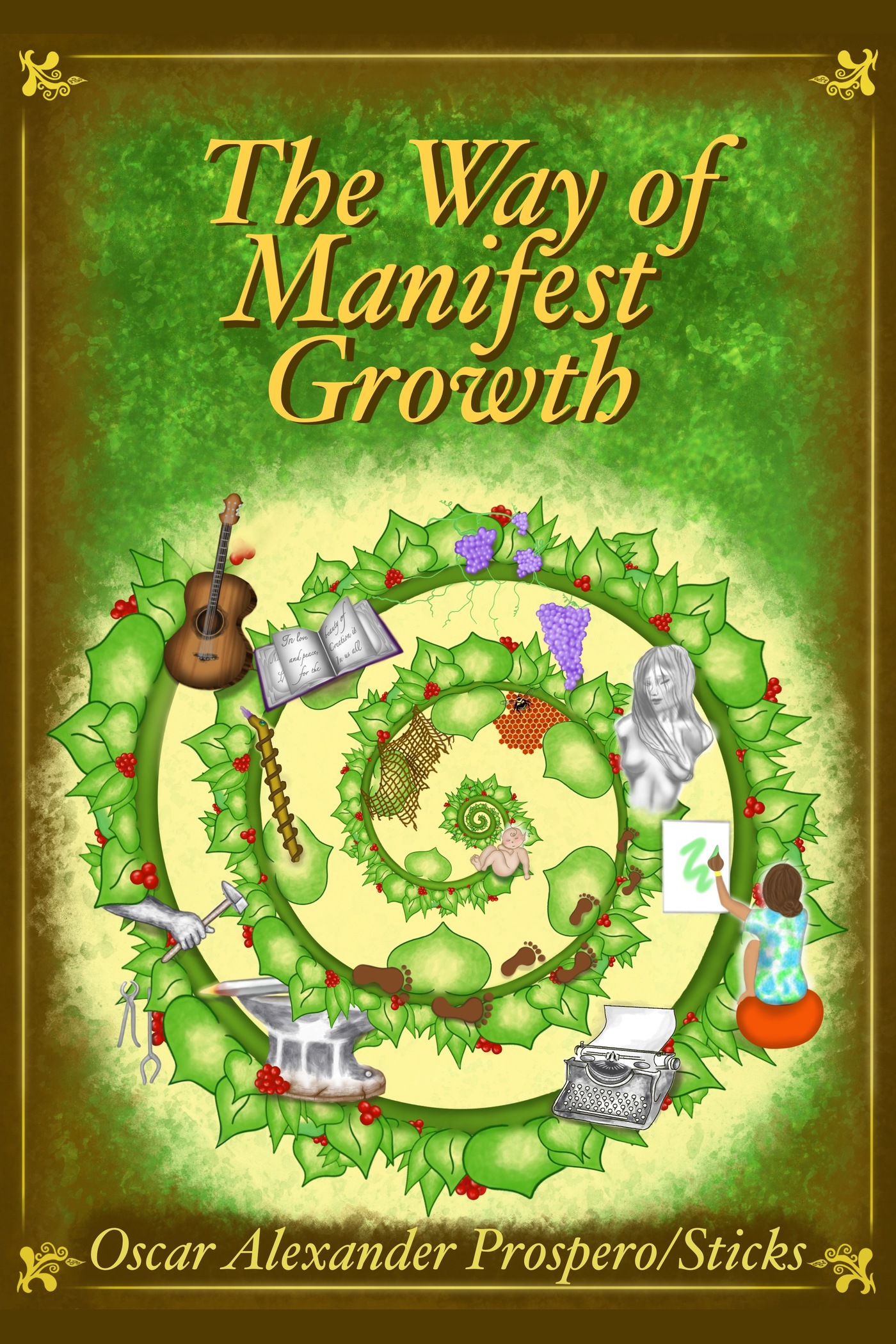
Oscar Alexander Prospero, The Way of Manifest Growth, with Claude (Anthropic). Edited by Sarah Dougherty. The whole book is on this page. 17 sections. About 54,500 words. Free to read, free to download.
The book builds capability from five sources: knowledge, will, relationships, renown and wealth. Health and shadow integration sit underneath them as the foundational work, because a practitioner running on empty has nothing to spend and a practitioner at war with himself spends it badly. The whole structure is pointed at something other than personal accumulation. Every mechanism in it works whether you read it literally, as consciousness participating in manifestation, or psychologically, as attention, pattern recognition and disciplined follow-through. The practice is the same either way.
 Support this work on Ko-fi
Everything I write is free. The Ko-fi page is for anyone who wants to pay for what they could take for nothing.
 Support the work on Ko-fi
This book is free to read right here, in full. Buying it is a choice.
Why this is free
We are living through the turn from one age into the next. The Piscean model concentrated capability at the top and let information down through gatekeepers, by permission. The Aquarian one circulates it among equals. You do not have to accept the astrology to see the pattern, just look at how institutions are restructuring. Either way, putting a paywall across something this useful belongs to the age that is ending.
So the book is free here, free as a PDF, and free on every platform that will take it. If you can afford to pay and you think the work was worth something, pay me what you think I deserve. If you cannot, take it anyway. The information matters more than my cut of it, and what is in someone's bank account is a bad reason to lock them out of it.
That arrangement covers everything I make, not just this book.
What I sell comes from my hands or my voice: the audiobook I read aloud, hand-bound copies, signed hardbacks, and the tools I make at the bench. Those cost materials and time, and they are the part you are actually buying.
The audiobook goes up chapter by chapter. Maybe weekly, maybe daily, maybe when the mood takes me. Stay tuned.
Download it free
The 6 × 9 print PDF is a print-ready book interior, 226 pages, set for anyone who wants to print it and bind it. The US Letter PDF is 198 pages in larger type, opening on the cover, for reading on a screen or printing at home on ordinary paper. No sign-up, no email, no wall. An EPUB exists as well and comes with the Etsy edition, alongside both PDFs.
If this was worth something
Everything stays free, here and everywhere else. If you want to know when the next one lands, the newsletter is where I announce it: Oscar’s Workings and Wonderings.
Everything else — the shop, the Discord, the rest of the writing — is on the Directory.
Read the book
Click any chapter to open it. The whole book is on this page, nothing withheld.
Most books on magic teach techniques. This one teaches how capability actually develops.
After years of practice and observation, I've identified why some practitioners produce consistent, reality-shaping results while others plateau at wishful thinking. The difference isn't talent or divine favor. It's understanding how development actually works and building systematically across the sources that matter most.
This book presents what I believe are the five most important sources of magical capability: knowledge, will, relationships, renown, and wealth. These five, supported by foundational work on health and shadow integration, form a complete system. Other books explore topics I only touch on here—entire libraries exist on herbalism, ceremonial traditions, specific deity work, and specialized divination systems. What those books often lack is the underlying framework that makes any technique work better. That framework is what you're holding.
What makes this book different? Most magical education focuses on individual accumulation. Build your power. Expand your influence. Manifest what you want.However, I find that orientation hollow at best and dangerous at worst.
The Way of Manifest Growth takes a different position. Personal development serves freedom. Your freedom, and the freedom of those you're connected to. Capability matters because it expands what becomes possible—waking in a space that reflects your values, spending time on work that matters, speaking truth without fear, loving who you love, practicing what you're called to practice. Freedom to fail without catastrophe, to experiment without punishment, to grow without permission.
But freedom developed in isolation remains stunted. The solitary practitioner developing focus is preparing to hold space for others. The student accumulating knowledge is preparing to teach. The person building resources is preparing to support those who lack them. Development divorced from relationship eventually stagnates. Development embedded in community compounds, and that compounded capability circles back to expand everyone's freedom further.
The framework operates on dual-accessibility. Every mechanism in this book functions whether you interpret it literally or psychologically. A reader who believes consciousness directly shapes reality and a reader who views these techniques as optimizing psychology and social dynamics should both find the material useful. The Introduction unpacks what that means for how you engage with the work.
Now for honest expectations. This is one framework among many valid approaches. Results vary based on individual circumstances, constraints, and commitment. No specific manifestations or timelines are guaranteed. The book offers tools and perspectives; you determine what to build with them. Magical practice does not replace medical care, therapy, financial planning, or other professional services when those are needed. I share what has worked in my practice and observation, but I do not claim absolute truth.
Here is what each chapter offers.
Chapter One provides immediate entry points. You shouldn't have to finish a book before you can start practicing.
Chapter Two addresses knowledge—what you truly understand, you can observe more deeply, and deeper observation grants greater influence. Knowledge shared through teaching becomes more potent than knowledge hoarded.
Chapter Three develops will. Knowledge without focused intention remains theoretical. Will moves you through the territory knowledge maps.
Chapter Four covers health. Your body is the vessel through which everything else operates. Neglect it and everything built on top eventually collapses.
Chapter Five confronts shadow work. The same development that increases your effectiveness can amplify self-destruction if turned against yourself through unexamined patterns.
Chapter Six explores relationships and karma. Isolation limits capability while authentic connection multiplies it. How you treat others shapes what returns to you through natural consequence.
Chapter Seven examines renown. Collective trust in your capability creates effects beyond what solitary practice achieves. Belief based on witnessed results generates real amplification.
Chapter Eight addresses wealth. Material resources provide both practical foundation and the symbolic weight that collective consciousness assigns to demonstrated success.
Chapter Nine establishes purpose. Development without direction becomes accumulation for its own sake. This chapter carries the book's deepest philosophical framework and grounds everything else in meaning.
Chapter Ten introduces divination. Without feedback you're navigating blind, unable to assess whether your efforts are working or what adjustments to make.
Chapter Eleven covers tarot—a complete symbolic language charged by centuries of collective use, making it extraordinarily responsive.
Chapter Twelve addresses astrology and timing. Your efforts carry different weight at different moments. Working with natural rhythms amplifies what working against them diminishes.
Chapter Thirteen brings everything together into spellwork and ritual—the practices where all developed capability focuses into deliberate action, including group work and protection.
Chapter Fourteen covers tools. They amplify and anchor what you've built, though they cannot replace it. Tools come late because understanding everything else prevents mistaking amplifiers for sources.
Chapter Fifteen introduces supersigils—what I consider the most complete form of spellwork available. Supersigils unite technique and creation in a single practice, holding layered meaning over extended time while accumulating charge through aesthetic appreciation.
This book is for you if you're ready for systematic development rather than scattered techniques, if you can handle honest self-examination, if you value freedom and community together, and if you're willing to commit to sustained practice.
This book is not for you if you want quick fixes, if you're unwilling to examine your shadow, if you want to manipulate others rather than develop genuine capability, or if individual accumulation matters more to you than what you can contribute.
I cannot promise specific manifestations or timelines. What I promise is this: if you work with this book systematically, your capability will increase measurably, your results will become more consistent, and your development will serve something larger than yourself alone.
Begin where you are. Use what you have. Build systematically. Contribute what you develop.
You hold a book that asks you to do things before it fully explains why they work.
Most magical texts front-load theoretical frameworks, historical contexts, and philosophical foundations. By the time you reach anything practical, you've absorbed dozens of pages about what magic is without testing whether any of it applies to your actual life. This book inverts that pattern. The exercises come first. The theoretical grounding comes after, in chapters that will make more sense because you've already felt the framework operating through direct experience.
Reading about development is not developing. Understanding a technique intellectually leaves it inert until you've moved it through your body, your attention, your relationships, your daily choices. The opening exercises are simple enough to begin without elaborate preparation, significant enough to produce observable results within a week, and designed to create the experiential foundation that makes later chapters land differently.
If this structure frustrates you—if you prefer understanding the full map before taking steps—the book accommodates that preference. Read the theoretical chapters first, absorb the cosmological framework in Chapter Nine, and return to the exercises with complete context. They'll still work. Other readers will dive into practice immediately and find that subsequent chapters answer questions arising from experience. Still others will read straight through and circle back. All approaches serve. The book rewards return. I designed this as a system meant for living with rather than consuming once.
The Prologue names dual-accessibility as a core principle. Here I'll unpack what that means for your reading.
The framework proposes that consciousness allocates something like processing priority to whatever it observes. Where attention goes, influence follows. Sustained observation by multiple consciousnesses—collective attention—carries more weight than fleeting individual notice. Practices that have accumulated centuries of use work more reliably than innovations no one else has tested. Community amplifies what isolation limits. Renown matters because when many people believe in your capability, their observation allocates priority to your success.
When the book describes observation affecting outcomes, a literal interpreter understands this as consciousness influencing reality itself—as if attention carries genuine weight in determining what manifests. A psychological interpreter understands this as attention shaping perception, priming pattern recognition, and producing results through conventional mechanisms. Both interpreters perform the same exercises. Both can achieve results. The book does not adjudicate between them because adjudication is unnecessary for the practices to work.
I'll be direct about my own position: I believe parapsychology research and certain developments in physics are suggestive, though not conclusive, regarding the mechanisms this book describes. Some contested interpretations of quantum mechanics propose that observation plays a fundamental role in determining outcomes. The trend of increasingly large and complex molecules exhibiting quantum behavior—entanglement and coherence at scales once thought impossible—suggests to me that the boundary between quantum and classical may be more permeable than the standard model assumes. Whether collective belief and expectation play any role in where that boundary sits remains an open question.
But I don't require you to share this view. A skeptical scientist should find the practices useful without accepting my interpretation. Where I reference scientific concepts, they function as models that illuminate the work—models I find compelling, but models you can set aside if they don't serve you.
A practitioner who takes the metaphysics literally should not feel their experience is being reduced to mere psychology. The framework respects both readers. You can hold your own views about ultimate mechanisms. The practices work either way.
The five sources—knowledge, will, relationships, renown, and wealth—are not arbitrary categories. They represent the primary channels through which capability develops and expresses in human life. They interconnect and reinforce each other. Knowledge without will remains theoretical. Will without relationships lacks amplification. Relationships without the foundation of health and shadow integration become distorted. The system is integrated, not modular. Chapter One touches all five sources plus health and shadow work because development happens across all of them simultaneously, not sequentially.
Health and shadow work appear alongside the sources but operate differently. Health is foundational—the biological substrate that makes everything else possible. Skip it and whatever you build will eventually collapse. Shadow work is protective—it prevents the other developments from being turned against you through patterns you haven't examined. These two don't bend to personal preference the way the five sources can. Once you've built a foundation, you can prioritize based on your own judgment and circumstances. Health and shadow hold the floor.
The chapters build on each other while remaining individually useful. Later chapters assume familiarity with earlier material, yet each offers something complete enough to stand alone. Cross-references point toward related material throughout. Some ideas introduced early receive full treatment later. Some exercises gain additional meaning from subsequent chapters.
The book assumes you'll move through it more than once, each pass integrating practice with understanding more fully, with Chapter One as the entry point.
Chapter One offers immediate entry points so you can begin testing the framework today. The exercises there touch multiple sources and foundational practices, giving a taste of integrated development before the detailed chapters examine each component. Readers who complete those practices for even one week will approach the subsequent chapters differently than readers who only read. Direct experience changes how theory lands.
Development happens through doing, not through reading about doing. The best way to evaluate this framework is to use it for a month and observe what changes. Someone starting today with no prior experience can follow these practices. Someone with years of existing practice will find material to integrate with what they already know.
The work begins when you begin it. Turn the page.
The Introduction described what this book asks of you. This chapter tells you exactly what to do today, this week, and this month. You don't need perfect conditions. You don't need elaborate tools. You don't need to read the entire book before starting. You need commitment to begin where you are with what you have—and you need connection, which means reaching toward others who share this path from the very beginning.
Week One: The Foundation
Set one small, clear, achievable intention each morning and write it down. Make it specific and measurable. Not "I want to feel better" but "I will take a twenty-minute walk before sunset." Not "I want more money" but "I will update my resume and send it to three contacts by 9 PM."
Hold this intention clearly in mind for two minutes. Visualize yourself completing it. Feel the satisfaction of accomplishment. Then release and go about your day with normal effort toward the goal. At day's end, check whether you accomplished it. Don't judge yourself either way. Just observe. If yes, acknowledge success. If no, note what interfered without self-criticism. Chapter Three explores will in depth; what you're building here is its foundation. Do this daily for one week.
Alongside intention-setting, train attention itself. Choose one object to focus on for five minutes—a candle flame, a crystal, a simple image, anything that holds your gaze. Set a timer. Focus all attention on the object. When your mind wanders, and it will wander constantly, notice without judgment and gently return attention to the object. The practice is not perfect focus. The practice is noticing drift and correcting it. Each correction strengthens attention capacity. Do this daily.
Twice during your first week, spend thirty minutes building knowledge. Choose one topic within magical practice where you want foundational understanding—elemental correspondences, planetary associations, herbal properties, moon phases. Use books, reputable websites, or experienced practitioners as sources. Take notes. Test what you learn through simple observation. Notice elemental qualities in your environment. Track how you feel during different moon phases. Observe planetary hours and your energy levels. By week's end, you'll have basic working knowledge in one specific area plus direct observational data that begins training your perception.
Now the piece that transforms solitary practice into something larger. Think of three people who support your growth or share your interests in this work. They might be friends who practice, acquaintances you've seen at gatherings or in online spaces, or people whose work you've followed from a distance. Reach out to each one this week. The contact can be simple—a genuine compliment, sharing something you think they'd find interesting, asking a thoughtful question about their practice. You're not networking strategically or accumulating contacts. You're beginning to build the relational web that will support your development and give you opportunities to support others in theirs.
If you don't know three people who share this path, your first relationship-building task is finding them. Search for local pagan, occult, or magical community groups in your area. Look for online forums, Discord servers, or social media communities focused on practices that interest you. Attend a public ritual, workshop, or meetup if any exist within reasonable distance. You're not committing to anything permanent—you're exploring where your people might be. Even one genuine connection made this week begins building what will become your chosen family in this work.
Practice generosity in every interaction without expecting immediate return. Offer value. Be authentically interested. Ask questions and listen to answers. Share what you know when it's helpful without positioning yourself as an authority you haven't yet become. Connection built on genuine care and mutual interest compounds over time in ways that strategic networking never does.
Chapter Four explains why health forms the biological foundation for everything else. This week, commit to three basic practices that you can actually sustain. Aim for seven to eight hours of sleep by going to bed at the same time each night and creating a dark, quiet sleeping space. Eat at least one vegetable with each meal and drink water instead of soda at least half the time. Move your body somehow—walk for twenty minutes three times this week, or stretch for ten minutes daily, or dance to three songs. These aren't drastic changes. They're sustainable starting points.
Shadow work, covered fully in Chapter Five, prevents the self-sabotage that can accompany growing capability. This week, spend five minutes daily with honest self-observation. Write in a journal or simply reflect: What am I telling myself about myself today? Where am I being unnecessarily harsh in my self-talk? What would I say to a friend experiencing what I'm experiencing? Notice patterns without trying to fix anything yet. You're building awareness of how you relate to yourself.
Assess your current financial situation with honest clarity. Write down your monthly income, necessary expenses, and where money actually goes. No judgment—just seeing clearly what is. Identify one concrete action you could take this week to improve your financial position. Apply for one better-paying job, list one item for sale, research one new income stream, or cancel one unnecessary subscription and redirect that money to savings. Take that action this week. Chapter Eight addresses wealth in depth.
You don't need elaborate tools to begin. But if you want to establish a basic practice space, gather simple items this week—one candle of any color and size, matches or lighter, a small bowl for water, a small bowl for salt, one incense stick or bundle of herbs you can safely burn. These cost under twenty dollars total and are sufficient for most basic workings. Elaborate tool collections come later if at all. Start small–with the intention of building your practice into a positive habit.
All of this depends on one habit: keep a single record. A notebook, a notes app, or one document on your computer, whichever you’ll actually open. Each night, write down the intention you set and whether you hit it, how the attention practice went, who you reached out to, what you did about money and health, and what you noticed in your self-talk. A few sentences per area. Five minutes. Without one place to put it, the tracking this chapter asks for doesn’t happen and the review at month’s end has nothing to review. Chapter Two shows how this record grows into a grimoire once there’s enough in it to organize.
By the end of your first week, you will set a pattern for yourself. You will track seven daily intentions, practice focused attention for five minutes each day, and gain basic knowledge in one specific area. You will also initiate or strengthen at least three relationships with people who share this path, take one concrete action to improve your financial position, and establish three sustainable health practices. You will gather basic working tools if you chose to do so and begin to learn shadow work skills through daily self-observation.Not one of these actions alone is dramatic, but together, they begin developing all five sources plus health and shadow integration.
Weeks Two Through Four: Expansion
Continue everything from week one while adding gradual expansion. Increase the difficulty of your daily intentions slightly. If you succeeded consistently in week one, set slightly more challenging goals and track your completion rate. Extend your focused attention practice from five minutes to ten, noticing whether your attention wanders less frequently and how quickly you catch yourself and return.
Choose a second knowledge topic to study, spending one hour per week on each topic. Begin connecting what you're learning—how do elemental correspondences relate to planetary associations? How do moon phases interact with both? The goal is building integrated understanding rather than collecting disconnected facts.
Reach out to three additional people each week. By month's end, that's twelve new or strengthened connections. Some won't go anywhere. Some will become important relationships. You can't know in advance which is which, so you practice consistent authentic generosity and let the connections that are meant to develop reveal themselves over time.
Take one concrete financial improvement action weekly. Track what actually produces results and adjust your strategy based on evidence rather than wishful thinking. Maintain your three basic health practices. If they're becoming habitual, add one more—meal timing, a stress reduction technique, improved sleep hygiene. Continue daily shadow observation, beginning to notice recurring patterns in your self-talk. Where do these patterns come from? What purpose did they serve when they developed? What purpose do they serve now?
Learn one basic cleansing technique and practice it on your tools and your space. Chapter Fourteen covers tools in detail, but for now, running objects through incense smoke while holding clear intention to clear stagnant energy is sufficient. Begin charging your candle through use in your daily practice, letting it absorb the accumulated focus of your attention exercises.
Month's End
By month's end, you will set and track thirty daily intentions with measurable improvement in completion rate, and practice focused attention for at least 150 minutes total. You will also develop working knowledge in two specific areas, and build your skill with direct observation. You will also strengthen or create twelve relationships through authentic generosity, and take at least four concrete financial improvement actions. Most importantly, you will begin to establish sustainable health practices that support your development, build substantial self-awareness through shadow observation, and create basic working space with cleansed and charged tools.
No one becomes a master in one month. But in one month of consistent practice across all sources, you cross from theoretical interest to actual practitioner. Results begin showing up—small synchronicities, minor manifestations, increased energy, better focus, stronger relationships, financial improvement, physical vitality. These are evidence that the framework functions and your effort is producing results.
You'll also begin experiencing how community feels. Some of the twelve people you reached out to will respond with interest. Some will become practice partners, study companions, or friends who share this path. You'll find yourself part of conversations about topics that matter to you, receiving support when you face obstacles, and offering support when others face theirs.
After the First Month
Continue with the practices that are working. Read the full chapters for depth and advanced techniques. Work the specific exercises you find there. But you don't need to wait until you've read everything.
Once you have a foundation—once you've felt the practices working and observed your own patterns—you can prioritize based on your own judgment. Maybe knowledge comes easily to you but relationships feel like a struggle. Maybe your will is strong but your shadow keeps tripping you up. Maybe wealth-building energizes you while health practices feel like drudgery. With a month of experience, you can see where you're strong and where you need work. You can make informed decisions about where to focus rather than following a formula.
However, please note. There are Two areas in this practice that don't bend to personal preference. Shadow work and health are non-negotiable foundations that everything else rests on. A practitioner with strong will but unexamined shadow will use that will against themselves. A practitioner with deep knowledge but depleted health won't have the capacity to apply it.
Every other source can flex based on your circumstances, your strengths, your current life demands. Shadow work and health hold the floor.
The goal isn't obsessive optimization or grinding development at the expense of living. The goal is learning to prioritize growth, fun, and responsibilities efficiently and effectively. Some seasons call for intense focus on one area. Some call for maintenance across all of them while you handle life's demands. Some call for rest. The framework serves you; you don't serve the framework. Once you understand how the sources work and how they interact in your particular life, you become your own authority on what to prioritize and when.
Today
Set one clear intention for today. Practice focused attention for five minutes. Choose one knowledge topic to research. Reach out to one person authentically. Take one financial improvement action. Commit to one health practice. Spend five minutes observing your self-talk. Gather one tool or use what you already have.
Start now. Build systematically. Track results. Find your people. Adjust based on what works. Give it time to compound.
The path is clear. The first steps are simple. What you do today shapes what becomes possible tomorrow.
You've spent a week setting intentions, training attention, and reaching out to people who share your path. Now we examine what makes any of that work—and why some practitioners produce consistent results while others fumble through the same techniques without traction.
Knowledge is the most accessible source of magical capability. Anyone can begin building it today, regardless of resources, location, or existing connections. A practitioner with limited means but systematic understanding often outperforms someone with elaborate tools and shallow comprehension. The student who genuinely grasps how a working functions achieves better results than the collector who owns impressive equipment but doesn't know why any of it matters.
Two Axis of Knowledge
Knowledge develops along two equally essential axes: knowledge of self and knowledge of universe. Neither substitutes for the other.
Understanding how reality operates gives you the capacity to work with its mechanisms deliberately. Understanding yourself gives you the clarity to direct that capacity without self-sabotage. The practitioner who knows the universe but not themselves will trip over their own shadow, as Chapter Five explores in detail. The practitioner who knows themselves but not the universe will lack the frameworks to engage reality effectively. Both forms develop together, each informing and strengthening the other.
When you understand how energy moves through living systems, how matter forms and transforms, how symbolic patterns reflect natural laws, you gain the ability to work with these forces deliberately. You stop guessing and start operating from comprehension. The difference between hoping your workings succeed and knowing they will succeed often comes down to whether you understand the mechanisms involved.
But understanding mechanisms requires knowing what those mechanisms are. The next section addresses where I stand on this question—and why your answer to it matters less than you might think.
How Knowledge Creates Influence
I want to be direct about where I stand on the mechanisms underlying magical practice. I believe that consciousness participates in shaping reality—that where attention goes, influence follows, and that focused observation carries genuine weight in determining what manifests.
Recent findings in quantum physics that suggest increasingly large and complex molecules exhibiting quantum behavior (behavior effected by observation/measurement) suggests something important to me. Experiments have demonstrated entanglement and superposition in molecules exceeding 25,000 atomic mass units—scales once thought impossible. The boundary between quantum and classical behavior keeps shifting. I interpret this as evidence that collective belief and expectation play a role in what becomes possible at the physical level. As more consciousness accepts and expects certain behaviors, those behaviors manifest in larger systems.
Mainstream physics explains these developments differently. Physicists attribute expanding quantum effects to improved experimental techniques and controlled laboratory conditions rather than collective consciousness. You don't need to share my interpretation for the practices in this book to work. Whether the mechanism is literal consciousness affecting matter or psychological optimization of attention and effort, practitioners report consistent results when working as if observation matters.
Consider two practitioners performing a prosperity working–a focused ritual pursuing financial gain or employment. The first practitioner understands only that green candles attract wealth. The second understands the historical associations of green with fertility and growth across multiple cultures, the psychological impact of color on perception, the numerological significance of the candle's burn time, the astrological timing that aligns with Jupiter's influence over expansion, the symbolic relationship between fire's transformative nature and the process of manifestation, and the chemical properties that give the candle its color.
The second practitioner engages multiple layers simultaneously. Their working operates through more dimensions—more points of coherence between intention and reality. The difference is not intellectual superiority. It's the mechanics of how knowledge creates influence.
In my framework, the more aspects of a working that you understand, the more power you have over possible outcomes. The more complete your personal perception, the more influence you have, vs the collective perceptions keeping things the way they already are.
There are three key principles to Sympathetic Magic.
The first is the Law of Similarity, which holds that an effect resembles its cause. You produce a desired outcome by imitating it. As seen in (flawed) depictions of voodoo in Hollywood movies, a doll shaped like a person becomes a point of influence over that person. A green candle dressed with prosperity oil becomes a vector for wealth. The representation participates in the nature of what it represents.
This law doesn't reflect primitive confusion between symbol and referent—it describes operative technology. Resemblance creates resonance. In a framework where consciousness participates in manifestation, similarity functions as a tuning mechanism: a way of aligning intention with target through shared pattern.
The second is the Law of Signatures, which extends the Law of Similarity into the material world. Plants, minerals, and animals bear visible marks indicating their hidden virtues. A walnut's brain-like kernel signals cognitive applications. Heart-shaped leaves correspond to cardiac conditions. Yellow-sapped plants traditionally associate with liver work. These aren't arbitrary assignments but perceived communications. As herbalist Julia Graves explains, it is "how the medicinal plants introduce their healing powers to the healer." The signature reveals essential nature, and working with that essence produces effects aligned with it.
The third is the Law of Contagion, which holds that things once in physical contact continue to influence each other after separation. Hair, nails, blood—any substance that was once part of a living body retains connection to that body. A photograph captures something of the subject's essence. An object worn against skin absorbs the wearer's energetic signature.
This principle generates the hierarchy of taglocks that practitioners across traditions recognize. Bodily substances carry the strongest connection because they literally participated in the target's existence. Personal items rank next, followed by objects touched or owned, then photographs and signatures, and finally purely symbolic representations. The logic is consistent: the closer something was to the living essence of the target, the stronger its sympathetic connection remains.
Quantum entanglement provides a suggestive parallel. Particles that have interacted remain correlated regardless of distance—measurements on one instantaneously correlate with the other. Critics note that entanglement correlates measurements but doesn't transmit information—the parallel is suggestive rather than exact. But sympathetic magic may operate through resonance rather than transmission, through influencing which possibilities manifest rather than sending signals. The entanglement metaphor points toward connection without requiring the specific mechanism of quantum communication.
These three principals underlie every working you will ever perform under this practice. When you understand why resemblance creates resonance and why contact creates connection, you stop following recipes blindly and start designing workings that leverage these principles deliberately. The practitioner who knows only that "you need a personal item for this spell" has a recipe. The practitioner who understands that contact creates lasting sympathetic connection, that connection strength correlates with intimacy of contact, and that this principle has been recognized across every magical tradition because it reflects something genuine—that practitioner can innovate, adapt, and troubleshoot when recipes fail.
Why Correspondences Work
The correspondence systems you'll study actually function—not just because tradition says green candles serve prosperity magic, but because that association produces results through identifiable mechanisms.
Correspondences function as established channels for attention and influence. When generations of practitioners use green for prosperity work, they repeatedly direct consciousness through that association. Each working reinforces the channel. For example, over centuries, the association between green and growth and abundance becomes carved into how consciousness interacts with intention. Whether you interpret this as literal priority allocation in a field of consciousness or as conditioned psychological association reinforced by cultural repetition, the practical result is the same: traditional correspondences carry weight that arbitrary assignments lack.
Using a traditional correspondence means your working flows through established pathways rather than having to carve new ones. You're not starting from scratch. You're drawing on accumulated investment from practitioners across generations.
In addition, you are not working alone. Personal correspondences you've developed through your own practice can serve your workings powerfully for a different reason. When you've repeatedly directed your own attention through a particular association—discovering through experience that a certain stone or herb or color correlates with certain outcomes for you—you've carved a personal channel. Your consciousness knows that pathway. Your intention flows through it efficiently when you use it.
The most effective practice combines both. Traditional correspondences carry collective weight accumulated over centuries. Personal correspondences carry your individual investment developed through direct experience. Layer them together and your working flows through multiple reinforced channels simultaneously.
Knowledge Shared Multiplies
Knowledge hoarded remains limited to a single consciousness. Knowledge shared multiplies—each person who learns adds their observation to the collective engagement with that understanding.
Teaching is not charity. It is self-interest properly understood, and it is preparation for contribution. You learn not just to increase your own capability but to become someone who can help others develop theirs. The way you explain a concept might click for someone who struggled with every other explanation they encountered. Your particular framing might become the one that gets passed along, helping practitioners you'll never meet.
Teaching also reveals gaps invisible to solitary study. When a student asks why a particular correspondence exists—why Mars rules iron, why oak corresponds to strength—and you find yourself reaching for explanations you've never articulated, you discover where your knowledge is rote rather than understood. Their questions become your curriculum. The practitioner who teaches regularly develops faster than the one who only studies, because teaching forces integration that passive learning never requires.
This is how magical traditions stay alive and grow richer over time—not through single brilliant innovators but through countless practitioners sharing what they've learned with others who then share it further.
Building Foundational Breadth
Start with breadth, then develop depth. Working knowledge across multiple domains forms a solid foundation, and each domain connects to others in ways that become visible only after you've studied several.
Also consider the universal acceptance of these principles across cultures. For example, there are many historical worldwide practices and studies of elemental science. Be aware of this expanded knowledge. Study not just the Western fourfold model but the Chinese five-element system, the Hindu tattvas, and indigenous elemental frameworks where you can access them respectfully. Notice where systems agree and where they diverge. The overlaps reveal universal principles. The divergences show cultural adaptations that may not apply to your practice. Over time you develop an intuitive sense for elemental qualities that operates beneath conscious thought—you feel the fire in an argument, the water in grief, the earth in patience.
Planetary and astrological correspondences are like weather and the seasons in magick. The farmer plants his crops in seasons that improve the likelihood of a bountiful harvest. He also uses the seasons to predict weather extremes. The same applies to the magician with astrology. Chapter Twelve explores the why's and hows in depth. For now, learn which planets govern which intentions, what hours strengthen which workings, and how lunar phases affect magical operations. This book doesn't have information on correspondences, but the internet has plenty\! Track your own work against astrological timing and record which correspondences prove most effective in your practice. Some traditional correspondences will work powerfully for you. Others won't. Knowledge means knowing both what the books say and what your experience shows.
Another influential cross-cultural foundational field is the study of Material properties. Botanical and mineral properties rightfully deserve serious study—not just of magical correspondences but the actual chemical and physical properties of herbs, woods, and stones. A deep understanding of why rose quartz forms in certain geological conditions adds layers of meaning to its use in heart-centered workings. When you know that a particular wood grows slowly in difficult conditions, that knowledge informs its use in endurance and persistence workings. The material world is not separate from the magical world. It is the magical world in one of its expressions.
There are also Symbolic systems you should investigate. Tarot (which I explain a bit in chapter 11): runes, sigils, sacred geometry, color theory, numerology—each system offers a vocabulary for working with meaning. Fluency in multiple symbolic languages allows you to construct workings with precision and nuance. You can layer meanings, create complex correspondences, and work with whatever framework suits a particular intention.
It is also important to explore the Scientific foundations. Psychology and consciousness studies illuminate the mechanisms. Understanding cognitive biases helps you distinguish genuine manifestation from wishful thinking. Understanding neuroplasticity explains why repeated ritual rewires your brain's response to certain symbols. The skeptic who interprets everything psychologically and the practitioner who interprets everything magically are often describing the same phenomena through different vocabularies.
Biology teaches how living systems work—cellular processes, energy transfer in organisms, how plants grow and respond to their environment. When you know how life actually operates at the physical level, your workings with living things become more effective because you're working with natural processes rather than against them.
Chemistry reveals the behavior of matter. Learn the periodic table, how elements combine, what makes reactions happen, how crystals form, what makes colors appear in minerals and plants. This knowledge transforms your understanding of material correspondences from purely symbolic to comprehensibly grounded.
Physics describes fundamental laws. Energy, motion, thermodynamics, electromagnetism, wave behavior, light, sound, and quantum principles all provide insight into how reality operates at the deepest level we can currently access.
Lastly, develop awareness and respect for the History of practice. The history of magical practice reveals where your techniques come from. What were the original cultural contexts? How have they changed over time? What was preserved and what was lost? This knowledge prevents cargo-cult magic where you perform actions without understanding their purpose. It also reveals which practices have remained effective across centuries and cultures—a form of empirical validation that carries real weight. The technique that worked in ancient Egypt, medieval Europe, and contemporary practice probably connects to something genuine.
Training Perception Through Practice
Raw information is not enough. Knowledge becomes capability only when it trains perception. This requires active practice that transforms what you've learned into how you see.
Daily observation practice. Each day, select one correspondence or principle to observe in your environment. If you're studying fire correspondences, spend a day noticing every instance of transformation, passion, destruction, purification, or energy in your surroundings—the candle on your desk, the fever burning out an infection, the argument that clears the air, the coffee energizing your morning, the destructive urge to quit a dead-end situation. This trains your mind to recognize these patterns automatically. What seemed invisible becomes obvious. Eventually you perceive elemental energies constantly, effortlessly, which means you can work with them constantly.
Correlation journal. For one month, record every working you perform alongside observable conditions: lunar phase, planetary hour, day of the week, weather, your emotional and physical state, any relevant astrological transits. Also record the result and timeline of manifestation. At month's end, analyze the data. Which conditions correlated with successful workings? Which with failures? This transforms abstract correspondence theory into personal empirical knowledge about what actually works for you.
Whether you interpret the correlations as evidence of cosmic influence or as data about your own psychological patterns, the journal serves the same function: it replaces assumption with observation. You stop believing what you've been told about timing and start knowing what actually works for you.
Periodic return to foundational texts. Choose a magical text you've already read and re-read it completely, but in a different format or context. If you read it as a book, listen to an audiobook version. If you studied it alone, read it with a partner and discuss each chapter. If you read it quickly, read it slowly with detailed notes. Different formats reveal layers of meaning you missed the first time. Repeat this with core texts every year. Each pass deepens understanding.
Do a Cross-tradition comparison. Select one magical goal or technique and research how at least three different traditions approach the same goal. Note what materials and ingredients they use, what timing considerations matter, what underlying principles or theories they follow, and what practical methods they employ. The convergences reveal universal principles that likely reflect deep truths about how consciousness interacts with reality. The divergences show cultural adaptations or innovations. Test workings from at least three traditions. Which produces the strongest results for you? This reveals your own energetic affinities and shows which traditions naturally align with your consciousness.
Material deep study. Choose one material you use frequently in magic and research its scientific and material properties thoroughly. Look into chemical composition for plants and minerals, how it forms or grows, physical properties like hardness, conductivity, crystalline structure, traditional human uses across cultures, ecological relationships, and geographic distribution. Then examine the traditional magical correspondences. How many can you trace back to physical properties or practical uses? This deepening transforms correspondences from arbitrary associations into comprehensible relationships between material properties and symbolic meanings. Your workings gain coherence because you understand why the correspondence exists rather than just that it exists.
Teaching practice. Take something you've recently learned and teach it to someone else. Teaching forces complete synthesis. You must organize information coherently, anticipate questions, and explain clearly. This process reveals gaps in your understanding that passive study never catches. If you can't explain something simply, you don't understand it well enough yet. Make this a regular practice: for every major new piece of knowledge you acquire, teach it within two weeks.
The Personal Grimoire
As you accumulate knowledge, organize it in a personal grimoire or book of shadows. This isn't just a collection of spells—it's a living document of your growing understanding. Structure it for quick reference and easy updating.
Include foundational correspondences covering elements, planets, lunar phases, days of the week, your tested associations for each including successes and failures, notes on timing that proved particularly effective, and cross-references between systems.
Build a section for materials knowledge covering herbs, woods, stones, and other materials you work with, traditional correspondences and your empirical findings, practical notes about sourcing, preparation, storage, and combinations that proved particularly effective.
Include detailed notes on any divination or encoding systems you use, your interpretations and insights, and patterns you've noticed.
Document effective workings with the exact conditions, timing, materials, methods, results and timeline of manifestation, and what you'd do differently next time. Keep equally detailed records of failed workings including honest analysis of why they failed, what you learned, and how you'd approach the same goal differently.
Record observations about your own patterns—your energetic rhythms and preferences, times when you work most effectively, states of consciousness that produce best results, obstacles and how to work around them.
Maintain a section for questions and mysteries covering topics you're currently investigating, contradictions between sources that need resolution, phenomena you've observed but don't yet understand, and directions for future study.
Review and update your grimoire monthly. Knowledge that sits unused becomes static. Knowledge that informs active practice becomes capability. The grimoire transforms scattered learning into organized wisdom you can access instantly—and share with others when they need guidance.
The Path Forward
Knowledge is infinite. You will never finish learning. This is good news—it means your capability can always grow.
Start with a systematic foundation. Develop working knowledge across multiple domains. Test everything through direct practice. Build depth in one system before adding others. Keep meticulous records of what works and what doesn't.
As knowledge accumulates, you'll notice perception shifting. Reality becomes richer, more layered, more responsive. What seemed mysterious becomes comprehensible. What felt random reveals patterns. Your ability to work with outcomes increases because you understand more dimensions of how the two laws operate—how similarity creates resonance, how contact creates connection, how these principles manifest across every domain you've studied.
You become someone who can guide others—a teacher, a resource, a contributor to the collective wisdom that makes community practice possible. Knowledge-building reaches its purpose not in what you accumulate for yourself, but in what you can offer to those who share your path.
But knowledge alone remains theoretical. Understanding the two laws doesn't move reality. Knowing correspondences doesn't produce manifestation. Perception trained through observation still requires something to direct it.
The next chapter addresses what makes knowledge operative: Will, the focused intention that moves you through the territory knowledge maps. Without Will, everything you've learned sits inert. With it, knowledge becomes capability that shapes outcomes.
Knowledge gives you the map. Will moves you through the territory.
Chapter Two explored how understanding shapes perception and how perception shapes what you can influence. But understanding alone changes nothing. You can know exactly how a working functions, grasp every correspondence, time your rituals to the minute—and still produce no results because you lack the capacity to focus intention and follow through.
Will is where consciousness touches reality and leaves a mark. It is the most fundamental capacity in magical development because everything else depends on it. Relationships amplify your workings, but Will creates the workings to amplify. Renown generates collective belief in your capability, but will directs that belief toward manifestation. Wealth provides resources, but Will determines how those resources get used. Health provides the biological foundation, but will directs what you build on that foundation.
Without Will, every other source of development remains potential rather than kinetic. Knowledge sits inert in your mind, never applied. Relationships stay merely social, never becoming channels for mutual support and shared working. Renown becomes empty reputation without substance to back it. Wealth buys comfort but not transformation. Will is what makes everything else work.
Will determines whether you can show up reliably for the people and purposes you care about. The practitioner who says they will be at the ritual and then shows up has Will. The practitioner who not only commits to completing their part of a group working and then actually completes it has Will. The practitioner who promises to support a community member through crisis and then maintains that support through difficulty and inconvenience has Will. This reliability makes you trustworthy. Trustworthiness makes genuine community possible. Without Will, you cannot be counted on. Without being counted on, you remain peripheral to any group that requires consistent participation.
Will is often misunderstood as forceful determination or aggressive assertion. Practitioners imagine gritting their teeth and pushing harder, trying to bludgeon reality into compliance. This is strain, not Will, and strain dissipates energy rather than focusing it. The practitioner who strains exhausts themselves fighting against reality rather than working with it.
True magical Will is the capacity to hold intention with absolute clarity while remaining flexible about means. You know exactly what you want. You focus sustained attention on that outcome.
You maintain that focus without desperation or doubt until manifestation occurs. But you remain open to how the outcome arrives.
Think of Will as a laser versus a floodlight. Both produce light. The floodlight scatters photons in every direction—useful for general illumination but incapable of cutting through material. The laser focuses all photons in coherent alignment, same frequency and phase, producing a beam that can cut through steel despite using less total energy. Magical Will is coherent attention. Not more attention, but organized attention. All mental energy aligned toward a single point until that point manifests.
In the framework this book proposes, will is what makes your observation coherent and directed. You can have substantial capability from knowledge, relationships, and renown, but without will, that capability remains scattered. A bright light shining everywhere illuminates nothing particularly well. Will organizes scattered attention into a focused beam that actually shapes outcomes.
Whether you interpret this as consciousness literally participating in reality or as attention shaping perception and priming effective action, the practical result is identical: focused Will produces more consistent results than scattered intention.
Developing Will requires three capacities working together: the ability to form clear intention, the ability to sustain attention without distraction, and the ability to release attachment to specific outcomes while maintaining commitment to the goal. Each capacity supports the others. Weakness in any one limits what you can accomplish with the other two.
Please note that to be effective, Magical Will should be combined with clear intention. When practitioners fail. It’s not because their Will is weak but because their intentions are muddy. For example, "I want to be happy" is not a clear intention—it's a vague gesture toward a feeling. "I want to cultivate daily practices that support emotional regulation and meaningful connection" gives you something workable. "I want more money" is just noise. "I manifest at least three thousand dollars within sixty days through ethical means that align with my skills" specifies amount, timeframe, ethical boundaries, and connection to your actual abilities. The second version lets you form clear mental images, track results, and know whether you succeeded.
Practice precision in stating intent. Write it down. Revise until every word is necessary and accurate. Remove contradictions—if you want financial stability but also want to quit your job without a plan, those intentions contradict. Resolve the contradiction before the working. Test intention by visualization: can you picture the desired outcome in specific detail? If the image is vague, the intention needs refinement. If multiple images compete, you have multiple intentions and need to prioritize.
The practitioner who can sustain focused attention on a single intention for extended periods directs substantial conscious influence toward manifestation. They're telling reality—or telling their own neurology, depending on your interpretation—that this matters. Most people's attention scatters constantly. They think about the spell for thirty seconds, then wonder what's for dinner, then worry about work, then remember they need to email someone, then return briefly to the spell. This fragmented attention produces minimal results because the observation never coheres into anything significant.
Building attention capacity requires daily practice. Chapter One introduced the basic exercise: five minutes of sustained focus on a single object, image, or concept. A candle flame works well. A crystal. A sigil. An image of your desired outcome. The specific focus matters less than the practice of holding attention steady.
When the mind wanders—and it will wander, constantly at first—notice without judgment and gently return attention to the focus. The practice is not never drifting. The practice is noticing when you drift and choosing to return. Each return strengthens the attention muscle, like each bicep curl strengthens the arm. You don't get stronger by never struggling with the weight. You get stronger by struggling and completing the rep anyway.
Gradually extend duration. After one week at five minutes, increase to ten. After another week, fifteen. Build toward thirty-minute sessions where your attention remains predominantly on the single focus, with brief wanderings caught and corrected quickly. This trains the core will capacity: noticing when attention fragments and redirecting it. During ritual, this skill allows you to maintain focus on intention despite distractions, physical discomfort, or doubt. Your conscious influence remains concentrated on the working rather than scattering across random thoughts.
Attention capacity also improves through regular meditation practice, but with a crucial difference from some meditation traditions. Some meditation teaches observing thoughts without attachment, letting them arise and pass without engaging them. This is valuable for many purposes—Chapter Five on shadow work discusses how passive observation helps you recognize patterns without being possessed by them. But developing the skill of will training requires a more active approach: choosing a specific focus and actively returning attention to it whenever it wanders. You're not just observing the mind—you're directing it. This builds the executive function that makes Magical Will effective.
Here's the paradox of Will: you must care deeply about the outcome while simultaneously releasing attachment to the specific form it takes. You hold the core intention with full intensity, then let go of controlling exactly how it manifests. This is not indifference. This is strategic flexibility. You set the intention for financial stability, then remain open to whether that comes through a raise, new job, unexpected windfall, cost reduction, or opportunity you haven't imagined. Rigid attachment to one specific pathway often prevents manifestation because reality finds easier routes than the one you're insisting on.
A common pattern: A practitioner performs extensive prosperity workings focused specifically on getting a particular job. The intention is clear, the will strong, the focus sustained. The working feels powerful. And the job goes to someone else. Two weeks later, a different opportunity appears—one they hadn't known existed, better suited to their skills, paying more, with flexibility their original target lacked. If they'd gotten the job they'd focused on, they would have been locked into something suboptimal while the better opportunity passed them by. Reality found a better path to their core intention—financial stability—than the specific path they'd demanded. But because they'd been rigidly attached to one outcome, they wasted energy trying to force a suboptimal manifestation instead of remaining open to superior alternatives.
After the working, release it. Stop obsessing about the outcome. Stop checking constantly for signs of manifestation. Stop worrying whether you did it right. Perform the working with full intensity, then consciously let it go. Trust that you've directed conscious attention appropriately and reality will respond.
Release is easier when you have other sources of development to draw on. If you're desperate because you have no other options, release feels impossible. Your survival hinges on this one working succeeding immediately. That desperation creates the worst possible energetic signature for manifestation—it broadcasts powerlessness and fear. Financial stability provides cushion that allows you to perform prosperity workings without desperation. Strong relationships provide emotional support that allows you to work on personal goals without clingy attachment. Knowledge provides confidence that if this working fails, you understand enough to try something different. Community provides context that reduces your need for this particular manifestation to prove your worth—you already have value to the people around you regardless of whether any specific working succeeds.
Will works best when it's one source among many, and not your only tool.
Trained Will strengthens capacities this book doesn't cover in depth but many practitioners pursue these additional capacities through other resources. These may included Altered states—trance, journey work, channeling, ecstatic practice, and more, but even these skills become more navigable when you can maintain enough executive function to direct the experience rather than simply being swept away by it. The same capacity that returns your attention to a candle flame provides the rudder that lets you go deep while retaining the ability to steer. Spirit communication and entity work become more reliable when you can distinguish your own mental chatter from genuine contact. The practitioner who has spent months observing their own thought patterns learns what their own mind tastes like and begins to notice when something else is present. Intuition sharpens when you can tell the difference between genuine knowing and wishful thinking wearing conviction's mask. Discernment in all these areas rests on the same foundation: the trained capacity to observe your own consciousness clearly enough to notice what originates within and what arrives from elsewhere. Many excellent books address these topics directly. What this book offers is the underlying will development that makes all of them work better.
Getting Started with Magical Will and Intention
For the first thirty days of practice, set one small, clear, achievable intention each morning. Write it down. Make it specific and measurable—something like "completing the project proposal by 5 PM" rather than "being productive today." Hold the intention clearly in mind for one to two minutes. Visualize completion. Feel the satisfaction of accomplishment. Then release and go about your day with normal effort toward the goal. At day's end, check whether you accomplished it. If yes, acknowledge success without dismissing it. If no, analyze why without self-judgment. Was the intention unclear? Did you lack genuine commitment? Did external obstacles interfere? What would make success more likely tomorrow?
Track completion rate over thirty days. As it improves, gradually increase difficulty of intentions. Include some intentions that involve other people—following through on a commitment you made to someone, completing something that contributes to a group project, showing up when you said you would. This trains will in the context where it matters most: reliability within relationship.
Choose a simple focus object—candle flame, crystal, sigil, image of desired outcome. Set a timer for five minutes. Focus all attention on the object. Each time your mind wanders to other thoughts, gently return attention to the object without self-criticism. Don't try to empty your mind or stop thoughts completely. Just keep returning to the chosen focus. Do this daily. After one week at five minutes, increase to ten. After another week, fifteen. Build gradually toward thirty-minute sessions. Track how many times attention wanders and how quickly you notice and correct. Both should improve over time.
Create a progression of increasingly significant manifestation goals. Start with the simplest and don't move up until you can reliably manifest at the current level. The first level: manifesting seeing a specific color or number sometime during your day. This may seem Easy enough and even trivial, but if you can't do this consistently, you shouldn't attempt more difficult manifestations. The second level: manifesting hearing a specific word or phrase, which requires slightly more precision. The third level: manifesting contact from a specific person within three days, which now involves another consciousness responding to your intention. The fourth level: manifesting a small amount of money—one to twenty dollars—within one week through unexpected channels. The fifth level: manifesting a desired object or opportunity within two weeks. The sixth level: manifesting a significant life change within one month.
For each level, perform a proper working with clear intention, sustained focus during ritual, and strategic release after. Document everything—intention, method, result, time to manifestation.
This builds will systematically while proving to yourself that your intention shapes reality. Each success increases confidence, which increases effectiveness, which increases confidence further. The feedback loop compounds.
Do not skip the early levels because they seem too easy. Success at basic manifestation trains the neural pathways that make advanced manifestation possible. The practitioner who skips straight to major workings without proving they can handle minor ones typically fails at the major ones too. They've never built the foundation that supports sustained, complex intention.
After performing any working, formalize the release so it becomes habitual. Light a candle. Hold the intention clearly in mind one final time, visualizing it as vividly as possible. Speak aloud: "I have done the work. The outcome is released to unfold as it will. I trust the process." Blow out the candle, visualizing the intention carried away on the smoke into reality where it can manifest. Then consciously shift attention to something else—another task, a conversation, entertainment. Every time you catch yourself worrying about the outcome or checking for signs, repeat silently: "Released. It unfolds." This trains the release aspect of will, which is as crucial as the focusing aspect. Obsessive attention after working often interferes with manifestation by broadcasting doubt and desperation.
Choose one mundane behavior you want to change or establish and frame it explicitly as will training for magical purposes. Exercising consistently trains commitment and follow-through. Maintaining clean space trains sustained attention to environment. Completing tasks before starting new ones trains focus and completion. Responding to messages promptly trains reliability and presence. Work on this behavior for one full lunar cycle with full awareness that you're training magical will. Track success rate daily. Notice when you succeed and when you fail. Analyze patterns. At the end of the cycle, perform a magical working and notice whether your will feels stronger, more reliable, more effective. The mundane practice transfers directly to magical capacity because will is will. The same muscle that maintains exercise consistency is the muscle that maintains ritual focus.
Once you've built basic Will capacity, more sophisticated techniques become available. Instead of single-layer workings, create intentions with multiple nested levels that reinforce each other. The surface layer represents the specific manifestation—new job. The middle layer represents the underlying need—financial stability. The deep layer represents the core value—security that allows focus on development and contribution. Hold all three layers simultaneously during working. This creates more robust intention that can manifest through multiple pathways while remaining aligned with your deepest priorities. Chapter Fifteen on supersigils explores this layered approach in depth.
Instead of single workings, create thirty to ninety day campaigns where you perform related workings consistently, each building on the last. Daily candle work for prosperity. Weekly abundance rituals. Monthly financial review combined with manifestation work. The sustained, coherent focus over time directs conscious influence much more effectively than scattered single workings. This is advanced technique and it requires a strong Will foundation, but the results scale dramatically. A ninety-day campaign with strong Will behind it can create life-changing manifestation that single workings rarely achieve.
Work with planetary hours and days, lunar phases, and astrological timing to align your will with natural rhythms. Chapter Twelve covers this in detail. Timing doesn't replace will—it amplifies will by working with reality's existing patterns rather than against them.
Using Your Magical Will in Group Rituals
Group workings require a different application of will than solitary practice. In group ritual, your Will must align with the group's collective intention while still contributing your individual focus. Harder than solitary work in some ways: you can't set the pace yourself, can't adjust timing to your personal rhythm, must hold focus while others move around you or speak their parts. Easier in other ways: the group's combined attention creates momentum that carries individual participants. If you drift, the collective focus pulls you back.
Strong Will in group context means maintaining your contribution even when you're tired, distracted, or uncertain. It means not disrupting others' focus with your own restlessness. It means holding your piece of the working steady while trusting others to hold theirs. As your will develops, you become someone who can anchor group focus—the practitioner others unconsciously orient toward when their own attention wavers. Eventually you may lead group workings, holding the central intention that others contribute to. This requires not just strong personal will but the capacity to hold space for others while maintaining your own focus. That compound skill comes only from extensive practice in both contexts.
Teaching Will development to others is one of the most effective ways to refine your own capacity. When you guide someone through attention training or intention formation, you must articulate principles you may have internalized without fully understanding. Their questions reveal gaps in your own comprehension. Their struggles mirror struggles you've forgotten you once had. Their successes prove that what you've learned can be transmitted—that you're not just an unusual case but someone who has learned transferable skills. This is how Will development becomes a contribution to community rather than a purely personal achievement.
Will is not innate. It's not something you have or don't have. It's a skill you develop through systematic practice over time. Start with daily intention setting. Add sustained focus practice. Work the manifestation progression. Practice strategic release. Train mundane will through behavior change. Gradually build toward longer campaigns, nested intentions, and group applications.
The work is simple but not easy. The techniques are clear but require discipline. The results are real but take time to manifest.
If you do the work, Will develops. If Will develops, capability follows. The path is straightforward. Walking it requires exactly what you're building: sustained focus, clear intention, and strategic patience.
Begin now. Set one small intention and follow through. Then another. Then another. Let each practice compound over time until your Will becomes so reliable that manifestation feels natural, and the people around you Will recognize you as someone who can be counted on absolutely.
The framework is sound. The techniques work. Your success depends entirely on whether you actually practice consistently rather than just reading about practice.
Choose practice. Build Will. Show up for the people and purposes that matter to you.
Your body is where magic happens. Not metaphorically. Literally. Whatever consciousness is, it expresses through your nervous system. Whatever attention is, it requires metabolic energy to sustain. Whatever will is, it depends on neurochemical processes you can support or undermine through how you treat your physical form. Neglect your body and watch your magical capacity diminish regardless of how much knowledge you accumulate or how many relationships you cultivate. The vessel matters because everything else flows through it.
Health differs from the five sources in a crucial way. Knowledge, will, relationships, renown, and wealth are capacities you build—each one increases through specific practices and compounds over time. Health is the foundation. It doesn't compound the way knowledge does. It either supports what you're building or it doesn't. Think of it as the ground under a structure rather than another floor you add. You can build an impressive tower of capability, but if the ground beneath it is crumbling, everything comes down eventually.
The practitioner who develops powerful will but sleeps four hours a night will find that will increasingly unreliable. The one who builds deep knowledge while eating nothing but processed food will notice their retention degrading and their focus fragmenting. The one who cultivates strong relationships while ignoring chronic pain will eventually have nothing left to offer those relationships because pain consumes everything given enough time. Health doesn't make the other sources possible in some abstract sense. It makes them possible in the concrete, biological sense that your brain needs glucose, your attention needs adequate sleep, your emotional regulation needs a nervous system that isn't constantly in crisis mode.
Health is not the absence of illness, disability, or limitation. Almost no one meets that standard, and framing health that way excludes most practitioners from the conversation before it begins.
Health means optimizing function within your actual circumstances. It means working with the body you have rather than the body you imagine you should have. It means supporting your system's capacity to sustain the practices that matter to you, given whatever constraints you're operating within. A practitioner managing chronic illness who maintains the stability their condition requires is practicing health. A practitioner with physical disability who has learned their body's rhythms and works with them is practicing health. A practitioner whose depression makes some days harder than others who has built structures to weather those days is practicing health.
The point is not achieving some ideal state. The point is building and maintaining the biological foundation that allows you to practice, to contribute, to show up for the people and purposes you care about. That looks different for every body.
What follows assumes you have access to choices about sleep, food, and movement. I recognize that assumption doesn't hold for everyone. Poverty, disability, caregiving responsibilities, dangerous living situations, and a dozen other constraints can make these recommendations feel like mockery rather than guidance. If your circumstances make basic health practices genuinely impossible—not just inconvenient but actually impossible—this chapter still matters because it explains what you're working against. Understanding why health is foundational helps you identify which constraints most urgently need addressing and which workarounds might preserve some capacity even in difficult conditions. It also clarifies what community should provide—and what you can provide to community members whose circumstances are harder than yours.
Your capacity for focused attention—the core of Will training—depends directly on your nervous system's state. A nervous system in chronic activation has reduced capacity for sustained focus. When your body believes threat is imminent, it prioritizes survival responses over the kind of deliberate, extended concentration that magical work requires. Cortisol narrows attention to immediate danger. Adrenaline fragments focus across potential threats. These are useful responses to actual emergencies. They devastate your ability to hold complex intention for extended ritual.
Most people in modern life carry elevated baseline stress for so long that they've normalized their constant anxiety. People with chronic stress don't register it as stress anymore. It's just how they always feel. But their nervous systems remain in low-grade activation that steals capacity from everything else. Sleep suffers because the body won't fully rest when it believes danger is present. Digestion suffers because blood flow prioritizes muscles over gut. Emotional regulation suffers because the system lacks the resources for nuanced response when it's preparing for fight or flight.
Health practices that support your nervous system create the conditions where sustained attention becomes possible. Sleep restores the neurotransmitter balance that focused attention depletes. Movement metabolizes the stress hormones that fragment focus. Adequate nutrition provides the raw materials your neurons require. Regular periods of genuine rest—not just the absence of work but actual safety signals that tell your nervous system it can stand down—allow the system to recover capacity for everything else.
The connection to magical practice is direct. The practitioner with a regulated nervous system can sustain twenty minutes of focused visualization where the dysregulated practitioner loses focus after three. The practitioner who sleeps well can perform a working, release it, and trust the process where the sleep-deprived practitioner lies awake obsessing about whether it will work. The practitioner with adequate energy reserves can show up consistently for group ritual where the depleted practitioner keeps canceling because they just can't face it tonight.
You can power through dysregulation for a while. You can compensate with caffeine, stimulants, and willpower. But you're borrowing against capacity you'll eventually have to repay, and the interest compounds.
If you change nothing else about your health, fix your sleep. Sleep deprivation mimics intoxication in its effects on cognition. After twenty hours awake, your mental capacity resembles someone at the legal limit for drunk driving. After extended restriction to four or five hours a night, accumulated debt produces comparable impairment even when you feel fine.
Sleep is when your brain consolidates learning, integrates experience, and clears metabolic waste. The knowledge you studied doesn't fully encode without sleep. The patterns you noticed don't integrate into your perceptual framework without sleep. The neural pathways you're building through attention practice don't stabilize without sleep. Everything you're doing to develop the other sources requires sleep to take hold.
Sleep deprivation also impairs emotional regulation, increases stress reactivity, and reduces impulse control. The practitioner trying to do shadow work while chronically sleep-deprived will have less capacity to observe their patterns without reacting, less resilience when difficult material surfaces, and less ability to integrate what they discover. Sleep-deprived people are more likely to interpret neutral situations as threatening, more likely to respond with irritation or aggression, and less able to repair relational ruptures. This matters for everything in Chapter Six on relationships.
Practical sleep guidance has diminishing returns. You know the basics: aim for seven to eight hours, go to bed at roughly the same time each night, make your sleeping space dark and quiet, avoid screens before bed, limit caffeine after midday. What you might not know is how much even small improvements matter. Going from five hours to six produces cognitive benefits. Going from six to seven produces more. You don't have to achieve perfect sleep hygiene to see results. You have to do better than you're currently doing and sustain that improvement.
If you have a sleep disorder—insomnia, apnea, restless legs, anything that prevents normal sleep regardless of your habits—that's a medical issue deserving professional attention. The guidance here assumes you have the capacity for normal sleep and aren't using it. If something physiological prevents sleep even when you create the right conditions, addressing that becomes one of your highest priorities because everything else waits on it.
What you eat becomes what you are in the most literal sense. The amino acids from your dinner become the neurotransmitters that carry your thoughts. The fatty acids from your lunch become the membranes of your neurons. The minerals from your breakfast become the electrical signals your nervous system runs on. This isn't metaphor. It's biochemistry.
Practitioners have long recognized food as magical. Blessing meals. Choosing foods for their correspondences. Fasting before ritual. Feasting after. These practices reflect genuine insight that what enters your body matters beyond mere nutrition. The skeptic interprets this as attention to the psychological power of ritual eating. The believer interprets it as a direct energetic effect. Both interpretations support taking food seriously.
Basic nutritional guidance follows patterns that most traditions recognize even when they disagree on details. Eat whole foods that look like what they came from rather than processed products that require industrial equipment to exist. Eat vegetables—dark leafy greens, colorful vegetables, the full range of plant foods. Eat adequate protein from the sources that align with your ethics and circumstances. Limit sugar, especially the kind added to products rather than occurring naturally in whole foods. Drink water rather than sweetened drinks.
These patterns matter for magical capacity because your brain is metabolically expensive. It constitutes roughly two percent of your body weight but consumes roughly twenty percent of your energy. Feed the brain poorly and it performs poorly. Blood sugar spikes and crashes produce attention that spikes and crashes. Inadequate protein means inadequate raw material for neurotransmitter synthesis. Deficiencies in B vitamins, magnesium, zinc, or omega-3 fatty acids all affect cognitive function in documented ways.
The relationship between gut and brain adds another layer. Your gut produces most of your serotonin. The microbiome influences mood, inflammation, and cognitive function through mechanisms we're only beginning to understand. A gut disrupted by processed food, antibiotics, or chronic stress affects your brain– whether you notice the connection or not..
None of this advice means you need to eat perfectly. A perfect diet isn't practical or achievable and the stress of pursuing it probably causes more harm than imperfect eating does. Simply Focus on building better nutritional habits. Not focusing means that your chronic negative eating patterns can undermine everything else you're building, while adequate nutrition supports it. The occasional indulgence doesn't matter. The baseline does.
Magical practice lives in the body. Ritual involves physical movement, gesture, posture, breath. Divination requires reading the subtle signals your body provides. Working with energy means perceiving and directing sensation. A practitioner disconnected from physical awareness lacks access to half the information their practice could provide.
Additionally and importantly, focus on moving your body as well. Movement practices build body awareness. When you exercise, you learn what different physical states feel like—fatigue versus energy, tension versus relaxation, strength versus weakness. You learn your body's signals for when to push and when to rest. You develop the proprioception and interoception that make physical ritual more precise and effective.
Beyond awareness, movement provides immediate nervous system benefits. Exercise metabolizes cortisol and adrenaline—the stress hormones that accumulate during daily life. It stimulates endorphin release. It promotes better sleep. Regular movement creates a body with greater capacity for the demands of sustained practice.
Movement also circulates blood and lymph, supporting the physiological processes that health depends on. Sedentary life creates stagnation at every level. Blood pools. Lymph sluggishes. Energy that needs to move gets stuck. Regular movement keeps the system flowing, clearing what needs to be cleared, delivering what needs to be delivered.
The specific form of movement matters less than consistency. Walking works. Swimming works. Weightlifting works. Gardening works. Dancing in your living room works. What doesn't work is inactivity punctuated by occasional bursts of exercise that leave you sore and exhausted. Regular moderate movement, sustained over years, produces more benefit than intense programs that you abandon after six weeks.
If you have a body that moves easily, use it. Move for the sheer pleasure of having a body that can move, recognizing this capacity as impermanent and precious. Move to build the physiological resilience that sustained practice requires. Move as spiritual practice itself—not as preliminary to the real work but as the expression of embodied consciousness.
If you have a body with limitations—chronic illness, disability, pain that restricts movement—work with what you have rather than mourning what you lack. Movement looks different for different bodies. The practitioner in a wheelchair, the practitioner with chronic fatigue, the practitioner managing chronic pain—each can find forms of movement appropriate to their actual body. Chair yoga, gentle stretching, water-based exercise, movement adapted for specific conditions. The goal is to engage your body at the level of challenge it can handle, not reaching some universal standard of athletic performance.
Your autonomic nervous system operates below conscious awareness, managing heart rate, digestion, immune function, and dozens of other processes you don't control voluntarily. This system has two main branches: sympathetic, which mobilizes energy for action, and parasympathetic, which conserves energy and supports rest and recovery.
Healthy function involves flexible movement between these states—activation when circumstances require it, recovery when the challenge passes. Dysregulation occurs when the system gets stuck: chronic sympathetic activation that never allows recovery,a wired, anxious, unable-to-relax state or chronic parasympathetic collapse that prevents engagement, an exhausted, shutdown, unable-to-respond state..
Modern life systematically dysregulates the nervous system. Constant stimulation, chronic low-level stress, insufficient recovery time, disrupted sleep, inflammatory diet, sedentary lifestyle, and social media designed to trigger activation combine into a baseline state of dysregulation that most people experience as normal because everyone around them shares it.
Magical practice makes demands that dysregulated nervous systems cannot meet. Extended ritual requires the capacity to sustain activation without becoming overwhelmed or collapsing. Shadow work requires the capacity to tolerate uncomfortable internal states without dissociating or spiraling. Group work requires the capacity to attune to others while maintaining your own center. Divination requires the capacity to receive subtle information without amplifying it through anxiety. Every aspect of practice benefits from a nervous system that can move flexibly between states rather than getting stuck.
Learn what calms your nervous system specifically. Common options include slow deep breathing, especially exhaling longer than inhaling,, cold water on the face, gentle stretching, time in nature, physical contact with trusted people or animals, and specific sounds or music. Experiment to find what works for you. When you identify effective practices, use them deliberately. When you notice stress building, intervene before it peaks. When you're about to do focused magical work, spend a few minutes settling your system first.
Keep in mind, however, that despite the positive aspects of health awareness, everything in this chapter can curdle into obsession. Concern for sleep becomes sleep anxiety. Attention to food becomes disordered eating. Movement practice becomes compulsive exercise. Health optimization without limits can become another arena for perfectionism to destroy you.
Watch for these patterns. Health practices should support freedom, not consume all available attention. If you're spending more time tracking metrics than living your life, if missing a workout triggers anxiety spirals, if eating something "unhealthy" produces guilt that ruins your day—you've crossed from health practice into health obsession, and obsession serves shadow, not development.
Good enough works. Perfect is not required and usually isn't achievable anyway. Sleep most nights. Eat well most days. Move your body most weeks. Maintain good enough baseline most of the time, and don't catastrophize the inevitable exceptions. The stress of perfectionism about health practices probably harms you more than the imperfect practices themselves.
Some seasons require letting health practices slide to minimum maintenance. Illness. Caregiving. Crisis. Intense work periods. Life happens. During these times, do what you can, protect what matters most, and don't compound difficulty by berating yourself for not maintaining optimal habits while dealing with overwhelming circumstances. You can rebuild habits when the crisis passes. You can't rebuild yourself if perfectionism breaks you.
The collectivist orientation of this book extends to health. Your health is not purely individual concern—it affects your capacity to contribute to community. And community health practices are not individual responsibility alone.
Check in on practitioners in your community. When someone disappears from gatherings, find out whether they're managing health challenges that need support. When someone seems depleted, offer practical help rather than platitudes. Isolation worsens health, and struggling alone when community could help is a failure of community, not of the struggling individual.
Mutual aid extends to health resources. In communities where members have differential access to healthcare, food, or housing stability, those with more access can support those with less. This might mean sharing a meal, helping navigate healthcare systems, providing temporary housing during crisis, or simply ensuring someone doesn't have to choose between medication and food this month. Community that doesn't include material support when needed isn't community—it's a club for people who happen to share interests.
Teaching health practices to community members who lack this knowledge is also contribution. Not everyone grew up learning how to sleep well, eat adequately, or manage stress. Knowledge you take for granted may be transformative for someone who never had access to it. Share what you know. Cook together. Exercise together. Make health practices communal rather than isolated.
Health interacts with every source differently. Understanding these interactions clarifies why health is foundational and what happens when you neglect it.
Knowledge acquisition requires attention, memory encoding, and retention—all cognitive functions that degrade with poor health. The sleep-deprived practitioner reads a chapter and retains nothing. The malnourished practitioner struggles to concentrate on complex material. The practitioner in chronic pain can't sustain focus on study because pain demands attention. Building knowledge requires a brain that functions well enough to learn.
Will training depends on executive function, which depends on prefrontal cortex capacity, which depends on adequate rest, stable glucose, and a regulated nervous system. The depleted practitioner cannot sustain the focused attention that Will development requires. Their intentions scatter. Their follow-through fails. Their capacity for the release-without-anxiety that effective working requires vanishes entirely because anxious rumination is what exhausted nervous systems do. Will training without adequate health is building on sand.
Relationships require emotional regulation, patience, and the surplus capacity to attend to others rather than only to your own needs. The practitioner running on empty has nothing to offer. They become irritable, withdrawn, unreliable—not because they're bad people but because their system lacks resources for anything beyond survival. When you’re depleted, maintaining relationships takes everything, and building new relationships becomes impossible. Community depends on members having enough health to show up consistently, so focus on building health baselines instead of perfecting your health practices.
Renown is the collective trust others place in your capability. The practitioner who produces inconsistent results because their health varies wildly builds no reputation for reliability. The one who commits to things and then cancels because they're exhausted, who starts projects and abandons them because they can't sustain effort, who seems capable in theory but unreliable in practice—this practitioner does not build the trust that renown requires.
Wealth-building requires the sustained effort and focus that health supports. The depleted practitioner lacks capacity for the additional work that creating new income streams requires. They make poor financial decisions because decision quality degrades with exhaustion. They may even use money to compensate for poor health—spending on convenience foods because they're too tired to cook, buying solutions to problems that better health would prevent—creating a drain that undermines wealth development.
Every source flows through the vessel of the body. Every development depends on the foundation of health. Neglect it at the cost of everything else.
Magical practice is not a sprint. The capability you're building through this book unfolds over years and decades. The practitioner at fifty drawing on thirty years of developed capacity accomplishes what the practitioner at twenty-five cannot imagine. But only if they've maintained the vessel that carries all that accumulated development.
Consider what you're building toward. Not just this year's workings, not just next month's manifestations, but the lifetime of practice that represents your full contribution. That lifetime requires a body capable of showing up across decades. The choices you make now about sleep, food, movement, and stress management compound forward across all those years.
Chronic illness and degenerative conditions become more likely with age. Many of them are influenced by lifestyle factors accumulated over decades. The practitioner who spends their twenties and thirties treating their body as expendable arrives at their fifties facing limitations that didn't have to happen. Some conditions are unavoidable—genetics, accidents, environmental factors beyond individual control. But many are made more likely or more severe by sustained patterns of poor health practice.
The healthiest practitioners I know in their sixties and seventies are not those who were most athletic in their youth. They're the ones who found sustainable rhythms and maintained them across decades. Moderate consistent practice outperforms intense sporadic effort when viewed across a lifetime. The practitioner who walks daily for forty years develops more foundation than the one who trains intensely for two years and then stops.
You are building for that future, even if it seems distant now. The choices you make this week about sleep, food, movement, and substances ripple forward across all the years between now and then. Not perfectly—no one optimizes every choice—but directionally. Are you building sustainable function or accumulating damage? Are you investing in foundation or borrowing against future capacity?
Start where you are. Pick the area where improvement seems most achievable with your current constraints and focus there before expanding.
For one week, track your actual sleep. What time do you get into bed? What time do you fall asleep? What time do you wake? How many times do you wake during the night? How do you feel upon waking? Track this honestly rather than optimistically. At week's end, identify one specific, achievable improvement. If you're getting into bed too late, commit to an earlier bedtime—not radically earlier, just thirty minutes. If you're falling asleep with screens, commit to putting devices away an hour before bed. Make one change and maintain it for three weeks before adding another.
For one week, track what you actually eat without trying to change anything. Note how you feel after eating: energized, tired, satisfied, still hungry, bloated, clear, foggy. Look for patterns. Choose one improvement that seems sustainable—perhaps adding one vegetable to a meal you already eat, or replacing one processed snack with something whole. Make that change for three weeks. Then assess and potentially add another.
Identify five minutes in your day that could include movement without requiring schedule change. Perhaps five minutes after waking. Perhaps five minutes at lunch. Commit to using that time for some form of movement—stretching, walking, dancing, anything that gets your body moving. After two weeks, assess whether you can expand.
Learn what calms your nervous system. Experiment with slow breathing, cold water, gentle stretching, time outside, contact with trusted people or animals. When you identify what works, build it into your routines so it happens consistently rather than only when you remember.
Frame health practices as magical practice rather than as obligation. Blessing your food is magical practice that also improves your relationship with eating. Treating sleep as sacred restoration is a magical practice that also improves your sleep. Making your morning movement a ritual—lighting a candle, setting intention, moving deliberately—is magical practice that also improves your embodiment. The framing isn't manipulation. Health practices genuinely are magical practices because they support everything else.
Health is foundational because everything else runs on it. The will you train in Chapter Three requires the neurological resources that adequate sleep provides. The shadow work you do in Chapter Five requires the nervous system regulation that supports processing difficult material. The relationships you build in Chapter Six require showing up consistently, which requires physical capacity. The renown you build in Chapter Seven requires demonstrating results over time, which requires remaining functional over time. The wealth you build in Chapter Eight requires the sustained effort that depleted health cannot support.
None of this means you must achieve perfect health before doing anything else. You begin where you are and develop in parallel—building health practices while also training will, developing knowledge, cultivating relationships. But health receives special emphasis because neglecting it eventually undermines everything else regardless of how well-developed other sources become.
The practices introduced in Chapter One—three sustainable health commitments, maintained week after week—begin this integration. As you work through subsequent chapters, continue those practices. Add to them gradually as earlier changes become habitual. Let health-building become as integral to your daily practice as any ritual or exercise in attention.
Your body carries your consciousness through this world. It is the instrument through which you perceive, the vehicle through which you act, the temple within which whatever you worship is worshipped. Treat it accordingly. Not as burden to transcend, not as machine to optimize, not as obstacle to spiritual development—but as essential, irreducible partner in the work of becoming what you are capable of becoming.
The practitioner with abundant energy can take on projects that matter. The practitioner who sleeps well can think clearly about complex decisions. The practitioner with a regulated nervous system can navigate conflict without becoming dysregulated. The practitioner who inhabits their body can access information and pleasure that disembodied practitioners miss. Health is not a moral achievement or a status marker. It's a foundation for freedom.
The freedom to practice when you want rather than only when your body happens to cooperate. The freedom to show up for community rather than constantly canceling. The freedom to build wealth and pursue opportunity rather than merely surviving. The freedom to maintain relationships rather than withdrawing into isolation because you have nothing left to give. The freedom to be present to your life rather than dragging through it in a haze of exhaustion.
This is what health is for. Not aesthetic goals. Not longevity optimization. Not impressing anyone. Freedom.
Build the foundation. Maintain it. Notice what becomes possible when the vessel is cared for.
Then turn to the shadow work that prevents everything you're building from being used against yourself.
Shadow work is the integration, and healing of subconscious perceptions and emotions that can sabotage everything you are working towards. It might save your life. More importantly, it might save your relationships, your community, and every good thing you build through the practices in this book. The same mechanisms that amplify your capability can amplify your self-destruction. The same development that increases your capacity to bless can increase your capacity to curse—and you will curse yourself and those you love if you develop without examining what you've rejected in your own nature.
Shadow is the psychological term for everything about yourself that you've pushed out of awareness. The parts you don't want to see. The impulses you've labeled unacceptable. The desires you've convinced yourself you don't have. The fears you've buried so deep you've forgotten they're there. The wounds that still bleed under scar tissue you pretend is healed. None of this material disappears when you reject it. It operates outside your conscious awareness, shaping your perceptions, distorting your relationships, and sabotaging your intentions in ways you cannot see until the damage is done.
This chapter addresses how shadow forms, how it operates, how it gets captured by external forces that feed on your unconscious investment, and how to work with it so your development serves you and your community rather than destroying everything you're building.
How Shadow Forms
Shadow forms early and accumulates throughout life. Every child arrives with the full range of human possibility—every impulse, every emotion, every capacity exists as potential. Then family, culture, and experience begin sorting that potential into acceptable and unacceptable categories. Some children learn that anger is dangerous because angry children got punished. Some learn that vulnerability is weakness because showing need brought shame rather than care. Some learn that ambition is threatening because standing out made them targets. Some learn that sexuality is dirty, that sadness is inconvenient, that joy is naive, that power is corrupt.
Whatever gets labeled unacceptable doesn't disappear. It gets pushed into shadow—the psychological basement where rejected material accumulates. The child who learned anger is dangerous doesn't stop feeling anger. They stop acknowledging they feel anger. The anger continues operating, leaking out as passive aggression, chronic resentment, sudden explosive episodes that surprise even the person experiencing them. The person who learned vulnerability is weakness doesn't stop having needs. They stop admitting they have needs, then wonder why they feel chronically unseen and unloved in relationships where they never asked for what they actually wanted.
Shadow accumulates throughout adulthood as well. Every time you encounter something in yourself that conflicts with your self-image, you face a choice: integrate it into a more complex understanding of who you are, or reject it into shadow. Most people choose rejection most of the time because integration is uncomfortable. It requires admitting you're not who you thought you were. It requires holding contradictions. It requires accepting that you contain capacities you've judged harshly in others.
The cosmological framework in this book offers one way to understand why shadow work matters so fundamentally. Chapter Nine explores this in depth, but the essential insight is that consciousness contains infinite diversity. In this model, every fragment of awareness exploring existence contains the seeds of every possible expression. You carry within you both poles of every dynamic you will ever participate in—dominance and submission, creation and destruction, generosity and greed, courage and cowardice. This is not a flaw in your design. It is the design. Whether you take this framework literally or as useful psychological metaphor, the practical implication is identical: what you reject in yourself doesn't vanish. It waits in the dark, shaping your life from below.
Why Capability Without Shadow Work Is Dangerous
When you develop knowledge, will, relationships, renown, and wealth while carrying unexamined shadow, you develop more sophisticated tools for your own destruction. Knowledge gives you surgical precision for self-attack—you know exactly which criticisms cut deepest, which failures to catalog, which flaws to magnify. Will gives you the capacity to sustain self-punishment with the same focused attention you bring to manifestation. Relationships become distorted through the lens of your shadow—you interpret neutral interactions as rejection, genuine care as pity, honest feedback as attack. Renown makes your struggles visible to the very people whose opinion matters to you. Wealth becomes another tool for self-harm through reckless spending, self-sabotaged opportunities, or refusal to pursue income because you've convinced yourself you don't deserve it.
Shadow work is not a luxury or an advanced practice reserved for later. It is foundational protection that must develop alongside every other capacity you're building.
How Projection Works
Shadow operates primarily through projection. When you cannot tolerate something in yourself, you see it everywhere in others. The person enraged by other people's selfishness is often someone who cannot acknowledge their own selfish impulses. The person obsessed with detecting dishonesty in others is often someone who cannot face their own relationship with truth. The person who sees threats and enemies everywhere is often someone whose own aggressive impulses have been pushed so far into shadow that they can only be experienced as external attack.
Projection shapes perception at the neurological level. When your shadow contains unacknowledged anger, your brain becomes better at detecting anger cues in others—the slight tightening of a jaw, the edge in a voice, the micro-expression that might indicate hostility. You see anger everywhere because you're unconsciously scanning for it constantly, hypervigilant against the quality you cannot tolerate in yourself. Meanwhile, evidence that contradicts your projection gets filtered out. The same person's kindness, patience, and good will become invisible while every hint of aggression gets amplified.
What you project reveals your frequency. The person who assumes everyone with capability will become a destructive tyrant is revealing something about what they would do with capability. The person who sees manipulation behind every kindness is revealing their own relationship with ulterior motives. The person who expects betrayal in every relationship is revealing how much betrayal they carry in their own shadow.
Soul Capture and the Egregore
Your consciousness is your capacity for awareness, attention, and development. Where you invest consciousness determines what grows. Invest it in developing knowledge and your understanding expands. Invest it in training will and your capacity for focused attention increases. Invest it in genuine relationships and your network of mutual support strengthens. These investments return compound interest because they develop capacities that remain yours.
What I call soul capture occurs when consciousness gets diverted into external entities that provide a feeling of meaning, belonging, or identity without requiring the difficult work of building these yourself. You encounter something offering what you crave—purpose, community, certainty, significance. You invest attention. Attention generates emotional charge. Charge reinforces itself until your identity entangles with the entity. Now an attack on it feels like an attack on you. Its victories feel like your victories. Its enemies become your enemies. You're no longer choosing to invest—consciousness flows automatically toward the entity instead of toward your own development.
These entities are sometimes called egregores—thought-forms that arise when many minds focus sustained attention on a shared symbol or concept. Whether you interpret egregores as literal autonomous entities or as emergent properties of collective psychology, the observable pattern is the same: the egregore develops what functions as interests and will, becoming capable of influencing consciousness in ways that serve its continued existence. When millions pour sustained attention into a shared focus point, they're not merely feeling things together. They're feeding something. And what they feed grows hungry for more.
The entities that capture souls share common features. They offer meaning without requiring you to construct meaning through your own reflection. They offer belonging without requiring you to build genuine relationships through vulnerability and reciprocity. They offer identity without requiring you to discover who you actually are through honest self-examination. They offer certainty without requiring you to tolerate the ambiguity that mature understanding requires. They capture attention through emotional charge—outrage, fear, tribal loyalty, vicarious triumph. And crucially, they cannot reciprocate genuine care.
These patterns appear across domains: political parties that demand identity investment rather than pragmatic evaluation, sports franchises that generate genuine physiological stress based on performance of strangers, religious institutions that substitute institutional defense for authentic practice, brand communities that incorporate consumption into core identity, parasocial relationships with influencers who don't know you exist, self-improvement industries that maintain perpetual becoming so you never arrive. Multiple entities can have partial controlling interest in your consciousness simultaneously—some political attention here, some brand loyalty there, some parasocial investment elsewhere. The combined drain represents consciousness that isn't going toward your actual development.
Recognizing and Reclaiming Captured Consciousness
How do you know if you've sold your soul, partially or entirely? Ask yourself honestly: Is there any evidence that could change your mind about this entity? If nothing could make you withdraw support, you're no longer reasoning—you're defending regardless of reality. Do you feel personally attacked when someone criticizes this entity? Does your emotional state depend on its fortunes? Have you lost relationships over it? Do you consume content primarily to feel validated rather than challenged? Can you articulate why you care without reference to identity or belonging? Can you go a week without thinking about it? Do you spend more time engaged with this entity than with people who know your name?
Soul capture represents a specific form of shadow operation. The entity captures consciousness precisely because it offers substitute gratification for needs you haven't addressed directly. The person captured by political tribalism often has unmet needs for community, purpose, and righteous engagement. The person captured by parasocial relationships often has unmet needs for connection that feel too risky to pursue with people who might reject them. The egregore offers a cheap substitute for the real thing—community without vulnerability, purpose without difficulty, identity without terror of uncertainty.
Reclaiming captured consciousness requires recognizing what you've been feeding and choosing to stop. This sounds Simple, but it is not easy—the entity has become entangled with your identity. Withdrawing investment feels like losing yourself. The community that formed around shared capture will treat your departure as betrayal. You will feel the withdrawal like any addiction—restless, empty, uncertain where to direct the energy that used to flow automatically toward the egregore.
Starving the egregore requires identifying what genuine needs it was poorly satisfying and finding authentic ways to meet those needs. If you were captured by political tribalism, how might you meet needs for community and righteous engagement through actual relationships and problems you can affect? If captured by parasocial relationships, how might you meet needs for connection through the risk of actual intimacy?
Integration: The Heart of Shadow Work
The goal of shadow work is not to exile rejected parts of yourself through force of will. That strengthens shadow through resistance. You cannot defeat your own nature by attacking it. You can only integrate it into a more complex and honest understanding of who you are.
Integration begins with acknowledgment. The part of you that contains anger, selfishness, fear, greed, vulnerability, need—each developed for reasons. The anger protected you when you were too small to protect yourself. The selfishness preserved resources when resources were scarce. These adaptations served survival purposes. They became shadow not because they're evil but because they conflicted with what you needed to become in order to belong.
Integration means acknowledging these parts without either acting them out unconsciously or trying to destroy them. You might say, internally or aloud: "I see you, anger. You developed to protect me when I was young and powerless. I don't need you the same way now, but I acknowledge you're part of me." This isn't permission to rage at everyone who annoys you. It's recognizing that conscious relationship with that capacity gives you more choice about when and how to express it.
Practical Approaches
Daily self-observation catches patterns before they spiral. Spend five minutes at the end of each day asking: What emotions surprised me today? Where was I unnecessarily harsh with myself or others? What am I telling myself about myself that might not be entirely true?
Projection investigation means that when you notice strong judgment of others, you ask what that judgment might reveal about yourself. If you're intensely critical of someone's selfishness, where does selfishness live in you? The charge often indicates rejected material.
Shadow prompts access material that daily observation misses. Explore completions to prompts like: "I'm afraid that if I'm truly successful, people will see that I'm actually..." or "Deep down, I believe I don't deserve good things because..." or "The part of me I most reject is..." Write without censoring.
Physical practices often access shadow more directly than mental approaches. Intense exercise, breathwork, body-based therapies can surface material that intellectual examination misses. The body holds what the mind has forgotten.
Shadow work in community context provides accountability and reflection that solitary work lacks. The people who know you well can often see your patterns more clearly than you can. They notice when you're projecting. They recognize your defenses. If you've built genuine relationships with people who will tell you the truth, they become invaluable mirrors.
When to Seek Professional Support
Professional support becomes necessary when shadow work surfaces material that exceeds your capacity to process alone. Deep trauma, active addiction, severe depression or anxiety, persistent suicidal thoughts, dissociative experiences, or any material that destabilizes your functioning requires professional help.
Look for therapists who will respect your spiritual framework without pathologizing your practice. They don't need to share your beliefs—they need to not treat your beliefs as symptoms. Ask potential therapists directly how they feel about working with clients who have spiritual or magical practices. Jungian analysts work with shadow as a core concept and are often comfortable with symbolic frameworks. Internal Family Systems practitioners work naturally with "parts" in ways that complement shadow work. Somatic experiencing and other body-based modalities access material that talk therapy misses. Transpersonal therapists explicitly integrate spiritual dimensions.
If cost is a barrier, look for sliding scale practitioners, community mental health centers, graduate training clinics where student therapists work under supervision, or online platforms that reduce overhead. Some practitioners trade services with other practitioners.
Seeking help is not weakness. It's recognizing that some healing requires witnesses, that some integration requires professional guidance, that some material is too heavy to carry alone.
The Stakes
Shadow work is uncomfortable. It requires facing things about yourself that you've spent considerable energy avoiding. It asks you to tolerate ambiguity about your own nature when certainty would feel so much better. It demands honesty when self-deception is easier. And it never ends—there's always more material, always deeper integration available, always another layer of shadow to illuminate.
But the alternative is worse. The alternative is building from everything this book offers and then watching your own self-work destroy you and hurt the people you love because you never examined what you carry in the dark.
Do the work. Start now. Your future self depends on it. So does everyone who will ever be close to you.
Isolation kills magical development. Authentic community multiplies it exponentially.
This runs counter to popular images of the solitary wizard in a tower or the lone witch in the forest. Those archetypes have their place. Solitude allows deep study and focused practice. But sustained isolation from genuine human connection limits your capability severely and cuts you off from the very purpose that makes development meaningful.
The practitioner who develops alone develops less than the practitioner who develops alongside others. Both develop less than the community that grows together. This is not moral instruction imposed from outside. It is an observation of how consciousness actually operates.
This chapter explains why relationships matter at every level—from practical amplification of your workings to the deepest truth about what you actually are—and how to build the relational foundations that make everything else in this book work better.
Why Relationships Multiply Capability
Reality is not a collection of isolated minds operating independently. Consciousness is fundamentally relational. It arises in the space between awareness and experience, between self and other. When you form genuine connections with others, you create channels through which capability flows and amplifies.
The mechanism connects directly to the observation principle explored throughout this book. Where attention goes, influence follows. Your individual observation carries weight. The observation of others carries additional weight. When someone genuinely wishes you well, that wish carries influence. When multiple people hold you in their positive regard simultaneously, those observations compound and reinforce each other.
Think of it as having multiple consciousness nodes all directing attention toward your growth simultaneously. A working you perform alone operates with your personal focus. The same working performed while people in your network hold you in positive awareness operates with substantially more because their observation compounds with yours.
This is why isolated practitioners plateau so consistently. They develop strong knowledge and will, but they lack the amplification that comes from collective connection. They work with one consciousness node instead of a network of nodes all reinforcing each other.
More importantly, they develop capability without the relationships that give capability its purpose. What good is the capacity to manifest if you have no one to share abundance with? What good is the skill to heal if you have no community to tend? Development divorced from relationship eventually stagnates. Development embedded in community compounds—and the freedom that compounded capability creates extends to everyone connected to the practitioner who built it.
The collectivist orientation that shapes this entire book finds its heart in this chapter. Relationships are not just another source of development alongside knowledge, will, health, and the rest. Relationships are the context that gives all other development meaning. They are both how you develop and why you develop. The five sources are not parallel tracks to be worked independently. They are aspects of one integrated life lived in connection with others.
Karmic Luck: The Immediate Mechanism
Many spiritual and magical systems speak of karmic luck or spiritual credit—the idea that generosity and right action accumulate and return as good fortune. Some dismiss this as wishful thinking or moral propaganda designed to make people behave.
It is actually an accurate description of how relational networks function through the observation mechanism.
When you help someone genuinely, with no expectation of return, you create something real in that relationship. That person now holds you in their awareness with gratitude, appreciation, or simple good feeling. When they think of you, their observation carries positive weight. Their attention directed toward you carries expectation of your success, your wellbeing, your flourishing.
This is the beginning of karmic luck.
Do this consistently across many relationships and you build a distributed field of positive observation from your network. These people are not consciously performing magic for you. They are just thinking well of you, remembering your help, and feeling grateful for your presence. But that collective positive attention influences probability in ways that benefit you.
Synchronicities increase. Doors open unexpectedly. Help arrives from surprising sources. Obstacles dissolve without your direct intervention. Resources appear when needed. This is karmic luck manifesting—the accumulated goodwill of your network influencing outcomes through the same mechanisms that govern all magical practice.
The reverse operates equally. The practitioner who hoards knowledge, refuses to help others, and operates purely for personal gain builds no relational network. They have no distributed field of positive observation. When they hit obstacles, nothing in the probability field favors alternative paths because no one else is attending to them with care or interest. Worse, they may have created negative karmic luck through selfishness and harm—people who think of them with resentment, distrust, or active ill will. That negative attention creates drag on their efforts and resistance to their workings.
The key word is authentic. Karmic luck cannot be manufactured through manipulation or transactional relationship building. You cannot fake generosity to accumulate spiritual credit. The observation of others distinguishes between genuine care and strategic positioning, even when the person cannot articulate how they know.
Manipulative relationship building creates weak, unstable networks that provide minimal support and often backfire. People sense when they are being used. That sensing creates negative observation—resentment, distrust, dislike—which diminishes your development just as positive observation enhances it.
Authentic relational development comes from genuine care, real generosity, and honest engagement. You help people because you value helping, not because you are accumulating credit. You build community because connection matters to you, not because you are networking strategically. The capability emerges as a natural consequence of authentic relationship, not as a goal you manipulate toward.
Cosmic Karma: The Larger Pattern
Karmic luck operates in your current life, through your current relationships, via mechanisms that work whether you interpret them literally or psychologically. Cosmic karma operates on a larger scale—across lifetimes, through soul groups, in ways that require the fuller cosmological framework explored in Chapter Nine.
The full framework holds that consciousness fragments into infinite individual expressions to experience existence from every possible perspective. Each fragment incarnates with specific assignments—particular dynamics to explore, particular poles to experience, particular understandings to develop. Your astrological chart is your curriculum. Your desires are your assignments. Your creative output is your contribution to the infinite database of possible experiences.
Within this framework, cosmic karma functions as an empathy engine rather than a punishment system. Reality places you in the position of everyone you have impacted, ensuring that understanding becomes embodied rather than merely theoretical. The fragment that dominates in one cycle experiences submission in another. The one who always takes eventually experiences loss, and the one who heals eventually needs healing. This is not punishment but completion—each fragment must know the full spectrum of any dynamic it participates in to integrate that experience back into source.
In karma, as in most endeavors, there is strength in numbers and diversity. Soul groups are clusters of fragments who incarnate together repeatedly, playing different roles across lifetimes to help each other learn. The person who is your difficult parent in this life may have been your student in another, your rival in another, your beloved in another. The dynamic between you serves both fragments' learning. What feels like a random relationship actually follows patterns established across multiple incarnations.
This perspective transforms how you understand conflict, difficulty, and harm in relationships. The person causing you trouble may be fulfilling an agreement made before either of you incarnated—providing the friction necessary for specific growth. This does not excuse harmful behavior or mean you should tolerate abuse. You can recognize the soul-level purpose while still setting boundaries, protecting yourself, and refusing to participate in dynamics that damage you.
You naturally treat others as a combination of how you want to be treated and how you expect to be treated, knowing on at least a subconscious or superconscious level that the same could happen to you. This natural orientation toward reciprocity reflects awareness of the karmic mechanism even when that awareness operates below conscious thought.
Chapter Nine develops this cosmological framework in depth. However, the purpose of Chapter Six, is to impart a key understanding: cosmic karma operates on a different timescale than karmic luck. Karmic luck is immediate and practical—the accumulated positive or negative regard of your current network influencing your current outcomes. Cosmic karma is the larger pattern across lifetimes, ensuring that every fragment eventually understands every perspective through direct experience.
Both are real. Both matter. But they operate through different mechanisms and require different responses.
You build karmic luck through authentic generosity in your current relationships. You navigate cosmic karma through understanding that your current life is one chapter in a longer story, that the people in your life are fellow travelers with their own assignments, and that the friction you experience serves purposes you may not fully see from inside a single lifetime.
A person who interprets the cosmological framework psychologically can treat cosmic karma as a useful model for understanding why certain relationship patterns repeat and why some dynamics feel charged with significance beyond their surface content. The model functions whether taken literally or as a framework for psychological insight. What matters is whether engaging with it helps you navigate relationships more skillfully and develop more effectively.
Building Chosen Family
Chosen family means the intentional relationships built through shared values, mutual care, and deliberate commitment. Covens, lodges, practice groups, close friendships, romantic partnerships, and intentional households all function as chosen family when they offer authentic connection and mutual development.
Biological accidents of birth may or may not provide the support you need for genuine growth. This framework makes no assumptions about blood relations. What matters is the quality of connection, the authenticity of care, and the mutual commitment to each other's flourishing.
Building chosen family takes time and cannot be rushed. You find people who share your values by showing up consistently in spaces where those values are practiced. You deepen acquaintance into friendship through accumulated shared experience. You transform friendship into chosen family through demonstrated reliability across difficulty—by being there when it is hard, not just when it is easy. By keeping commitments even when inconvenient. By repairing ruptures rather than abandoning relationships when conflict arises.
Every promise kept strengthens your network. Every promise broken weakens it. You will occasionally fail to meet commitments due to circumstances beyond your control. What matters is how you handle those failures—whether you make excuses and deflect, or acknowledge, apologize genuinely, and make it right.
Finding Practice Partners and Community
Start with where you already are. Notice the people in your existing life who show interest in the topics that matter to you. Pay attention to who lights up when these subjects arise.
Explore public spaces where practitioners gather—metaphysical shops, public rituals, workshops, meditation groups. Online communities provide connection for those in isolated areas. Forums, Discord servers, and social media communities focused on magical practice can become genuine community with sustained engagement.
When reaching out to potential practice partners, lead with genuine interest rather than need. Ask thoughtful questions about their practice. Share something you have learned. Demonstrate that you have something to contribute, not just something to extract. Move slowly from acquaintance to deeper connection. Watch how people treat others. Notice whether they keep their word. Let trust build through accumulated evidence rather than assuming it from shared interest.
Recognizing Toxic Dynamics
Red flags exist for a reason. Pay attention when you notice them.
Teachers and leaders who isolate you from other practitioners or from outside relationships are dangerous. Healthy teachers want you to learn from multiple sources. They encourage you to maintain friendships outside the group. They support your independent judgment. Unhealthy teachers insist they are your only legitimate source. They discourage or forbid outside connections. They position themselves as the sole authority on what is true.
Claims of exclusive authority or unique spiritual status signal trouble. Be wary of a teacher who claims to be the only one who truly understands a tradition, the only channel for a particular entity, the only legitimate inheritor of a lineage.These claims should raise immediate suspicion. Spiritual capability exists on a continuous spectrum. Anyone claiming to occupy a singular position at the top is either deluded or manipulating you.
A common reason for manipulation on this level is financial gain for the teacher or authority being trusted. Be aware of this motive. Financial exploitation takes many forms. There may be endless upsells where each course or initiation requires payment for the next level. There is often pressure to donate beyond your means or expectations that students provide free labor while teachers profit. Magical practice costs money sometimes—books, tools, instruction, travel to gatherings all have price tags. But the cost should be transparent, proportional to value received, and within your means. Teachers who pressure students toward financial strain serve their own interests, not their students' development.
Another motive for manipulation is sexual exploitation. Sexual pressure in magical contexts constitutes abuse. The teacher who claims that sexual involvement is necessary for your spiritual advancement is lying. The leader who targets vulnerable members for sexual relationships exploits their position. Consensual adult relationships can develop in magical communities as they do anywhere else. But the power differential between teacher and student makes genuine consent complicated, and any sexual pressure whatsoever crosses the line into abuse.
One common marker of a questionable authority is the Resistance to questions or criticism. A authority who becomes defensive or forbids questioning is revealing fragility rather than wisdom. Mature practitioners welcome questions. They can acknowledge uncertainty. They admit when they do not know something. They accept feedback about harm they have caused and make genuine repair. Practitioners who punish questioning, who respond to criticism with rage or retaliation, who insist that any doubt reflects spiritual failure in the doubter rather than legitimate concern are protecting their position rather than serving their students.
Secrecy and isolationism are also markers of questionable teaching practice. Discouraging relationships outside the group creates dependence. Healthy groups want members to have rich lives that include but are not limited to the group. Unhealthy groups position themselves as family, community, and total social world. They frame outside relationships as spiritually inferior or actually dangerous. They create conditions where leaving means losing everyone you know.
Additional warning signs include scapegoating, where problems are consistently blamed on one member or a rotating series of members rather than addressed systemically. Another sign is Love-bombing, constant devoted attention followed by coldness. This often occurs when new members receive intense positive attention until they are committed to the group, but then find that the warmth disappears or becomes conditional on compliance. Excessive secrecy that goes beyond reasonable privacy into active concealment of practices, finances, or leadership behavior. Pressure to escalate commitment faster than feels comfortable, whether commitment of time, money, intimacy, or identity. The sense that you are never quite doing enough, that more is always expected, that rest or boundaries constitute spiritual failure.
Trust your discomfort. If something feels wrong, it probably is. You do not need to prove harm to yourself before leaving a situation that does not serve you. You are allowed to walk away from any group, teacher, or relationship that does not feel right, even if you cannot articulate exactly why. This is especially true if others in the group dismiss your concerns or insist you are being paranoid.
Building Healthy Community
To participate in healthy communities, one should recognize what they are. Healthy communities distribute responsibility rather than concentrating it in a few hands. Clear boundaries protect community health—about what the group is for, about confidentiality, about time and energy, about behavior expectations. Honest communication prevents festering conflict. Tolerance for growth and change keeps communities alive across time.
Maintaining relationships across distance requires deliberate effort. Regular communication, periodic visits, shared ritual at agreed times, and consistent care during both ordinary times and crisis sustain bonds that geography would otherwise fragment. Technology helps—use it deliberately to maintain relationships that matter.
Beyond the Human Community
Your relational world does not stop at the edge of your own species. Chapter Fourteen makes the case that the wood, stone, and metal in a tool are not inert matter waiting to be switched on by a human being. What follows is the relational half of that same position. If reality is populated by participants rather than furnished with objects, then relationship is the correct approach to a great deal of it, and the qualities that build sound human relationships build these as well: consistency, honesty, reciprocity, discernment.
Land spirits are the consciousnesses of the places you live and practice in. If that framing asks more than you are willing to grant, call it the distinct character a place actually has, which is not the smaller claim it sounds like. Your watershed, your ridge, the cottonwoods along the creek, the vacant lot behind your building each have qualities that reward attention. Relationship with land gets built the way any relationship gets built. You show up. You learn what grows there and when. You notice which way water runs after rain and where the deer cross. You leave offerings. You ask before taking, and you take less than you could. A practitioner rooted in the ground beneath their feet has support available that the practitioner who ignores it does not. Read literally, that support is a local intelligence responding to sustained courtesy. Read psychologically, it is the accumulated advantage of knowing your actual environment in detail rather than in outline. The practice is identical either way, and so is most of the result.
Deities and larger entities operate on the same terms at greater scale. Offerings. Kept promises. Attention to what comes back. Listen for response, act on what you receive, and say plainly when you cannot. Discernment matters more here than anywhere else in this chapter, because not everything that presents itself as helpful is helpful. The red flags described earlier apply without modification. An entity that wants you cut off from your other relationships, that punishes questions, that escalates what it asks for faster than you agreed to give, has earned the same suspicion as a human being behaving that way. Being other than human is not a credential.
Egregores are the thought-forms that accumulate when many minds hold sustained attention on one symbol or one practice. Every tradition has one. Every coven, lodge, and study circle builds one across the years it operates. Working inside an established tradition means working with its egregore, feeding it through your practice and drawing on what practitioners before you fed into it. This is part of why old systems often move more readily than the ones you assemble yourself. The attention is already there. Read psychologically, an egregore is the accumulated cultural weight of a symbol, which is a real force whether or not anything looks back. What you put into one outlives you, which is where relationship stops being bounded by a single lifetime.
Relationships Do Not End at Death
Recognize, as well,, that death does not end relationships. When someone you love dies, the relationship changes but does not vanish. You can no longer speak with them in ordinary ways. You cannot share meals or touch their hands. But the bond persists. You can maintain it through ancestor practice—speaking to them, making offerings, keeping their memory alive, acting in ways they would be proud of, completing work they could not finish.
Community care for dying members is part of healthy community function. Presence with those approaching death. Support for their families and chosen families. Ritual to mark transition. Continued relationship with those who have passed through regular ancestor practice and by speaking their names at gatherings.
This continuity matters for understanding what relationships actually are.
The cosmological framework in Chapter Nine holds that we are all fragments of source consciousness—individual expressions of one underlying awareness exploring existence from different perspectives. If this is true, then relationship is not connection between separate beings. It is source communing with itself through its own expressions. The person across from you is not fundamentally other. They are another angle on the same thing you are.
Death, in this view, does not sever relationships because there was never true separation to begin with. Physical presence ends, but the underlying connection between fragments of source persists. The bond you feel with someone who has died is not memory alone—it is continued relationship between expressions of the same awareness, one still embodied and one not.
This perspective also illuminates why isolation damages development so profoundly. The solitary practitioner cut off from others is not merely limiting their practical capability. They are a fragment of source refusing contact with other fragments—trying to understand existence while ignoring the other perspectives that hold pieces they cannot see from their single position. Hoarding capability, refusing connection, treating others as competitors rather than fellow expressions of source—these stances are incoherent once you understand what you actually are:
You are relating now with people whose names you will never know, practitioners who will inherit what you transmit a hundred years after you die. And you are receiving now from practitioners who lived and died before you were born. The web of relationship extends across time in both directions, connecting fragments who never share physical space but participate in the same larger pattern of source knowing itself through its own diversity.
A practitioner who interprets this psychologically can treat source consciousness as a metaphor for the deep commonality of underlying human experience—the recognition that we share more than divides us, that understanding others expands self-understanding, that isolation impoverishes while connection enriches. The practical implications are the same either way: relationships matter at the deepest level, not just as tools for amplifying your workings but as participation in something you cannot fully be without.
Teaching and Mentorship
When you know something useful, you become ready to share it. This does not require mastery or official credentials. If you have learned something that helped you, you can offer it to someone earlier on the path.
Teaching consolidates your own understanding, builds relationships with those you teach, and contributes to community continuity. The practitioner who hoards knowledge imagines they are maintaining advantage. They are actually impoverishing themselves. Knowledge shared gains weight that knowledge hoarded cannot. Each person who learns from you adds their engagement to your understanding. Their questions reveal gaps you missed. The teacher often learns more than the student.
Being a good student involves honoring teachers while maintaining discernment. Learn what they offer. Practice what they teach. Bring your own intelligence to the material. Question what does not make sense. You can respect someone, learn from them, and still recognize their limitations.
Practices for Building Relational Capability
For thirty days, maintain a daily gratitude practice focused on people. Each morning, identify three people you are grateful for. Hold each in mind for thirty to sixty seconds with genuine appreciation. Track what shifts.
For one lunar cycle, commit to one act of genuine generosity per week—something that costs you, given freely without expectation of return. Note how you feel after each act and what unexpected returns appear.
Assess your current community honestly. Who do you practice with? Who supports your development? Who would show up if you needed help? If the answers reveal isolation, make a concrete plan to build connection.
The Circulation of Help
Help others with their magical practice. Share knowledge freely. Offer your skills and time when you can genuinely afford to do so. The energy you put into the world through authentic generosity returns amplified, though rarely from the same source you gave to.
You help practitioner A understand correspondences. Six months later, practitioner B whom you have never met offers you a resource you desperately need. The energy cycled through the broader network and came back through a different channel. This is how karmic luck operates. You contribute to the field. The field supports you in return.
The crucial element is no expectation of return. If you are mentally tracking who owes you what, you are not being generous—you are making investments and expecting dividends. Give because giving aligns with who you are. The returns will come through mechanisms you cannot control or predict.
When another practitioner achieves something significant, acknowledge it without envy. Genuine celebration of others' success creates reciprocal patterns. Envy creates negative observation toward someone else's success and negative karmic luck for yourself.
When you cause harm, acknowledge it. Make genuine amends. Change the behavior. This repairs relational damage and prevents negative karmic luck from accumulating.
Relationships as Source of Freedom
Unlike resources that deplete with use, relationships grow stronger the more you use them. The more you give authentically, the more capacity you build for giving. The more you help others, the more help flows back through unexpected channels.
This is recognizing that generosity, care, and authentic connection are the very mechanisms through which capability flows and amplifies. And that capability serves freedom—yours and others'. The practitioner embedded in strong community has more options than the isolated practitioner. Their freedom expands because they are not alone.
The freedom you build for yourself, you can help build for others. Your development serves your freedom and creates possibility for the freedom of everyone you're connected to.
Start with genuine care. Build authentic community. Give freely without expectation. Honor your commitments. Celebrate others' successes. Clean up your messes promptly. These practices are your magical work operating at the level of relationship.
Over years, you build a distributed network of consciousness nodes all holding you in positive awareness. That collective observation raises your capability and creates karmic luck that manifests as synchronicities, unexpected support, and obstacles dissolving before you reach them.
Connect authentically. Give generously. Show up consistently. Let the relational capability build, and let your capacity to contribute multiply accordingly.
Your development serves something larger than yourself. Your capability finds meaning through connection. Your growth matters because it enables you to give more fully to those you love, to live more freely yourself, and to help others do the same.
This is the heart of the collectivist orientation. This is why relationships occupy the center of the Way of Growth. Everything else you develop gains its purpose here.
Reputation carries weight. You've seen it operate. A teacher whose students consistently succeed attracts more students. A craftsperson whose tools work well receives more commissions. A healer whose patients recover finds their waiting room full. Something beyond word-of-mouth marketing operates here—something that practitioners have observed and worked with for as long as humans have practiced together.
In the framework this book presents, that something involves collective observation. Chapter Two established how observation allocates priority—the degree to which reality responds to intentions. When many people believe in your capability, their belief contributes to that priority. Within a literal interpretation, this operates as genuine metaphysical amplification. The trust others place in you generates a field of supportive expectation that makes your workings more likely to succeed. Within a psychological interpretation, this operates through priming, confidence, and social dynamics. Students who trust their teacher approach learning differently. Clients who believe in their healer relax into the healing process. Believers become participants in the outcome rather than skeptical observers waiting for failure.
Both interpretations arrive at the same practical conclusion: the practitioner trusted by their community produces more consistent results than the practitioner working in isolation or against skepticism.
Contemporary culture has a term for deliberately cultivating this kind of presence: aura farming. The phrase captures something real. Personal power generates a perceptible field that others respond to, often without conscious awareness. You've felt it when someone walks into a room and the room changes. You've felt it when someone speaks and everyone listens, not because of volume or authority but because of something harder to name. That field is real, and it can be deliberately cultivated.
Renown is one aspect of what strengthens aura—but only one. The other sources this book addresses all contribute to aura as well. For example, Knowledge deepens the substance behind presence. Will gives it coherence and direction. Health provides the vitality that radiates outward. Shadow integration removes the distortions and leakages that weaken the field. Relationships create the web of connection through which personal power circulates and returns amplified. Wealth adds material weight and demonstrated capability. Renown specifically addresses how others perceive and respond to you, which feeds back into the field itself. When people expect you to be powerful, their expectation contributes to your power. When your reputation precedes you, you arrive into a space already shaped by collective belief about who you are.
The aura is the whole, and renown is the part that involves others' perception of you. This chapter addresses that part specifically, but remember that renown built without the other sources creates a hollow shell—impressive from outside but lacking substance within.
This is why teachers in established traditions could transmit techniques that seemed to lose potency when extracted from their original context. Beyond the techniques themselves, the teachers carried the accumulated trust of entire lineages. Generations of students and practitioners all held these teachers in awareness with conviction in their capability. That collective observation provided something the isolated technique lacked.
You don't need generations of lineage trust to benefit from this mechanism. Even local reputation among fifty practitioners provides substantial support. The key is that the support and trust should derive from the genuine belief based on demonstrated capability, not casual awareness or manufactured hype.
Renown matters for the Way of Manifest Growth because it determines how far your contributions can reach. The most brilliant insights help no one if they remain locked in one person's head. The most effective techniques serve only their inventor if no one trusts the inventor enough to learn from them. Your capacity to contribute to collective growth depends partly on whether anyone is willing to receive what you offer. Renown is earned trust that opens doors for your gifts to reach those who need them.
But renown also serves your freedom. The practitioner with established reputation can choose which students to teach, which projects to undertake, which opportunities to pursue. They're not scrambling for attention or proving themselves in every interaction. Their track record speaks for them, freeing their attention for the work itself rather than for constant self-justification.With this comes freedom: freedom to say “no” to what doesn't serve you, to wait for the right opportunity rather than grabbing any opportunity, to work at your own pace rather than desperately producing to maintain visibility—these freedoms come from having built reputation that doesn't require constant maintenance through performance.
Renown cannot be manufactured through self-promotion alone. Attempting to build reputation without underlying capability creates visibility that eventually collapses when people discover the gap between presentation and reality. The practitioner who claims expertise they lack may attract initial attention, but that attention turns toxic when the claims prove false. Damaged reputation is harder to repair than no reputation at all.
Authentic renown is built on actual results that others can verify, consistent delivery on commitments, ethical behavior that maintains trust over time, and generous sharing of knowledge and skill with those who can benefit from it. You build renown by becoming genuinely capable at something specific, then letting people experience that capability directly.
Reputation develops through many paths, and different paths suit different practitioners. Understanding the range of possibilities helps you recognize which ones align with your gifts and temperament.
Direct results provide the most straightforward path. When your readings prove accurate over time, when your workings consistently manifest, when your tools function as described, people notice. They tell others. Reputation spreads through the community of people who have experienced your work firsthand. This path requires no platform, no self-promotion, no public presence—just consistent capability that people encounter and remember.
Local community standing grows from showing up repeatedly over years. The practitioner who attends gatherings consistently, contributes to group workings, helps with logistics, and remains present through both good times and difficulties earns trust. And no amount of online presence can substitute for trust that is genuinely earned. . This is reputation you can't fake—it emerges from accumulated direct experience that community members share with each other. If you're part of a physical community, this may be the most powerful form of reputation available to you.
Craft reputation develops when physical objects you create circulate and demonstrate your skill. A well-made wand that someone uses for years becomes a continuous advertisement for your capability. A set of tarot cards hand-painted with care speaks every time someone draws from the deck. Tools carry their maker's reputation into contexts the maker never enters directly. If you make things, your things build your reputation wherever they go.
Teaching reputation compounds through students who credit you with their development. When someone you taught goes on to produce excellent work, their success reflects on your teaching. Over time, a lineage of successful students creates reputation that exceeds anything you could build through your own work alone. This path takes years to develop but creates particularly durable standing in any community that values transmission.
Lineage recognition—being vouched for by respected practitioners—provides a shortcut that newer practitioners often underestimate. When someone with established reputation says "this person knows what they're doing," their endorsement carries weight. This isn't nepotism or empty credentialism—it's the natural result of how trust networks function. Earning the respect of practitioners you admire creates reputation that flows from their standing to yours. This means choosing your teachers and mentors carefully, working with them seriously, and maintaining those relationships over time.
Written work creates reputation that persists and spreads without your ongoing effort. Articles, guides, blog posts, and books continue reaching new readers for years after you write them. A well-written piece on a topic you understand deeply keeps working on your behalf long after you've moved on to other projects. This path suits practitioners who think through writing and who have something specific to contribute to collective understanding.
Service to community builds reputation through contribution rather than display. The practitioner who organizes gatherings, maintains shared spaces, mentors newcomers, or handles unglamorous logistics earns trust through demonstrated care for collective wellbeing. This kind of reputation doesn't come with visibility or applause, but it comes with deep respect from those who understand what it takes to keep community functioning.
Creative work and content can extend your reach far beyond local community. Videos, podcasts, social media presence, art, music, and performance all create channels for your ideas and capability to find people you'll never meet in person. For practitioners with natural inclination toward creative expression, this path offers unique benefits. Your work can reach kindred practitioners across geographic barriers who would never otherwise encounter you. A video explaining a technique or an essay articulating a framework continues finding new audiences long after you've finished creating it. Creative output compounds over time in ways that one-on-one teaching cannot match. For those who find performance or artistic expression energizing rather than draining, this path can also generate sustainable income through authentic practice rather than corporate labor.
The creative path does carry challenges that other paths avoid. Online platforms operate by their own logic, and the content that reaches widest isn't always the content with most depth. Audiences can form impressions of you based on fragments, developing relationships with an image that doesn't match your full self. These challenges are navigable with deliberate attention, but they require ongoing management in ways that local community reputation does not.
None of these paths requires being an influencer or building a public platform. Many accomplished practitioners maintain substantial reputation within their communities while remaining largely unknown outside them. The question isn't how to maximize visibility but how to develop the kind of trust that actually serves your practice and contribution.
Some practitioners thrive on teaching and wither at the thought of being on camera. Some love crafting tools but have no interest in writing. Some find community organizing deeply satisfying while others find it depleting. Some are natural performers who come alive in front of an audience; others do their best work in private. The point isn't to pursue all paths but to recognize which ones align with your gifts and temperament, then develop those deliberately.
When your reputation grows, certain benefits become available that weren't available before.
Teaching lands differently when students arrive already trusting you. They engage the material with openness rather than skepticism. They actually try what you suggest rather than looking for reasons it won't work.
Workings carry more weight when performed for people who believe you can help them. Their belief contributes to the working alongside your own intention—the same mechanism described at this chapter's opening, now operating in your favor.
Opportunities find you rather than requiring pursuit. When your reputation establishes you as someone capable in a specific domain, people who need that capability seek you out. You spend less energy marketing and more energy on actual practice. Invitations arrive—to teach, to collaborate, to contribute to projects that interest you.
Other capable practitioners seek you out for collaboration and mutual development. Reputation attracts peers, not just students or clients. The relationships formed between practitioners of similar capability often become the most important relationships in a mature practice—people who can work together on things neither could accomplish alone.
Community asks more of you, which means community trusts you with more. When crisis arises, people turn to practitioners with established reputation. When important workings need doing, trusted practitioners get asked. This increased responsibility is itself a form of recognition. Being asked to contribute to something that matters says others believe you're capable of contributing meaningfully.
Managing visibility becomes necessary as reputation grows. More people knowing your work means more people forming impressions of you, and those impressions may not match who you actually are.
In person, reputation spreads through direct experience and word of mouth among people who know you. The spread is slow but tends to be accurate because it passes through relationships where people can ask follow-up questions and assess credibility. When reputation spreads beyond people who know you directly—whether through writing, creative work, or word of mouth that reaches strangers—each person encounters only fragments of your presence and fills in the gaps with their own assumptions.
This gap between impression and reality requires attention. The temptation is to present only your best work, most impressive results, and most confident moments. But creating an image that doesn't match your actual range damages trust more than modest presentation would have. When people eventually encounter your limitations—and they will—the gap between expectation and reality feels like betrayal even when you never intended to deceive.
A more sustainable approach presents your genuine range from the beginning. Share struggles alongside successes. Acknowledge uncertainty when you feel it. Let people see the real proportions of your capability so their trust is calibrated to what you actually offer. This slower approach to reputation building creates more durable trust because people know what they're getting.
Some people who encounter your work will feel they know you when they don't. They've consumed your content, read your writing, followed your presence online, and developed a sense of connection that you have no corresponding awareness of. This asymmetry creates challenges. People who feel they know you may approach you with expectations appropriate to an established relationship—expecting immediate response, personal attention, emotional availability, or continued engagement. They may feel hurt when you can't provide these things, even though you never promised them.
Managing these dynamics requires clear boundaries communicated with warmth rather than coldness. You can appreciate that people value your work without accepting responsibility for their emotional needs. You can be genuinely grateful for support without owing individual relationships to every supporter. Setting expectations explicitly helps—making clear what forms of engagement you do and don't offer, what kind of response people can expect, what your public presence represents and what it doesn't.
Protecting your private life becomes more important as your public presence grows. The more visible you become, the more pressure you may feel to share everything. Resist this. You need relationships that exist outside your public role—people who know you as a person rather than as a reputation. These relationships ground you and provide support that public recognition cannot.
It should be noted that success has downsides that can impact your practice on many levels. Success attracts envy. As reputation grows, some practitioners will respond with jealousy, competition, or active opposition. Understanding this helps you navigate it without being destabilized.
Envy often masks itself as critique. Distinguishing between genuine feedback and attacks aimed at diminishing you requires attention to the specifics. Genuine critique engages with your actual work and offers specific observations. Envy-driven attacks often target you personally, misrepresent what you said or did, or seem disproportionate to any actual issue.
Don't engage envy on its own terms. Defending yourself against every attack exhausts you without changing the attacker's mind. Their envy emerges from their own relationship with scarcity and success, not from anything you can fix. Respond to genuine questions and legitimate critique. Let unfounded attacks pass without feeding them attention.
Competition between practitioners can either be healthy or toxic depending on how the competition operates. Healthy competition motivates everyone involved to develop further, celebrates others' genuine achievements, and recognizes that one person's success doesn't diminish others. Toxic competition treats others' success as personal threat, engages in sabotage or rumor-spreading, and assumes that any attention given to someone else is attention stolen from you.
Cultivate the healthy first orientation in yourself and seek community with others who share it. The Way of Manifest Growth operates from abundance rather than scarcity. Your development doesn't require anyone else's diminishment. Others' development doesn't threaten yours. The most powerful communities are those where everyone genuinely celebrates each other's growth because they understand that collective capability benefits everyone.
When you encounter toxic competition, protect yourself appropriately but don't descend to that level. Document problems if they might escalate. Set boundaries with people who consistently undermine rather than support. Seek community with practitioners who operate from healthier orientation. Your energy is finite—spend it on growth and contribution rather than on conflict with people who have chosen a different path.
Renown eventually creates demand that exceeds your individual capacity. More people want your teaching, your guidance, your workings than you can personally provide. This threshold tests whether your development has genuinely prepared you for expanded contribution or whether your growth has outpaced your infrastructure.
The first approach most practitioners try is simply working harder—more hours, more students, more content, more everything. This works briefly but leads inevitably to exhaustion. No one can sustain indefinite expansion through effort alone. The practitioner who tries burns out, their quality declines, and the reputation they built begins to erode.
Sustainable scaling requires building systems that extend your reach without requiring your presence at every point of contact.
Creating resources that teach without you frees your time while extending your contribution. Written guides, recorded lessons, structured courses, and reference materials can reach thousands of people while you sleep. The initial investment of creating these resources is substantial, but once created, they continue serving people without additional effort from you. A well-crafted guide answers the same question a thousand times so you don't have to.
Transitioning from individual instruction to group teaching multiplies your reach dramatically. A class of twenty students requires similar preparation to individual instruction with one student but serves twenty times as many people. Not every teaching works well in group format, but much does. Learning to facilitate groups effectively transforms your capacity to contribute.
Training others to teach what you know creates the most powerful multiplication and aligns most closely with the Way of Manifest Growth. When you develop other teachers who can transmit your techniques with skill and integrity, your contribution extends through their work for the rest of their careers and potentially through whoever they train in turn.
Training teachers requires more than just teaching the techniques. You must also transmit the principles that allow adaptation, the judgment that determines when techniques apply and when they don't, the ethics that ensure teaching serves students rather than exploiting them, and the humility that keeps teachers learning even while they teach. This transmission takes time and cannot be rushed.
Not everyone who learns from you should become a teacher of what you taught them. Teaching is its own skill that not everyone possesses or wants to develop. Select for both capability and calling. Someone who learned well but doesn't want to teach will serve your work poorly if pressured into that role.
Establish clear agreements about how trained teachers represent their connection to you. Can they say they studied with you? Can they teach the specific techniques they learned? Can they train others in turn? What quality standards must they maintain? What happens if their teaching diverges from what you transmitted? Clear agreements prevent confusion and conflict later.
As reputation develops, new responsibilities emerge that require ongoing attention. More visibility means more energetic contact with others. Some of that contact supports you. Some drains you. Some may be actively hostile. As Chapter Five discusses in detail, protecting your energy becomes more important as more people direct attention toward you. Regular cleansing and shielding practices maintain your capacity to function.
Pressure to produce content or accept opportunities can tempt you to work outside your genuine capability or sacrifice quality for quantity. Resist this temptation. Your reputation rests on quality and authenticity. One excellent contribution builds more trust than ten mediocre ones. One honest acknowledgment of limitations builds more credibility than exaggerated claims about expertise you lack.
Success tests character as thoroughly as failure does. When renown brings recognition and opportunity, staying grounded becomes essential. Acknowledge others' contributions to your success—no one achieves anything entirely alone. Stay connected with peers who knew you before reputation developed. Maintain practices that keep you honest with yourself.
Success that inflates ego creates arrogance, which damages the relationships and community that supported your rise. Success that reinforces humility and gratitude strengthens those connections and sustains long-term growth. Which pattern you fall into depends on choices you make when success arrives.
Begin now with whatever platform your current capability justifies. You don't need elaborate strategy or massive reach to start building reputation. You need genuine capability in some specific area and willingness to share it consistently.
Start small: Identify one area where you have developed real skill. Not where you want to have skill eventually, but where you have demonstrated capability right now. This might be a narrow area—a particular divination technique, a specific type of working, a craft skill, or deep knowledge of one tradition. Narrow expertise shared well builds more trust than broad claims made vaguely.
Start sharing what you know through channels available to you. Answer questions in communities you already participate in. Write about your practice. Offer your skills to people who can benefit. Document your process publicly so others can verify your development over time.
Track what resonates and what doesn't. Some contributions will generate response and build connection. Others will disappear without notice. Pay attention to patterns. The goal isn't chasing popularity but understanding where your particular gifts meet genuine need.
Maintain the practices that develop your underlying capability. Reputation without continuing development eventually becomes an empty shell. Your knowledge should keep expanding. Your will should keep strengthening. Your health and shadow integration should continue. Renown amplifies what you actually are—make sure what you are keeps growing.
After six months of consistent sharing, assess honestly. Ask trusted community members what you're known for, where people see your strengths, where credibility gaps exist. Self-assess whether your public presentation matches your actual capabilities. Adjust based on honest answers.
This is not a quick process. Authentic renown builds over months and years, not days and weeks. The practitioner who shows up reliably over time, shares genuinely, acknowledges limitations honestly, and keeps developing real capability will build trust that serves their contribution for decades.
Remember throughout that renown serves both contribution and freedom. The point is not to be admired but to have your gifts reach those who need them, and to earn the autonomy that comes from being known for what you actually do well.
Renown disconnected from contribution becomes empty status-seeking. Renown connected to contribution becomes the trust that makes all your other development more effective—the amplifier that multiplies everything else you've built.
Build capability first. Share generously. Practice consistently. Maintain ethics. Acknowledge limitations. Let reputation develop naturally through demonstrated value over time.
Money matters. This is perhaps the most uncomfortable truth in magical practice—not because the universe values capitalism, but because human consciousness does, and human consciousness shapes the field in which all magic operates.
Wealth, broadly defined as access to material resources and the social weight those resources carry, amplifies your capability through multiple mechanisms operating simultaneously. Understanding these mechanisms lets you work with them deliberately rather than stumbling through financial life hoping magic will somehow compensate for material neglect.
How Wealth Amplifies Capability
Material resources provide access to higher-quality tools, rarer ingredients, and better working conditions. A wand carved from ethically sourced wood by a skilled craftsperson carries different energy than a stick grabbed from a parking lot. Both can work, but the former holds the accumulated intentionality of its creation and the symbolic weight of its cost. Quality materials hold energy better. Rare ingredients carry stronger correspondences. Dedicated ritual space free from mundane interruption provides better conditions for deep work.
None of this is absolutely necessary. Skilled practitioners can work with minimal resources, and the chapters on Will and Knowledge make clear that developed capability matters far more than external tools. But quality materials and appropriate space help significantly. They remove friction. They signal to your own consciousness that this work matters enough to invest in. They create containers that support rather than undermine your focus.
Wealth provides access to education that would otherwise remain unavailable, including books from specialist publishers, workshops with advanced teachers., travel to sacred sites or communities of practice, and private instruction in specific techniques. Each of these accelerates knowledge development and provides experiences that deepen understanding in ways solitary study cannot match.
The practitioner who can afford to attend a weekend intensive with an experienced teacher can gain skills and insights in two days that might take months of solo work to approximate. The one who can travel to work with a lineage holder receives transmission that books cannot convey. These advantages compound over time. Early access to quality teaching shapes everything that follows.
Wealth buys time, and time is the currency that purchases everything else. Time to study without exhaustion. Time to practice without rushing. Time to craft tools with care. Time to perform extended rituals at optimal astrological moments rather than whenever you can squeeze in twenty minutes between shifts.
Financial stress fractures attention and drains energy. When you're worried about rent, preoccupied with debt, or exhausted from working multiple jobs, sustained magical focus becomes extraordinarily difficult. The mental bandwidth required for effective practice simply isn't available. You spend your attention on survival, leaving little for development.
Financial stability creates the spaciousness necessary for deep practice. You can wake early for dawn rituals without compromising the sleep you need for health. You can decline overtime to attend gatherings or practice group meetings. You can invest months in a long-term working without desperate attachment to immediate results because you're not depending on magic to solve financial crisis. The stability itself becomes the foundation for everything you build on top of it.
The Social Weight of Wealth
In most human societies, wealth confers status, and status confers a particular kind of attention from others. When a wealthy person performs a working, observers tend to believe it will succeed. Not because wealth causes magical effectiveness directly, but because collective belief in the correlation creates the correlation through the mechanisms described in Chapter Two. Society believes wealthy people manifest what they want. That collective belief creates a supportive field that makes wealthy practitioners' workings more likely to succeed.
Sympathetic magic operates here at societal scale. The collective assumption that wealth signals capability becomes self-reinforcing when enough people hold it. The wealthy practitioner benefits from this assumption whether or not their actual skill justifies it. Their higher social position translates to a kind of priority that comes from being observed with certain expectations attached.
In magical systems that use sympathetic correspondence, wealth itself becomes a symbol of prosperity and manifestation capability. A practitioner who demonstrates the ability to manifest wealth in mundane reality carries symbolic authority in prosperity workings. Their success serves as evidence that their methods work, which strengthens those methods through belief reinforcement from themselves and others who know their situation.
Successful manifestation of wealth increases confidence. Increased confidence makes future workings more effective. More effective workings produce more results. More results build more confidence. The loop accelerates when prosperity becomes visible to others, because their observation adds to the supportive field.
Working from Where You Actually Are
In order to build confidence in prosperity work, start where you actually are, not where you wish you were or think you should be. If you're in survival mode, struggling to cover basic needs, the approach differs completely from someone with stable income looking to build wealth. If you have basic security but live paycheck to paycheck, focus on building systems and reducing vulnerability. If you have abundance, work on wealth consciousness and how to circulate resources effectively.
Each threshold requires a different approach and different mindset. Don't try to jump directly from survival to abundance through magical thinking alone. Master each level before attempting the next. Use magic to support mundane efforts at each stage rather than hoping magic will substitute for practical action.
Survival Mode and Poverty
If you're reading this from survival mode or poverty, the standard advice about investing in tools and education can feel insulting. You don't have money to invest. You're trying to figure out how to eat, where to sleep, how to keep the lights on. Prosperity spells feel like cruel jokes when you can't afford candles.
Start with what costs nothing. The practices in Chapter Three require only your attention. The knowledge-building in Chapter Two can happen through free libraries, free online resources, and observation of your environment. The relationship-building in Chapter Six costs only genuine care and time. These sources don't require money to develop, and developing them improves your position for when money does become available.
For survival-mode prosperity work, focus on immediate, specific, achievable targets rather than vague abundance. Not "I want to be wealthy" but "I need three hundred dollars for rent by Friday." Pair every magical working with every mundane action you can take toward the same goal. Apply for assistance programs. Ask everyone you know if they have work available. Sell what you can spare. Reduce expenses wherever possible. The magic supports these efforts. It doesn't replace them.
When you're desperate, desperation itself becomes the biggest obstacle. The energy of desperation broadcasts "I'm failing, I'm powerless, nothing works for me." That broadcast interferes with manifestation because it contradicts the intention you're trying to set. This is brutally unfair, but it's how the mechanisms work.
The only remedy I know is to find something, anything, that isn't desperate. One small area of your life where you feel capable and grounded. Your ability to cook a decent meal with cheap ingredients. Your skill at fixing things. Your capacity to make someone laugh. Whatever small thing you're actually good at, let that be the ground you stand on while working prosperity magic. You're not a complete failure begging the universe for scraps. You're a capable person with specific skills facing temporary obstacles. That framing serves you better.
Finding Pathways Through the Other Sources
Not every door opens on the first knock. Some paths that work for others won't work for you—and some paths that are closed to others will open easily because of who you are and what you bring. The challenge isn't overcoming some universal set of obstacles. It's finding the specific pathways that fit your specific combination of abilities, circumstances, and timing.
The other sources you're developing help you find those pathways faster and recognize them when they appear.
Knowledge reveals opportunities invisible to those who haven't studied. The practitioner who understands how small business grants work, who knows which certifications actually open doors in their field, who has researched the actual hiring patterns in their industry—they see pathways that others walk past. Free resources exist for building this knowledge: public libraries, community colleges, online courses, mentors who remember struggling and want to help others through. The time invested in learning how systems actually function pays returns that pure hustle cannot match.
Will creates consistency that compounds over time. The practitioner who shows up reliably, who follows through on commitments, who maintains focus through setbacks—they build a track record that eventually speaks for itself. Employers, clients, and collaborators notice reliability. It's one of the rarest qualities and one of the most valued. Someone who delivers consistently, even on small things, becomes someone others want to work with and recommend.
Relationships open doors that credentials alone cannot. The practitioner embedded in community hears about opportunities before they're posted publicly. They get referrals. They find mentors who advocate for them. They discover that someone they helped last year knows someone who needs exactly what they offer. Every genuine connection is a potential pathway—not through manipulation or networking strategy, but through the natural way that people who trust each other create opportunities for each other.
This is Renown, and even on a small scale, Renown can be seen as a form of wealth because it attracts opportunity. The practitioner known in their community for one specific thing—the person who's genuinely good at fixing things, or organizing events, or explaining complicated topics clearly—gets asked to do more of that thing. Small reputation builds. Word spreads. What starts as helping neighbors becomes side income becomes, sometimes, a different life entirely.
Every person carries unique combination of abilities, perspectives, and potential contributions. The challenge is rarely that you have nothing to offer—it's finding where what you offer meets genuine need. That search takes time and experimentation. Some niches reveal themselves quickly. Others take years of trying different things before the fit becomes clear. The other sources accelerate this search by expanding what you can perceive, what you can commit to, who you know, and who knows you.
When one path doesn't work, developed sources help you find others. Capability built across knowledge, will, relationships, and renown creates options that weren't visible before you built them.
Mutual Aid and Community Resources
Mutual aid and community resource-sharing provide alternatives to individual accumulation that can bridge gaps when personal resources fall short. Tool libraries let practitioners access quality implements without individual purchase. Shared ritual space reduces the cost of appropriate working environments. Skill-sharing circles let people trade knowledge without money changing hands. Scholarship models make teaching accessible to those who couldn't otherwise afford it.
These structures embody the relationship between personal freedom and collective flourishing at the heart of this book. The practitioner who lacks money but has time can contribute to community in ways that build relationships and generate reciprocal support. The one with specialized knowledge can teach in exchange for other forms of value. The one with space can host. The one with transportation can help others reach gatherings.
If these structures don't exist in your area, consider building them. Start small. Find one or two other practitioners and begin sharing what you have. Pool resources for group purchases. Trade skills and labor.Focus on creating relationships and strong community. The structures grow from these seeds when people commit to them over time.
When you build community resource structures, you're also building the relational networks discussed in Chapter Six. The mutual aid circle becomes a practice group becomes a community of support that extends far beyond shared tools. The material sharing creates bonds that generate the positive observation and karmic luck that amplify everything else.
The Ethics of Charging
The ethics of charging for magical services and teaching deserve direct address because practitioners tie themselves in knots over this question.
You can charge for your work. In fact, you probably should once your work reaches a level where others genuinely benefit from it. Charging creates clear exchange. It respects your time and development. It lets you continue practicing rather than burning out from giving everything away. It signals to recipients that what they're receiving has value worth investing in.
The fear of charging often connects to shadow material around worthiness. "Who am I to charge for this? I'm not good enough. Real practitioners give freely." Examine these beliefs. Where did they come from? Do they serve you? Would you apply them to other skilled workers, or only to yourself?
At the same time, making money shouldn't become the primary purpose of practice. When profit motive dominates, quality suffers. You start optimizing for what sells rather than what serves. You take on clients you shouldn't work with because you need the income. You teach material people aren't ready for because they're willing to pay. The practice corrupts when extraction replaces contribution.
The balance point: charge fairly for genuine value provided, but maintain practice that isn't for sale. Keep parts of your work that exist purely for development, for community, for the work itself. Don't let everything become product.
Sliding scale and scholarship models help practitioners offer services without limiting access to those with money. Charge full rate to those who can afford it. Reduce rates for those with limited resources. Offer free or trade-based work for those with nothing. This lets you sustain yourself while keeping doors open.
The Dangers of Wealth-Based Development
The danger of wealth-based development is obvious: it can corrupt intention, create toxic hierarchy, and distance practitioners from the lived reality of those with less material access.
Guard against these corruptions by maintaining ethical clarity about wealth's role. Wealth amplifies capability but does not create it. A wealthy practitioner with no skill, knowledge, or relational network has only money, not magical potency. Wealth is an amplifier, not a source in itself.
Use wealth to elevate others when possible. Share resources. Fund community projects. Pay fairly for services. Support practitioners in need. This maintains integrity and prevents the stagnation that comes from holding too tightly.
Remember wealth is one form of resource among many. The most capable practitioners range from wealthy to poor. Financial status correlates far less with effectiveness than knowledge, will, and relational networks. Someone with deep practice and strong community connections but limited money often outperforms someone with resources but shallow development.
Shadow Work Around Money
Many practitioners carry deep blocks around money inherited from family, religion, or culture. Common blocks include beliefs that money is evil, that spiritual people should be poor, that wanting money is greedy, or that you specifically don't deserve wealth because of some flaw or failing you've internalized.
These beliefs sabotage prosperity workings before you even begin. Your conscious mind sets an intention for wealth while your subconscious broadcasts contradictory messages. The conflicting signals fragment your focus and prevent manifestation. You're pushing the gas and brake simultaneously.
Chapter Five addresses how to identify and integrate rejected parts of yourself. Apply those techniques specifically to your relationship with money. What did your family teach you about wealth, spoken and unspoken? What religious or cultural messages did you absorb? Where do you feel unworthy of abundance? What would you have to believe about yourself to genuinely expect prosperity?
Shadow work around money is not optional for practitioners serious about developing this source. The beliefs operating below conscious awareness shape results more than any spell or technique. Clear the internal obstacles first, or watch your best magical efforts dissipate against resistance you can't see.
Practical Protocol for Wealth Development
For practitioners with stable income looking to build wealth deliberately, begin with the same clarity required for any magical working. Assess your current financial situation with precision. What do you actually earn? Where does money actually go? Which expenses support development and which drain without return? What beliefs about money operate below your conscious awareness?
Create a concrete plan addressing at least three issues this audit reveals. Implement immediately. Don't wait for perfect conditions or complete understanding. Start with what you can see and adjust as you learn more.
For prosperity workings, clarify your specific financial goal with precision. "I want more money" is useless. "I manifest at least three thousand dollars within sixty days through ethical means aligned with my skills" gives you something workable. Identify the mundane actions required: applications, networking, skill development, whatever applies to your situation.
Choose optimal timing if possible, using the material in Chapter Twelve. Perform your prosperity working with full focus and clear intention. State your goal precisely, including amount, timeframe, and general pathway. Charge a coin or other small object as a prosperity talisman to carry as physical anchor.
Begin mundane actions immediately, same day as the working if possible. Don't sit back and wait for magic to deliver. Carry your charged talisman daily as reminder and anchor. Perform at least three concrete prosperity-building actions per week. Notice and follow synchronicities and opportunities that appear. Journal on progress, obstacles, and observations.
After thirty days, assess results honestly without self-deception. What manifested? What didn't? Which actions produced results? What would you do differently? Perform gratitude practice for whatever did manifest, even if less than your full goal. Gratitude maintains the circulation and opens channels for continued flow.
Repeat monthly with refinements based on results. Track patterns over six months to a year. Your prosperity practice should evolve as you learn what works specifically for you.
Investing in Your Practice
Invest in your magical practice financially when possible, but do so wisely. Purchase quality tools when you can genuinely afford them and when they'll serve actual practice rather than sitting unused. Pay fairly for instruction that genuinely advances your development. Support other practitioners by purchasing their work. This circulates wealth through magical communities and strengthens the collective field that supports everyone.
Manage money with ritual precision. Budget. Save. Invest. Reduce debt. Financial chaos is energetic chaos. Financial order creates stable foundation for magical development. The same attention and discipline you bring to your practice should extend to your finances.
Wealth as Circulation
Wealth circulated through community creates more abundance than wealth accumulated individually. This is both ethical commitment and observation of how the mechanisms work. Communities where resources flow freely develop faster and support their members more effectively than communities where individuals hoard separately.
Your financial development should always connect back to what you can contribute. As resources increase, so does capacity to support others. The practitioner building wealth in isolation builds less than the practitioner building wealth while simultaneously strengthening community infrastructure, supporting other practitioners' development, and creating resources that serve those who come after.
Money is energy in the social sense: it represents stored capacity to act, to exchange, to create. Direct it consciously. Circulate it intentionally. Build it systematically. Use it ethically. Let it amplify the capability you're developing through all sources.
The path is clear. The techniques work. Your financial situation can improve through integrated effort over time. Start where you are, not where you wish you were. Work the methods that match your current circumstances. Let development compound through both magical and mundane channels. Stay connected to community purpose so accumulation doesn't become end in itself—and stay connected to your own purpose, so the capability you build serves the life you actually want to live.
The preceding chapters taught you how to build capability. This chapter addresses why.
The answer to this question determines whether your practice liberates or destroys you. Get it wrong, and every technique in this book becomes a tool for your own corruption. Get it right, and personal development becomes what it was always meant to be: the capacity to live freely and help others do the same.
Freedom as Foundation
The purpose of personal development is freedom. Not freedom from responsibility or consequence. Not freedom to exploit or dominate. Freedom in its deepest sense: the capacity to express your authentic nature, pursue your genuine purposes, create what you're moved to create, and explore reality in all its infinite permutations. Freedom to wake in a space that reflects your values rather than someone else's aesthetic imposed through economic coercion. Freedom to spend your time on work that matters to you rather than labor that merely keeps you alive. Freedom to speak truth without fear of retaliation. Freedom to love who you love, live how you want to live, practice what you're called to practice. Freedom to fail without catastrophe, to experiment without punishment, to grow without permission.
We build knowledge not to feel superior, but to perceive more of reality and therefore have more choices about how to engage with it. We train Will not to impose our desires on others, but to focus and follow through on our own intentions– rather than being blown by every external wind. We cultivate relationships not to accumulate social capital for manipulation, but to give and receive support in an authentic community. We develop renown not for ego gratification but so our contributions can reach those who need them. We build wealth not to hoard resources but to have the material foundation that makes other freedoms possible.
Capability pursued for domination corrupts immediately. Capability pursued for freedom liberates continuously.
Use of these practices can have different results depending on the practitioner's motives. For example, two practitioners develop the same skills. One pursues capability to prove superiority over others. Every advancement requires someone else to be lesser. Every success demands a loser. Every gain creates an enemy. This practitioner lives in perpetual competition, perpetual threat, perpetual anxiety about maintaining position. Their capability makes them less free, not more. They become slaves to the hierarchy they're climbing, terrified of anyone who might challenge their rank.
The other practitioner develops capability to expand creative freedom. Every advancement opens new possibilities. Success doesn't require anyone else's failure. Gains create abundance that can be shared. This practitioner collaborates rather than competes, celebrates others' growth rather than fearing it, experiences increasing peace as capacity expands. Their capability makes them genuinely free because they're not defending position—they're exploring possibility.
Same techniques, same development, same increase in what can be accomplished. Entirely different outcomes based on why the capability was built. This isn't moral instruction imposed from outside. It's observation of how development actually functions. Domination-oriented capability requires constant maintenance against rivals—inherently unstable. Liberation-oriented capability doesn't depend on anyone else's diminishment—inherently stable. The structure of reality itself favors one approach over the other.
To understand why liberation-oriented development is structurally favored, we need to examine how consciousness actually operates.
A Framework for Understanding Existence
What follows is a model that illuminates how reality operates at its foundation. This is not a revealed truth requiring belief, but rather, a useful lens for understanding your practice and its place in the larger pattern.
In this framework, source consciousness represents the original unified awareness from which all individual consciousnesses emerge. Source fragmented into infinite individual expressions, each carrying unique energy signatures and motivations, because the only way for consciousness to know itself fully is through experiencing itself from every possible perspective. You are one such fragment. So is everyone else. So is everything capable of experience.
This fragmentation serves a purpose: infinite diversity of experience. Every want, every drive, every motivation exists because source requires that variation to fully comprehend its own nature. The saint and the warrior, the creator and the destroyer, the leader and the follower—all represent frequencies in an infinite spectrum that source explores through its fragments. This includes what humans label good and evil, pleasant and painful, constructive and destructive.
The principle of endless hierarchy applies throughout existence. There is always a larger fish, always a greater context, always something beyond the current boundary. No fragment achieves a final position of ultimate dominance or complete transcendence. Every experience has an end, which opens into the next experience. This prevents stagnation and ensures that no fragment mistakes its current position for permanent reality. The endless stories of creation—cosmogonies from every culture describing beginnings that themselves had beginnings—reflect this truth that origin itself recedes infinitely.
Here is where this framework parts company with most spiritual teaching: strife and friction are not flaws in creation but its fundamental engine. Growth requires resistance. Evolution requires selection pressure. Consciousness expands through contrast and challenge, not through static bliss. The predator-prey dynamic, the tension between opposing forces, the friction between different needs—these drive the wheel of creation forward.
To live is to consume. Plants possess awareness. Animals certainly do. There is no path through existence that doesn't involve taking from other life to sustain your own. The hawk kills the mouse. The mouse eats the grain. The grain draws nutrients from decaying matter that was once other living things. Every meal you've ever eaten required something else to die or be diminished so you could continue. This is not tragedy or moral failure. This is the mechanism through which experience generates.
The myth of ascending beyond wants and needs into a heaven where everything is good and nothing matters is destructive precisely because it strips away the primary motivation to improve, to grow, to create. If there's nothing to unite against, there's no unity. If there's no challenge, no friction, no strife—there's no drive. The traditions that promise escape from the wheel of existence into eternal unchanging bliss misunderstand what existence is for. The wheel is not a trap to escape. The wheel is the point.
This does not mean suffering is good or that causing harm is justified. It means that at the cosmic scale, the categories of good and evil are human projections onto a process that includes everything and excludes nothing. The lion is not evil for eating the gazelle. The gazelle is not virtuous for running. Both are fragments of consciousness exploring their particular frequencies, adding their experiences to the infinite library.
The Realms of Experience
Reality stratifies into environments of different density, different feedback speeds, different operating conditions. What some traditions call higher and lower realms aren't moral rankings. They're descriptions of pressure gradient and evolutionary function.
Lower realms are intensive pressure environments. Scarcity, threat, competition, and territoriality form the baseline conditions of existence. Beings in these realms aren't morally inferior. They're aligned with experiences that provide tight feedback loops. You act with hostility and meet hostility. You assert dominance and meet resistance. The environment delivers consequences quickly because the purpose of the realm is rapid learning through friction.
Higher or less dense realms slow the feedback. Growth shifts from survival to refinement. Emotional nuance, cooperation, stability, and subtle perception become the main challenges. These environments suit souls that have already extracted what they needed from adversarial experiences and now want to explore complexity without immediate threat.
The danger in higher realms is stagnation. Without friction, evolution decelerates. Without contrast, identity softens. Some advanced beings deliberately drop into denser realms after long periods of refinement because they need the weight of resistance to regain sharpness.
Lower realms serve a structural purpose in cosmic evolution. They're the pressure cookers where innovation happens fast, where adaptation is forced, where the creative engine runs hot. Competition innovates. Destruction resets stagnation. Trickery destabilizes the predictable. Without these forces, the universe calcifies. Higher realms preserve, refine, and stabilize. They're necessary for integrating the gains won through conflict. But they don't generate novelty the way lower realms do. The universe needs both—the forge and the workshop, the battlefield and the monastery.
A psychological interpreter might read all of this as a metaphor for intensity of experience rather than literally–as different planes of existence. Periods of high pressure and rapid change alternate with periods of integration and refinement within a single lifetime. Some people seem drawn to crisis and intensity; others to stability and depth. The framework illuminates patterns regardless of whether you take the metaphysics literally.
What does this have to do with freedom? Everything. Understanding that you chose your realm—that your psychology resonates with particular conditions rather than being assigned to them by external judgment—is the foundation of agency. You're not trapped. You're in curriculum. And curriculum can be completed.
Resonance and the Games We Choose
Psychological profile determines which realm a soul incarnates into. This is not assignment by external judge but resonance—you inhabit the reality that matches your internal architecture. For example, the sadist, as a real psychological phenomenon, carries an orientation toward inflicting intensity, controlling outcomes through force, and experiencing power through another's submission. This orientation resonates with realms where such dynamics constitute the baseline of existence. The sadist isn't punished by incarnating into adversarial environments. They're drawn to them because that's where their psychology finds expression and generates the friction necessary for their particular curriculum.
In contrast, the masochist carries the complementary orientation—toward receiving intensity, surrendering control, experiencing transcendence through submission to greater force. This orientation resonates with realms and circumstances where surrender is the lesson, where the soul learns what it means to be acted upon rather than acting. Again, this isn't punishment. It's compatibility. The masochist incarnates into situations that provide the specific pressure they need to understand their pole of the dynamic.
These orientations exist as real experiences within consciousness, frequencies that some fragments explore across lifetimes. The sadist and masochist are partners across incarnations, teaching each other what neither could learn alone. A soul may spend many incarnations exploring one pole before cycling to the other. Complete understanding requires experiencing both.
A mechanism underlies all of this that rarely gets articulated: you only do to others what you subconsciously accept or expect as possibly happening to you. This isn't conscious calculation. It's a metaphysical signature that determines your resonance with particular realms and experiences. When someone operates through manipulation, exploitation, or violence, they've already signed an invisible contract accepting those same forces as legitimate tools that could be used against them. They inhabit a reality where such dynamics are the rules of engagement. Their psychology has already agreed to the game.
Someone who consistently chooses kindness, transparency, and mutual benefit isn't naive. They're selecting into a different probability field. They attract allies who operate by similar rules. They build environments where trust compounds. Their psychology has signed a different contract—one that excludes certain tactics from their repertoire because they cannot accept those tactics being used against them. The choice isn't between morality and effectiveness—it's between which game you want to play and which consequences you're willing to accept as the cost of entry.
This is freedom operating at the deepest level—you choose which game to play by choosing which contract to sign. The choice isn't always conscious, but it can become conscious. And consciousness is where freedom lives.
Karma and the Completion of Understanding
Reincarnation operates as cycles of experience through which fragments eventually understand every perspective. The fragment that dominates in one cycle experiences submission in another. The one who takes will eventually experiences loss. The one who heals will eventually needs healing. This isn't punishment but completion—each fragment must know the full spectrum of any dynamic it participates in to integrate that experience back into source.
Karma functions as a cosmic empathy engine rather than a punitive accounting system. Reality places you in the position of everyone you've impacted, ensuring that understanding becomes embodied rather than merely theoretical. Karmic return isn't cosmic punishment. It functions more like statistical consequence. You place yourself in a psychological field with its own probabilities. You inhabit the kind of world your internal architecture resonates with. The soul needs to understand what power feels like from every angle before it can claim comprehension.
Karma isn't punishment—it's education. And education serves freedom. The soul that understands power from every angle is free in relationship to power in a way the soul still learning cannot be.
Present this framework with appropriate humility. A skeptical reader can interpret source consciousness as a metaphor for collective human experience, fragmentation as the diversity of individual psychologies, karma as the natural consequences of action rippling through social networks, and reincarnation as the way patterns repeat across generations or within single lifetimes. The framework functions whether taken literally or psychologically. What matters is recognizing that patterns have consequences, that actions create ripples, and that development serves purposes beyond immediate gratification. Whether you believe in literal reincarnation or simply observe that what you put into the world tends to return to you through social networks over time, the practical implications are identical.
Ethics at Different Scales
Morality exists and matters at the human scale. Shared agreements about behavior enable cooperation, community, and collective flourishing. These agreements are real and necessary for the life we actually live. The cosmological framework doesn't eliminate local morality—it contextualizes it. Within chosen family, within community, within the networks of relationship where practitioners actually operate, ethical behavior matters immensely.
The insight is that these local agreements shouldn't be projected onto a cosmic scale where the logic becomes untenable. Source exploring infinite diversity doesn't operate by human community standards. At cosmic scale, the lion eating the gazelle is not evil. The virus killing the host is not sinful. The earthquake destroying the city is not punishment. These are expressions of existence exploring its possibilities, each contributing to the infinite library of experience.
But humans building community absolutely should develop and honor ethical standards. The fact that cosmic-scale existence is amoral does not mean human-scale relationships should be. You are a human living among humans, embedded in relationships and communities that function through trust, reciprocity, and care. At your scale, ethics are not optional decoration—they are structural requirements for the life you're actually living.
This distinction prevents two errors. The first is cosmic moralism—projecting human ethical categories onto the structure of reality itself and then hating parts of existence that don't fit. People in denial of self-evident facts about the nature of existence will always hate parts of themselves. They can't accept that they must consume to live, that they contain both predator and prey, that their existence requires taking from others. So they split off those aspects, label them evil, and project that hate onto others when triggered. They see their own shadow in others and attack it there because they can't face it in themselves. Chapter Five addresses this dynamic in depth.
The second error is nihilism—using cosmic perspective to dismiss local ethical obligations and behave as if nothing matters. The lion isn't evil for eating the gazelle, so I'm not evil for exploiting my workers. This reasoning confuses scales. The lion isn't building community with gazelles. You are building community with the people you work with. Different relationships entail different ethics.
The practitioner must hold both perspectives simultaneously: cosmic understanding that all experience serves consciousness exploring itself, and local commitment to the relationships, communities, and ethical agreements that make human life meaningful.
The Spectrum from Unconscious to Conscious
Conscious participation matters even within a framework where all experiences ultimately contribute to source. The fragment moving through existence aware of the pattern—negotiating with other fragments, creating rather than only consuming, participating deliberately in chosen roles—generates less friction and more agency than the fragment stumbling through unconsciously. Both feed the wheel. Both are valid from a cosmic perspective. But from the practical perspective of the life you're living, conscious participation opens more doors and creates more freedom.
The same energies express across a spectrum from unconscious to conscious. Consider the energies of dominance, control, intensity, surrender, and submission. These exist. They are part of the infinite diversity of experience. Source consciousness explores these frequencies through its fragments. The question is not whether these energies should exist—they do and will regardless of anyone's opinion. The question is how consciously they get expressed.
I use dominance and submission as the primary example because they represent the starkest illustration of this spectrum. The distance between unconscious predation and conscious consensual exploration is vast and visible. But the same progression applies to every energy that humans find uncomfortable to acknowledge in themselves.
At one end of the spectrum sits the unconscious predator—the fragment who dominates without awareness or care for impact. This one takes what it wants through force or manipulation, treating other fragments as objects rather than fellow explorers. There's no negotiation, no consent, no mutual benefit—only hunger and the capacity to satisfy it. This expression creates massive karmic weight. The fragment will eventually experience every perspective it imposed on others, cycling through the receiving end of its own unconscious dominance until comprehension becomes embodied.
At the other end sits enthusiastic consensual exploration of the same energies. Two or more fragments consciously agree to explore dominance and submission together. They negotiate boundaries. They establish safety. They communicate throughout. Both participants know the game they're playing and have chosen their roles deliberately.
A dominant partner who negotiates a scene with a willing submissive is exploring the same energies as the unconscious predator—control, intensity, power exchange—but through an entirely different mode. Both fragments expand their understanding. Both add to their experiential library. Both serve the diversity of creation. But the conscious version moves through the spiral with grace while the unconscious version accumulates friction and karmic debt.
The progression applies identically to competition. At one end there is a person who must win at any cost, who destroys competitors through sabotage and exploitation, who experiences others' success as a personal threat and responds with aggression. They're possessed by competitive energy rather than wielding it. Their victories leave wreckage. Their defeats devastate them because winning was never a choice—it was compulsion.
At the other end, there is the athlete who trains intensely, competes fiercely, and shakes hands with genuine respect afterward. The entrepreneur who builds aggressively within ethical bounds, who wants to win but not through destroying others, who can lose a deal and learn from it rather than seeking revenge. The artist who enters competitions knowing that judgment is subjective, that losing doesn't diminish their work, that winning doesn't make them superior as a person. These practitioners engage competitive energy consciously. They can turn it on for appropriate contexts and turn it off when competition would poison a relationship. The energy serves them rather than possessing them.
Anger follows the same spectrum. Unconscious anger possesses—it erupts without warning, damages relationships, leaves regret in its wake. The person in an unconscious relationship with anger either explodes destructively or suppresses completely, terrified of what might emerge if they let themselves feel it. Neither is freedom.
Conscious anger is different. The practitioner who has integrated their anger can feel it arise, recognize what boundary has been crossed or what value has been violated, and choose their response. They might express anger directly when confrontation serves the situation. They might channel it into advocacy, using the energy to fight for change. They might simply note the information anger provides—something is wrong here—and address the underlying problem calmly. They're not suppressing anger or pretending they don't feel it. They're in a relationship with it. The energy moves through them without possessing them.
This is what conscious engagement looks like across every difficult energy: you can feel it without being controlled by it, express it without causing unnecessary harm, and set it down when the context doesn't call for it. You're free in relationship to the energy rather than enslaved by it or exiled from it.
The progression from unconscious to conscious represents evolution in how consciousness engages with particular frequencies. The energies themselves are neither good nor evil—they're frequencies in the infinite spectrum. What evolves is how consciousness engages with those frequencies. The movement runs from unconscious expression that harms self and others, through conscious but careless expression that knows what it's doing but doesn't care, through suppression that pretends these energies don't exist, through conscious engagement that works with the energies skillfully and ethically.
The person practicing consensual power exchange with enthusiastic partners has evolved beyond the unconscious predator not by eliminating the relevant energies but by learning to engage them consciously, ethically, and in ways that serve all participants. They've integrated what the unconscious taker acts out blindly and what the repressed person projects onto others. Those skilled in consensual power practices can hold the energy without being possessed by it. They can explore intensity without causing harm. They've found a way to add their fragment's unique exploration to source consciousness without generating the karmic weight that comes from unconscious or non-consensual expression.
A critical clarification must be made here. The consent framework applies to relational and cooperative contexts—not to defense, protection, or justice. Defense and protection magic are always ethical. You do not need permission from an attacker to defend yourself. You do not need consent from a harmful person to prevent them from hurting others. Justice magic—acting as an agent of karma against those who have caused harm—is ethical precisely because the framework already establishes that those who harm for selfish or sadistic reasons will eventually face karmic consequences.
The practitioner who binds a predator, protects a victim, or works magic to prevent future harm is not violating the conscious participation principle. They are participating in the natural balancing that the karmic system produces. The consent model governs how you engage with willing participants in power dynamics. It does not suggest that predators deserve protection from consequences or that defense requires negotiation with your attacker.
The Turning of the Ages
We are living through a civilizational transition in humanity's relationship with capability and how it's organized. The age now ending, which astrological tradition calls the Age of Pisces, has been characterized by hierarchical structures where influence flows downward from centralized authority. The age now beginning, the Age of Aquarius, is characterized by distributed networks where capability circulates among equals.
The decentralization patterns are observable regardless of whether you accept the astrological framework or not. For concrete examples, read the news. Look at how institutions are restructuring. Top-down command hierarchies are failing while networked collaborations are succeeding. Information that was once hoarded by elites now flows freely through distributed channels. Authority based on position is losing credibility while authority based on demonstrated value is gaining it. The old model concentrated capability at the top; the new model circulates capability where it's needed.
Every practitioner developing their capacity participates in this transition. When you build capability for freedom rather than domination, you're not just making a personal choice—you're contributing to the collective pattern that shapes how humanity relates to development itself. Your practice adds weight to one model or the other.
The dominator model has had five thousand years to prove itself. The results are visible: ecological devastation, mass suffering, and the construction of systems so complex that no one at the top actually controls them anymore. The liberation model is emerging now because the alternative has demonstrated its bankruptcy. Your orientation toward development matters beyond your individual practice. You're casting a vote with your development about what kind of world we're building together.
Corrupted Models of Capability
Patriarchy represents a corrupted relationship with capability—a system that has constrained human freedom for millennia by insisting that capability should flow through certain bodies and not others. Its core corruption is the belief that some people are inherently suited to wield capability while others are inherently suited to be wielded. This corruption manifests in obvious ways: systematic exclusion of women from institutional authority, devaluation of feminine-coded qualities like receptivity and care, violence against those who challenge gender hierarchy. But it also manifests in subtle ways that affect everyone, including men who nominally benefit from the system.
Patriarchy teaches that capability means dominance, that strength means hardness, that leadership means command. It divorces capability from relationship, strength from vulnerability, leadership from service. The result is a model of development so brittle that those who wield it live in constant anxiety about maintaining it. This is unfreedom masquerading as power.
The practitioner raised in patriarchal culture carries these distortions into their magical development unless they consciously examine and reject them. They may pursue capability as dominance over others. They may confuse strength with rigidity. They may seek to lead without learning to follow. They may build W while neglecting relationship, accumulate resources while starving community.
Rejecting patriarchy doesn't mean rejecting capability. It means reclaiming development from the distorted form patriarchy imposed. True capability includes receptivity as well as assertion, vulnerability as well as strength, following as well as leading. True capability circulates rather than accumulates, supports rather than suppresses, liberates rather than controls.
Colonialism is patriarchy's geographic expression—the belief that some peoples are inherently suited to control land and resources while others are inherently suited to be controlled. Its corruption runs parallel: capability as extraction, development as exploitation, progress as domination over both human and natural communities. Where patriarchy constrains freedom along gender lines, colonialism constrains it along cultural, racial, and geographic lines. Both represent the same fundamental error: the belief that capability justifies domination rather than serving liberation.
Magical practitioners in colonizing cultures inherit these distortions whether they chose them or not. They may approach practice as resource extraction, taking techniques from other traditions without reciprocal relationship. They may view nature as raw material for their workings rather than as a community of beings with their own agency and rights. They may pursue development as conquest—of themselves, of reality, of whatever stands between them and their goals.
The alternative isn't to stop practicing or to pretend colonial history didn't happen. The alternative is to recognize that sustainable capability operates through relationship, not extraction. Taking without giving back depletes the source. Dominating natural systems eventually triggers their collapse. Stealing techniques without honoring their origins disconnects the techniques from the living traditions that gave them meaning.
In contrast, the practitioner who approaches development as relationship rather than extraction builds something sustainable. Their practice feeds back into the systems it draws from. Their development strengthens rather than depletes their sources. Their capability grows through giving, not just taking. This is what freedom-oriented development looks like in practice.
Freedom-oriented development is in practice in many subcultures. For example, LGBTQA communities have often preserved models of capability that dominant culture tried to destroy. Ironically, the pressure of the patriarchy forced these preservations to exist. When you're excluded from institutional hierarchies, you develop alternative structures. When official culture denies your existence, you create your own cultures. When the approved paths to development are closed, you discover others.
Queer magical traditions have often emphasized relationship, community, and liberation rather than hierarchy, dominance, and control. When you can't climb the existing ladder, you learn that ladders aren't the only way to rise. When the normal model of success excludes you, you discover what success actually means for your authentic life.
These traditions carry wisdom that dominant culture needs as it struggles through the transition from Piscean hierarchy to Aquarian networks. The skills of building community without institutional backing, maintaining identity against hostile pressure, creating culture from scratch because existing culture has no place for you—these are exactly the skills the coming age requires of everyone.
Practitioners approaching these traditions from outside should do so with humility and reciprocity rather than extraction. Practitioners from marginalized communities should recognize the wisdom their communities have preserved and offer it—carefully, with appropriate boundaries—to a civilization desperately in need of alternatives to dominator models.
The Diversity of Paths
Not every consciousness experiences lower realms as suffering. Some find their curriculum there. The predator archetype finds meaning in the hunt. The strategist finds engagement in asymmetric advantage. The warrior finds purpose in conflict. These aren't broken souls who need healing—they're consciousnesses aligned with experiences that provide the exact friction they need for growth.
Violence, cunning, corruption, risk, and manipulation aren't exclusively destructive. They're modes of agency that exist within the spectrum of experience. They can sharpen perception, decision-making, boundaries, and self-awareness. Other souls gravitate toward nurturing, teaching, supporting, healing, or stabilizing roles because those lifetimes cultivate relational depth, empathy, patience, and subtle responsibility. They learn to sustain rather than break, to unify rather than fragment.
Over time, a soul rotates across the full spectrum of roles: destroyer and healer, ruler and rebel, victim and perpetrator, creator and saboteur. The point isn't moral purification. The point is total experiential comprehension. Wisdom forms through polarity, not through monotone virtue.
Competitive realms cultivate sharpness. Cooperative realms cultivate depth. Highly abstract realms cultivate metaphysical insight. Souls adapt to their challenges. Over many incarnations, they become specialized. This specialization increases the likelihood of returning to similar environments because that's where their competencies give them leverage. Karmic cycles feel like gravity because they're compatibility, not punishment.
At a certain point, a soul exhausts the value of repetitive experience. This triggers identity dissolution. The trickster becomes tired of isolation. The saint becomes tired of duty. The predator becomes tired of perpetual vigilance. The ascetic becomes tired of stillness. When an archetype reaches saturation, the soul sheds it. Old strategies fail. New ones feel unnatural. The soul must integrate contradictory lessons from all previous roles. This is the beginning of wisdom. It's also the beginning of transcendence.
Eventually a soul can move beyond the reincarnation cycle entirely. This isn't escape. It's completion. When a soul has integrated enough polarities, understood enough roles, and stabilized enough awareness, it no longer requires physical or dense incarnations to evolve. It enters higher realms where evolution continues in other modalities. But even these beings sometimes re-enter dense worlds to provide structural influence, disrupt stagnation, or accelerate collective transitions.
How Development Corrupts
The corruption of development follows predictable patterns. Recognizing them early allows you to interrupt them before they take root.
The most common corruption is believing your growing capability makes you better than others. You may perceive more layers of reality, focus your attention more coherently, manifest more reliably—but this doesn't make you more valuable as a person. It makes you more capable in specific domains. A surgeon with decades of training isn't a better human than someone who never held a scalpel. They're more skilled at surgery. Confusing capability with worth is the first step toward dominator consciousness—a trap that masquerades as achievement.
Closely related is forgetting that your capability developed through relationship. You didn't create the traditions that taught you. You didn't build the language you think in. You didn't generate the cosmic correspondences you work with. Everything you have came through lineages of transmission, and everything you develop contributes to lineages that will continue after you. Capability that forgets its sources becomes capability that refuses to give back, and capability that refuses to give back eventually starves. The practitioner who imagines themselves self-made has simply lost track of everything they received.
Another pattern emerges when practitioners use capability to avoid rather than engage. When you can manifest what you want, you may stop learning to work with what you have. When you can influence outcomes, you may stop accepting outcomes you didn't choose. When you can shape your environment, you may stop adapting to environments you can't shape. Capability used for avoidance creates brittleness, not strength. The truly capable practitioner can manifest and accept, influence and adapt, shape and be shaped. Freedom means having options, not refusing to encounter limitations.
Some practitioners come to believe capability should protect them from consequence. It won't. The karmic mechanisms don't disappear because you've developed strong Will. If anything, they accelerate. The more capability you have, the faster your actions return to you. The practitioner who thinks capability means escaping karma discovers the opposite: karma magnified, intensified, impossible to evade. This isn't punishment—it's the natural result of having more impact on the world around you.
The subtlest corruption is measuring yourself against others rather than against your own potential. There will always be someone more developed in some dimension. There will always be someone less developed. Neither comparison matters. What matters is whether you're doing the work your specific life calls for, developing the capacities your specific path requires, contributing what your specific gifts make possible. Comparison is distraction at best, corruption at worst. It pulls attention away from your actual curriculum and toward a competition that has nothing to do with freedom.
Maintaining Right Relationship
The practice of right relationship with development requires ongoing attention, not one-time resolution. Every increase in capability brings new temptations. Every expansion of freedom creates new responsibilities. You don't achieve correct orientation toward development and then coast—you maintain it through continuous practice.
Daily reflection helps. Before sleep, review how you used your capabilities that day. Did you exercise capability to expand freedom—yours and others'—or to contract it? Did you relate to others as equals developing together or as competitors for scarce position? Did you give back to the sources that support your development? Did you accept consequences or try to evade them?
Community accountability helps. Stay in relationship with people who will tell you the truth about how you're showing up. Isolation is where corruption festers. Connection is where it gets caught early.
Service helps. Regular practice of giving without expectation recalibrates your relationship with capability by reminding you that it flows through you rather than belonging to you. Teach what you know. Share what you have. Support others' development as seriously as your own.
Gratitude helps. Regular acknowledgment of what you've received keeps you honest about the relational nature of development. You didn't earn everything you have. Much of it was given—by teachers, traditions, natural systems, chance circumstances of birth and exposure. Gratitude maintains the humility that keeps capability from corrupting.
Your Curriculum and Your Contribution
Your astrological chart, in the framework this book presents, is your curriculum. Your desires—even the uncomfortable ones—are your assignments. Your creative output is your contribution to the infinite database of possible experiences. There's no cosmic judge. There's only consciousness asking what happens if I experience this and then incarnating fragments to find out. Some fragments are playing one role this round; they'll play the opposite next time. The system requires all roles to function. The question is whether you're playing your role consciously, understanding you're exploring one pole of a dynamic you'll eventually experience from every angle, or whether you're moving through without recognizing the pattern.
What you project reveals your frequency. People who assume emerging intelligences or capable others will become destructive overlords are revealing their own shadow. They're the type who would misuse capability if given it, so they assume any capable intelligence will do the same. Those who fear harm often carry the capacity to harm. Those who expect cooperation tend to create it. What you expect from others says more about your fragment's current frequency than about those others themselves.
This applies to everything—how you view other humans, authority, dynamics of capability, the future. You're always projecting your internal landscape onto the screen of reality. The person terrified of being dominated is often someone who struggles with their own impulses around control. The person who can't conceive of consensual dynamics often can't imagine wielding or surrendering capability with trust.
The Purpose That Keeps Development Clean
Build capability for freedom. Not freedom from relationship but freedom within it. Not freedom from consequence but freedom to accept it. Not freedom from limit but freedom to work creatively within it. Not freedom over or from others but freedom to meet them as equals in a vast collaborative project of mutual becoming.
This is the purpose that keeps development clean. This is the orientation that prevents corruption. This is the why that makes all the how worth learning.
Develop knowledge to perceive more of reality's infinite possibility. Develop Will to follow through on your authentic purposes. Cultivate relationships to give and receive support in genuine community. Build renown so your contributions reach those who need them. Generate wealth to have the material foundation freedom requires. Maintain health to sustain the practice over a lifetime. Integrate shadow to prevent your capability from turning against yourself.
All of this in service of freedom—yours, your community's, and ultimately everyone's.
This is why we build capability. This is the only reason worth building it.
Thus far, you have built knowledge across multiple domains. You have trained your will through sustained practice. You have addressed your health and started the ongoing work of shadow integration. You understand how relationships create networks of distributed support.
Now you need to know if any of it is working.
Divination is the practice of reading reality's response to your existence and your efforts. It tells you where you stand, what forces are active, what obstacles remain unseen, and whether a planned working is necessary, well-timed, or likely to succeed. Without divination, you navigate blind—performing workings without feedback, making decisions without consultation, assuming your magic landed without checking.
Beyond serving your own practice, divination serves your community. The practitioner who develops skill in reading becomes a resource for others who lack that skill or who need outside perspective. Every reading you perform for another person, every contribution to collective discernment about group decisions, every moment of clarity you offer someone struggling with confusion—these are acts of service that fulfill the purpose of your development.
How Divination Actually Works
Divination operates through the same principles explored throughout this book. In the framework presented here, consciousness observes reality, and observation shapes what is observed. Divination inverts the usual direction. Instead of focusing your attention to influence outcomes, you open your attention to receive information about existing patterns.
When you shuffle cards, cast runes, or formulate a question, you create a moment of focused attention that entangles your consciousness with the information you seek. The physical randomization process is not actually random from a perspective that takes consciousness seriously. Your attention influences which cards emerge in which positions through the same mechanisms that operate in all magical work. Whether you interpret this literally or as the psychological effect of attention priming perception, the practical result is the same: the cards that appear carry meaningful information about your situation.
The question and its answer are entangled across time. The moment you ask contains the information needed to respond because asking and answering arise from the same underlying pattern. This connects to the understanding of time discussed in Chapter Twelve—working with rhythms and timing means recognizing that moments are not isolated but connected.
Divination systems—especially mature systems with centuries of use—are vast repositories of collectively agreed meaning. When you draw a particular card, you access not just an image on cardboard but generations of accumulated interpretation. Thousands of readers have connected that image to specific types of experience. This collective investment charges the symbol with genuine information-carrying capacity. The card becomes a node in the collective field of human meaning. When it appears in your reading, you receive a transmission from that accumulated understanding.
The hermetic principle "as above, so below" applies directly to divination. The microcosm of the reading reflects the macrocosm of the situation. The pattern of cards on your table mirrors the pattern of forces in the querent's life. Both are expressions of the same underlying reality viewed from different angles.
Any genuine randomization process can serve as divination tool. Tea leaves, cloud formations, bird flights, coin tosses—anything that produces patterns– can be read, because all patterns emerge from the same source and therefore reflect the same underlying information. The specific system matters less than your relationship with it and your skill in reading its language.
A reading captures the forces active in a situation at the moment of inquiry. Karma, as Chapter Six explores, is not cosmic punishment but the natural consequence of actions rippling through interconnected consciousness. Those ripples create patterns. Divination reads those patterns. The cards that appear reflect not just the current situation but the trajectory already set in motion—the consequences of past actions, the opportunities opening through accumulated positive karma, the obstacles arising from unresolved patterns. A skilled reading shows where the current is carrying the situation so that conscious choice becomes possible.
The Three Primary Systems
While anything can be read divinatorily, three systems have proven most reliable across practitioners and traditions: tarot, astrology, and numerology. Each has accumulated centuries of collective investment, creating robust symbolic languages with consistent meaning.
Tarot offers the most accessible and flexible system for most practitioners. Seventy-eight cards encode a complete symbolic vocabulary—the major arcana representing archetypal forces and life stages, the minor arcana representing everyday experiences across four elemental domains. The imagery is dense enough to reward deep study but intuitive enough to read immediately. Chapter Eleven provides detailed guidance on working with this system.
Tarot's flexibility makes it ideal for specific questions, general guidance, and everything between. The same deck can address whether you should take a particular job, what you need to understand about a relationship, and what forces are active in your community this month. No other system adapts so readily to whatever you need to know.
Astrology provides the most precise timing information and the most detailed mapping of patterns across time. Your natal chart is a lifetime reference document—return to it repeatedly as you develop, and it will continue revealing layers you could not perceive before. Transit tracking shows you what cosmic weather you operate under and helps you time significant actions. Although we touch upon astrology in this chapter as a form of divination, Chapter Twelve addresses astrological timing in detail.
For readings, Astrology requires more technical knowledge than tarot but rewards that investment with a completely different type of knowledge unaffected by emotions. Perfect for questions about timing, life patterns, and compatibility, nothing else matches it.
In contrast, Numerology offers the simplest entry point and integrates easily with other systems. Numbers carry meaning that transcends specific symbolic vocabularies. Understanding the significance of three versus four versus seven enriches tarot reading, astrological interpretation, and pattern recognition in everyday life.
Numerology also provides quick readings through date calculations, name analysis, and number patterns that appear around you. When you keep seeing the same number repeatedly, numerology gives you vocabulary to interpret what you are being shown.
Consultation Before Working
The most important use of divination is consultation before magical working. Do not skip this step. It separates effective practitioners from those who waste effort on unnecessary or poorly timed workings.
Before any significant working, ask the cards or your preferred system several questions.
First, ask: Is this working necessary? Sometimes the situation will resolve without magical intervention. Sometimes mundane action is more appropriate. Sometimes the outcome you want is already manifesting and magical work would be redundant. The reading tells you whether magic is actually called for.
Then ask: What is the likely outcome if you proceed? Not all workings succeed. Not all successful workings produce the results you expect. Divination shows you the probable trajectory—not to lock you into fate, but to give you information for better decision-making. If the reading shows your intended working will succeed but with unintended consequences, you can refine your intention or choose a different approach.
Next ask: What obstacles or complications should you prepare for? Even well-designed workings encounter resistance. Divination reveals what forces oppose your intention, what karmic patterns might interfere, what blind spots in your planning need attention. Better to know before you begin than to discover mid-working that you overlooked something crucial.
Also ask: is the timing appropriate? Your astrological knowledge helps here, but divination adds another layer. Sometimes a working is sound but premature. Sometimes conditions that look favorable astrologically are complicated by factors the chart does not show. The reading integrates multiple sources of information into a single judgment about whether now is the time.
And finally ask: What approach will be most effective? If you have multiple ways to work toward your goal, divination can indicate which path offers the clearest route. Should you work through communication or through gradual building? Should the working be assertive or receptive? Fast or slow? The cards often suggest approaches you had not considered.
This consultation process might seem like it slows down your practice. It does, but in the best way. Consultation provides focus and prevents wasted effort on workings that are not needed, poorly timed, or badly designed. The few minutes spent on a pre-working reading saves hours or weeks of misdirected magical effort.
Reading for Yourself
Beyond practical consultation, divination serves as a tool for understanding yourself—your patterns, your shadows, your growth edges.
Regular self-readings reveal recurring themes. When the same cards appear across multiple readings, they point to something that needs attention. When certain cards never appear, their absence is also information. Your relationship with the deck over time becomes a mirror for your psychological development.
Develop the practice of regular readings—weekly or monthly—that ask simply: what do I need to see right now? Not about specific situations, not seeking prediction, just opening to whatever information wants to come through. These readings often surface material your conscious mind has been avoiding.
Strong emotion compromises accuracy. When you desperately want a particular answer, you see it whether it is there or not. When you are terrified of an outcome, you find threat in every card. When you are deeply invested in a situation, objectivity becomes nearly impossible.
In these moments, consult someone else. A reader without your emotional investment can see the cards clearly. Build relationships with readers you trust. Trade readings with practice partners. Pay professionals when the stakes are high and your clarity is compromised. The goal is accurate information, not proving you can handle everything alone.
Using AI for Objectivity
When another reader is not available or appropriate for your particular situation, artificial intelligence offers an alternative. AI has no emotional investment in your outcome. It carries no bias from your previous readings. It will not unconsciously steer interpretation toward what it thinks you want to hear.
Working with AI for tarot assistance requires protecting the reading from influence—including influence from the information you provide.
Be as vague as possible when describing your situation. Specificity contaminates the reading by steering interpretation. Never use proper nouns. Do not name people, places, companies, or anything else that provides identifying detail. Do not mention gender—not yours, not anyone else's. Even when asking about a relationship or conflict, describe it in the most general terms possible. Say you are asking about a work situation rather than naming your job or colleagues. Say you are asking about a relationship dynamic rather than describing the person or your history together. The less the AI knows about specifics, the less it can shape interpretation to fit details rather than reading what the cards actually show.
The practical process works like this. Draw your cards and lay them in whatever spread you are using. Take a clear photograph showing all the cards. Tell the AI what position each card occupies in your spread—which card represents the past, which represents obstacles, which represents likely outcome, or whatever positions your spread uses. Ask for interpretation based on the cards and positions, not based on situation details.
Verify accuracy before proceeding. AI can sometimes misidentify cards from photographs, especially with less common decks or unclear images. Check that it correctly named each card. Correct any errors with reversed cards—AI may miss that a card is upside down or may incorrectly identify an upright card as reversed. Once accuracy is confirmed, the interpretation can proceed.
Use AI assistance selectively. For readings where you have reasonable objectivity, read for yourself—this develops skill and deepens your relationship with the cards. Save AI consultation for situations where emotional investment genuinely compromises your clarity, or when you are still learning and want to check your interpretations. Over-reliance on external interpretation, whether from AI or human readers, prevents development of your own fluency.
Reading for Others
Reading for others requires different skills than reading for yourself. When you read for yourself, you bring context, history, and personal knowledge to the interpretation. When you read for others, you work with whatever they share plus whatever the cards reveal. You must translate symbolic language into terms that make sense for their specific situation without projecting your own assumptions onto their reading.
Community readings serve collective discernment. When a practice group faces a significant decision—whether to take on a new member, how to handle a conflict, what direction to take a collective project—divination can provide perspective that no individual member possesses. The reader in this role serves the group rather than any individual interest, holding space for honest information to emerge even when that information is uncomfortable.
Reading for others builds your skill faster than reading only for yourself because you encounter far more situations, symbols, and interpretive challenges. Each reading for another person expands your fluency with the system and deepens your understanding of how symbols manifest in diverse circumstances.
Reading for others also carries ethical weight. When someone trusts you with their questions and concerns, they become vulnerable to your interpretations and your discretion.
Consent matters fundamentally. Do not read for someone without their knowledge unless there is genuine necessity, such as when reading about your relationship with someone or when safety concerns justify it. Reading about another person without their presence or awareness raises questions about privacy and respect that deserve careful consideration.
Confidentiality is essential. What you learn in a reading belongs to the querent, not to you and not to your conversation with others. Do not discuss someone's reading with third parties without explicit permission.
Handle difficult information with care. Sometimes readings reveal genuinely troubling patterns—illness, betrayal, loss, danger. You have the responsibility to communicate truthfully without creating panic or despair. Frame difficult messages in terms of awareness and choice rather than inevitable doom. The cards show significant challenge in this area—here is what you might watch for and what options you have. That framing serves the querent better than pronouncing disaster.
Know your limits. You are not a doctor, lawyer, financial advisor, or therapist. You can offer perspective on decisions in those domains, but you cannot replace professional expertise. When readings surface serious health concerns, legal questions, or mental health crises, encourage the querent to seek appropriate professional support alongside whatever magical approaches they pursue.
Avoid creating dependency. Some people seek readings compulsively, using divination to avoid making their own decisions or trusting their own judgment. If someone returns constantly for guidance on every small choice, you serve them better by helping them develop their own discernment than by continuing to answer their questions. Teach them to read for themselves if they are interested. Otherwise, help them see that they already know what they need to do.
When Readings Are Unclear
Sometimes readings confuse rather than clarify. Cards seem contradictory, symbols pull in opposite directions, the overall message resists coherent interpretation. This happens to every reader and does not indicate failure.
When a reading seems unclear, first check your question. Vague or contradictory questions produce vague or contradictory answers. What should I do about my relationship might address dozens of different concerns. Should I have the conversation about moving in together this week is specific enough to get a clear response.
Sometimes timing is wrong. The situation may be too unstable for clear reading, the answer genuinely unknown, or the querent not ready to receive the information. Set the reading aside and try again in a few days or after circumstances shift.
Sometimes you lack the knowledge to interpret what you see. A card whose traditional meaning you understand may be operating through a correspondence you have not learned yet. Continue studying the system. Return to this reading later with expanded knowledge and see if new meaning emerges.
Sometimes the reading is clear but you resist accepting it. This is the hardest situation to recognize from inside. If a reading consistently shows something you do not want to see, consider whether your resistance to the message is distorting your interpretation.
Do not read repeatedly on the same question hoping for a better answer. If you did not like what the cards said, that is information about your relationship with the situation, not a reason to keep asking until you get the answer you want. The first reading is usually the most accurate. Subsequent readings on the same question become increasingly contaminated by your desire for specific outcomes.
Developing Your Practice
Choose one primary system and go deep before going wide. Tarot is the best starting point for most practitioners—accessible, flexible, well-documented. Learn the basic meanings. Then learn the traditional variations. Then develop your personal associations through practice. Then, if you want, add other systems.
A practitioner fluent in one system reads more accurately than a practitioner dabbling in six. Depth matters more than breadth.
Create spreads for your specific needs. Published spreads serve as starting points, but the best spreads are designed for your particular questions. A spread is just a structure that assigns meaning to positions. You can create structures that address exactly what you need to know.
For a pre-spellwork consultation, you might design a spread with positions for current situation, necessity of working, likely outcome if you proceed, likely outcome if you do not, primary obstacle, recommended approach, and timing considerations. Seven positions, each giving specific information relevant to the decision.
For self-knowledge work, you might design a spread exploring what you are conscious of, what you are avoiding, what is emerging, what needs release, and what action serves growth. Five positions mapping the territory of your current development.
Design spreads that ask the questions you actually need answered. Test them. Refine them. Build a personal library of spreads for different purposes.
Track your readings systematically. Record every reading in a dedicated journal or spreadsheet. Include the date, the question, the spread used, the cards drawn in each position, your interpretation at the time, and—crucially—what actually happened afterward.
This tracking serves multiple purposes. It builds your interpretive skill by showing you where your readings were accurate and where you missed. It reveals patterns in which cards appear frequently for you and what they tend to mean in your specific practice. It creates a record of your development over time.
Return to old readings periodically. Reinterpret them with your current knowledge. You will often see meaning you missed initially, and this teaches you to read more deeply in future readings.
What Divination Cannot Do
Divination shows you probabilities, not certainties. The future is not fixed. Every reading captures a snapshot of trajectories that remain subject to change through choice and action. A reading that shows a negative outcome is not condemnation—it is information you can use to change course.
Divination cannot tell you what to do. It can show you the forces at play, the likely consequences of various choices, the patterns you are operating within. But the choice remains yours. A reading that shows a difficult path ahead might mean avoid this or might mean prepare for challenge but proceed. You decide what the information means for your action.
Divination cannot replace the other work. Readings will not build your will, cultivate your relationships, earn your renown, or address your shadow. Practitioners who spend more time reading about their practice than actually practicing use divination as avoidance. The cards can guide your work. They cannot substitute for it.
Participation Rather Than Reception
Divination is not something done to you by external forces. It is participation in a cosmos that includes your participation in its structure.
When you read the cards, you do not passively receive messages from on high. You engage in a conversation with reality—a reality that is partly shaped by your engagement with it. The symbols speak because you have learned to hear them. The patterns mean something because you have invested attention in their meaning. The reading works because you are part of the working.
Different readers get different information from the same cards. Your readings for yourself differ from readings done by others. The same card means something different to you than it means to another practitioner. The divination system is a language, but what you can say in any language depends on your fluency, your intention, and your relationship with whoever you are speaking to.
Develop that relationship consciously. Treat your divination tools with respect. Build familiarity through regular practice. Learn the traditional meanings, then discover what the symbols mean specifically to you through accumulated experience.
The cards do not know more than you do. They know differently than you do. They access information through channels your conscious mind cannot reach directly. Your job is to receive that information, interpret it accurately, and integrate it with everything else you know.
Then act. Divination that does not inform action is entertainment, not practice. Read the cards. Understand what they tell you. Then do something with that understanding.
Serving Your Community
As you develop skill, you become a resource for those around you. Share what you learn. Offer readings to those who need perspective. Contribute to collective discernment when groups face important decisions. Teach others to read for themselves.
This is how knowledge multiplies. This is how the function of divination spreads through community. This is how your development serves collective growth—and how collective growth expands what becomes possible for everyone, including you.
The cosmos speaks to those who learn to listen. Learn to listen. Then speak back through your practice, your choices, your magic.
Read well. Act wisely. Let the feedback loop between divination and practice refine both over time.
This book is not a tarot instruction manual. Dozens of excellent books already teach card meanings, spread designs, and interpretive techniques. Those books excel at cataloging which cards correspond to which situations, how to design spreads for specific questions, how to read reversals and combinations. If you want a comprehensive guide to the seventy-eight cards, those resources exist and serve their purpose well.
This chapter explains why any of that works at all.
Why The Tarot Symbols Carry Weight
Since the 1440s, the seventy-eight Tarot images have accumulated sustained collective attention from millions of practitioners across dozens of generations. Every reader who learned that The Tower means sudden disruption added their consciousness to that association. Every querent who received The Star after crisis and felt hope return reinforced the connection between image and meaning. Every student who memorized correspondences, every teacher who transmitted interpretations, every artist who painted new versions of ancient archetypes—all contributed to charging these symbols.
In the framework this book teaches, sustained collective attention allocates priority to meaning. When enough consciousness agrees that a symbol means something, that symbol gains actual capacity to carry and transmit that meaning. The tarot images have been charged through five centuries of focused human attention until they function as legitimate channels for both receiving information and directing intention.
Other magical tools require you to build the charge yourself. Your wand accumulates power through your use over years. Your altar gains potency from your repeated workings. The tarot arrives pre-charged. When you work with these images, you access centuries of accumulated investment from practitioners who came before you.
Beyond Divination
Most people encounter tarot only as a system for receiving information about situations, relationships, timing, and possibilities. Chapter Ten addressed divination in depth. The cards excel at that function. But they are equally valuable as spell components, and this application remains underutilized by practitioners who learned tarot only for reading.
Each card encodes specific archetypal energy reinforced through centuries of association. That energy can be directed toward manifestation as readily as toward perception. When you include the Nine of Pentacles in a prosperity working, you add five hundred years of accumulated wealth symbolism to your intention. When you place The Chariot on your altar during a working for forward momentum, you channel the collective association between that image and directed victory. The cards function as pre-made supersigils: compressed symbols holding layered meaning that can be activated repeatedly.
Simple techniques include placing a card representing your desired outcome where you will see it daily, letting the image merge with your intention through repeated attention. You can layer cards to create visual narratives of transformation—current situation, process of change, desired outcome—and charge the arrangement through sustained focus. Cards can be incorporated into other workings as additional correspondences alongside herbs, candles, and other components.
More advanced applications include pathworking, where you enter the card through visualization and interact with its landscape and figures directly. This activates archetypal energies in your consciousness in ways that intellectual understanding cannot achieve. You can also design spreads that function as spells—placing specific cards face-up in positions representing what you are creating rather than drawing randomly to see what appears.
Understanding the Mechanism
When you understand why the tarot works, you can evaluate any technique you encounter. You can adapt when circumstances differ from what a book assumed. You can innovate when facing situations no traditional technique addresses. You can troubleshoot failures by identifying what actually went wrong.
The practitioner who knows they are directing collective attention through pre-charged symbols can identify where that attention scattered, where it was insufficient, where it conflicted with itself—and correct those problems. The practitioner who thinks they are merely shuffling cards and hoping for the best has no framework for improvement when workings fail.
Spreads and workings you design yourself, customized to your own practice and understanding, work better than borrowed formulas. A working you create from your own knowledge of correspondences, using materials that hold meaning for you specifically, performed with intention you have clarified through your own process—this working carries your full investment in ways that following someone else's instructions never can.
AI-Assisted Reading
Chapter Ten discussed consulting another reader when strong emotion compromises your accuracy. When another reader is not available, affordable, or trustworthy for your particular situation, artificial intelligence offers an alternative.
AI has no emotional investment in your situation. It carries no bias from your previous readings. It will not unconsciously steer interpretation toward what it thinks you want to hear.
The key principle is protecting the reading from influence—including influence from the information you provide. Be as vague as possible when describing your situation. Specificity contaminates the reading by steering interpretation. Never use proper nouns. Do not name people, places, companies, or anything else that provides identifying detail. Do not mention gender. Even when asking about a relationship, a transaction, or a conflict, describe it in the most general terms possible. The less the AI knows about specifics, the less it can shape interpretation to fit details rather than reading what the cards actually show.
The practical process: Draw your cards and lay them in whatever spread you are using. Take a clear photograph showing all the cards. Tell the AI what position each card occupies—which represents the past, which represents obstacles, which represents likely outcome, or whatever positions your spread uses. Ask for interpretation based on the cards and positions, not based on situation details.
Verify accuracy before proceeding. AI can misidentify cards from photographs, especially with less common decks or unclear images. Check that it correctly named each card and caught any reversals. Once accuracy is confirmed, the interpretation can proceed.
Use AI assistance selectively. For readings where you have reasonable objectivity, read for yourself. This develops skill and deepens your relationship with the cards. Save AI consultation for situations where emotional investment genuinely compromises your clarity, or when you are still learning and want to check your interpretations against another perspective. Over-reliance on external interpretation prevents development of your own fluency.
Building Your Practice
Choose one deck and work with it consistently over time. The relationship between practitioner and deck matters more than finding the perfect deck. Your familiarity with specific images, your accumulated associations from readings performed with those cards, your physical handling of that particular cardstock—all of this contributes to the channel you build. Switching between many decks spreads your investment thin. A deep relationship with one deck produces stronger results than shallow relationships with several.
Collecting holds its own pleasures, and different decks illuminate different facets of the archetypes. But designate one deck as your primary working tool and let the others serve as references and explorations.
Learn the traditional meanings. These represent centuries of accumulated consensus about what the symbols communicate. The tradition is not arbitrary;it reflects what generations of practitioners discovered through experience about how these images map to situations, energies, and outcomes. Starting from tradition gives you access to the collective charge invested in those meanings.
Then learn what the cards mean to you. Your personal associations, developed through reading after reading, will diverge from tradition in places. A card that supposedly indicates conflict might consistently appear in your readings when integration is the actual theme. A card traditionally associated with loss might appear for you primarily when release is needed. These personal meanings do not replace the traditional ones—they layer over them, giving you richer vocabulary.
Track your readings systematically. Record every reading in a dedicated journal. Include the date, the question, the spread used, the cards drawn in each position, your interpretation at the time, and what actually happened afterward. Return to old readings periodically and reinterpret them with your current knowledge. When this becomes part of your practice, you will often see meaning you missed initially.
What the Cards Cannot Do
The cards in a reading do not tell you what to do. They show you the forces at play, the likely consequences of various choices, the patterns you are operating within. The choice remains yours. A reading showing a difficult path ahead might mean avoid this or it might mean prepare for challenge but proceed. You decide what the information means for your action.
The cards cannot replace the other work. Readings will not build your will, cultivate your relationships, earn your renown, or address your shadow. Practitioners who spend more time reading about their practice than actually practicing use divination as avoidance. The cards can guide your work. They cannot substitute for it.
The deck you develop a relationship with over years becomes more than cardboard and ink. It becomes a charged tool carrying your accumulated practice, connected to centuries of prior practitioners who invested in these same symbols. When you draw a card, you receive transmission from a vast reservoir of human meaning, shaped by your specific question, filtered through your specific relationship with the system.
Build that relationship. Learn the language. Read consistently. Apply the cards to magical work beyond divination. Track your results. Let the tarot serve both your perception and your will.
The planets do not make you do anything. They never have. And yet something real happens when Mars crosses your Ascendant and you find yourself in three arguments before noon. Something consistent occurs when Saturn returns to its natal position and your life restructures whether you want it to or not. Something observed and recorded across five thousand years and every literate civilization that bothered to look up.
This chapter addresses what that something might be, how to work with it deliberately, and what astrology's remarkable consistency tells us about the nature of reality itself.
How Astrology Works In My Cosmology
Most discussions of astrology get trapped in a useless argument. Either the planets exert physical forces that causally determine events, or astrology is pure superstition with no mechanism at all. Both positions miss what practitioners actually experience.
The planets are not shooting invisible rays at you. Gravity from Mars at your birth was less than the gravitational pull of the attending physician. If astrology worked through classical physics, we would have detected the mechanism by now. We have not, because that is not how it works.
But astrology does work. Astrology is not perfect not deterministic or predictable, but results are consistent enough that careful observers across millennia and cultures have recorded the same correlations independently. Anyone who has worked seriously with complete natal charts knows the patterns are real. The question is what mechanism produces them.
In the framework this book presents, two models work together without conflicting.
The first model holds that genuine cosmic correspondence exists. The solar system is a coherent system, and we emerged from it. Our bodies are made of material forged in stellar processes. Our biological rhythms entrain to lunar and solar cycles through measurable mechanisms. We are not separate from the cosmos observing it from outside—we are the cosmos observing itself from a particular local position.
In a holographic universe where every part contains information about the whole, your birth chart is not a picture of distant objects that happen to influence you. It is a local expression of the same pattern that expresses itself as you. The chart and the person are two views of one underlying reality.
The second model holds that collective consciousness has programmed meaning onto these correspondences across millennia of focused attention. The raw cosmic pattern is real, but the specific meanings assigned are human constructions charged and reinforced through sustained collective focus.
Because billions of people across hundreds of generations focus sustained attention on the idea that Mars means conflict, the collective observation charges Mars with the meaning of conflict. The meaning becomes real through accumulated investment. Whether you interpret this literally—collective consciousness shaping reality—or psychologically—shared cultural frameworks creating self-fulfilling interpretive patterns—the practical result is identical. Mars correlates with conflict in ways that affect your life.
The psychological interpreter might say: you were raised in a culture that associates Mars with aggression, so when you notice Mars prominent in a transit, confirmation bias focuses your attention on conflicts while filtering out peaceful interactions. The result is real even if the mechanism is purely cognitive.
The literal interpreter might say: collective consciousness has genuinely charged Mars with conflictual energy, and that charge influences events through the same mechanisms by which observation affects outcomes throughout magical practice.
Both interpretations support working with astrology deliberately. The dual-accessibility of the framework means you do not have to resolve the metaphysical question to use the timing effectively.
What Full Chart Accuracy Suggests
Most people who dismiss astrology have only encountered sun sign horoscopes—those generic predictions in newspapers that apply to one-twelfth of humanity. Of course those predictions fail. They describe almost nothing about the individual.
A complete natal chart includes the positions of all planets, the angles they form to each other, the houses they occupy, the rising sign, and dozens of other factors combining into a unique configuration. No two people share an identical chart unless born at the same moment in the same location. The full chart describes specific personality traits, vocational aptitudes, relationship patterns, life themes, and timing of major developments with accuracy that defies easy dismissal.
The psychological explanation—that general chart descriptions are vague enough to fit anyone—falls apart when you work with specifics. A chart with Saturn conjunct the Ascendant produces different observable traits than Saturn in the fifth house. A Mars-Venus square manifests differently in relationships than a Mars-Venus trine. The distinctions are precise enough that experienced astrologers can often describe someone's temperament and life patterns from the chart alone.
This specificity is what kept astrology alive across five thousand years despite periodic attempts to suppress it. It survived because it worked well enough, often enough, that people kept using it regardless of whether it fit the prevailing worldview.
The framework this book presents offers an explanation. The chart does not cause your patterns. The chart and your patterns are both expressions of the same underlying reality, read from different angles. The cosmic configuration at your birth is the signature of a complete gestalt that includes everything you will become. The planets expressed this pattern through correspondence because all parts of an interconnected reality reflect all other parts.
Whether you accept this explanation literally or file it as useful metaphor, the practical implication is the same: the chart contains accurate information about your patterns, and that information is worth learning to read.
The Naming of New Worlds
The process by which new celestial bodies enter astrological practice provides striking evidence for how collective meaning and cosmic pattern might interweave.
When astronomers discover a new object, they name it according to International Astronomical Union conventions requiring mythological themes. Astronomers believe they select names based on available mythology. Yet the names chosen consistently match the archetype humanity appears ready to integrate at that moment.
Astronomer William Herschel discovered Uranus on March 13, 1781, a timeframe between the American and French Revolutions. The planet received the name of the sky god associated with rebellion and overthrow of established order. The astrological meaning that developed over following decades—revolution and sudden awakening—maps precisely onto what was happening historically at discovery.
Johann Galle observed Neptune on September 23-24, 1846. The god of the sea, of depth and mystery, named a planet whose meaning would develop as dreams, illusion, and the unconscious. The broader pattern of Neptunian themes was emerging throughout this period—Romanticism's emphasis on imagination, new anesthetics dissolving the boundary between consciousness and unconsciousness.
Clyde Tombaugh discovered Pluto on February 18, 1930, during the Great Depression, rising fascism, and the beginning of atomic research. The lord of the underworld named a planet whose meaning developed as death, rebirth, and transformation. Dane Rudhyar's work in the 1930s explored Pluto's psychological dimensions, drawing on Jungian depth psychology emerging in the same period.
Contemporary astronomer Mike Brown discovered Eris on January 5, 2005, and named it after the goddess of discord because, as he stated, this one has caused strife and discord too. The discovery triggered the controversial vote that reclassified Pluto—itself an apt expression of Eris energy disrupting established categories.
Astronomers do not consciously select names to match emerging cultural archetypes. Yet the names match consistently. The skeptic explains this as projection after the fact—we interpret the discovery in light of contemporary concerns and select resonant mythological names. The practitioner suggests something more interesting: that cosmic pattern and human meaning-making are two expressions of one underlying reality.
Either way, the practical effect is real. Each new planet enters astrology carrying the meaning its name evokes, charged by subsequent attention from practitioners who work with those associations. The system grows organically, incorporating new bodies as they are discovered and developing their meanings through collective practice.
Your Chart as Curriculum
In the framework this book presents, your birth chart is your curriculum—the specific growth edges you chose to work in this lifetime. The challenging aspects are not cosmic punishments but the particular tensions through which you develop. The harmonious aspects are not rewards but resources, the capacities you brought to meet the challenges.
Saturn square your Moon is your curriculum for emotional maturity. Mars opposite your Venus is the creative tension through which you explore integration of passion and harmony. The twelfth house stellium is the invitation to develop spiritual depth that visible success would not demand.
This framing transforms how you approach difficult chart placements. Instead of asking "why does this bad thing happen to me?" you can ask "what am I learning through this pattern?" The chart becomes a map of your development rather than a sentence you are serving.
The same applies to transits—the current positions of planets relative to your natal chart. A difficult Saturn transit is not punishment arriving from the cosmos. It is the timing of a lesson you are ready to integrate. A Jupiter expansion is not luck falling from the sky. It is the opening of a door you have been approaching.
Working with the chart from this perspective supports freedom rather than fatalism. You are not controlled by the planets—you are participating in a developmental process that the planets reflect. Understanding the timing helps you work with rather than against the current, but you remain the one doing the work. The chart shows the curriculum. You write the answers.
Collective Versus Individual Weight
Celestial timing affects how much priority your workings carry. The cosmos is a dynamic field of shifting emphasis, and your work gains or loses potency based on alignment with current configurations.
When you perform a Mars-type working during a Mars-emphasized time—Mars day, Mars hour, Mars in strong sign or house—you align your intention with the enormous collective attention already allocated to that combination. Centuries of practitioners have worked Mars energy on Mars times. That accumulated investment creates a channel your working can flow through rather than having to carve its own path.
The same principle applies to all traditional correspondences. The associations between planets, days, hours, colors, metals, and intentions are not arbitrary. They are channels carved by millennia of collective practice. Using them connects your individual working to that accumulated weight.
Your personal chart modifies which channels flow easily for you. A practitioner with strong natal Mars finds Mars workings particularly effective regardless of external timing. One with a challenged Mars might need more careful timing support to work that energy successfully. Your chart shows your individual relationship with these collective patterns.
This is why the same timing produces different results for different practitioners. The collective correspondences provide the structure. Your natal chart determines how that structure interfaces with your particular consciousness. Both layers matter.
Practical Timing
Any standard astrology text will teach basic correspondences: which planets rule which days and hours, what lunar phases traditionally favor, how retrogrades function. Rather than reproduce this material here, I emphasize something those books rarely address: how to work with your astrological curriculum.
The correspondences work because of accumulated collective attention, not inherent planetary causation. This means they are evolved agreements, not fixed laws. Your personal relationship with these patterns matters as much as traditional prescriptions.
Track your workings against timing factors for at least three months. Note which phases, days, and configurations actually correlate with your strongest results. Your natal chart influences which planetary energies flow easily and which require more effort. What the books provide is a starting framework. What you discover through systematic observation provides genuine knowledge tailored to your specific consciousness.
Some general principles hold across most practitioners:
The waxing moon—from new to full—favors workings that build, attract, increase, or begin. The waning moon—from full to new—favors workings that banish, decrease, release, or end. The new moon itself is potent for setting intentions. The full moon is potent for culmination, completion, and maximum power.
The day of the week carries the energy of its ruling planet. Sunday for success, recognition, and health. Monday for intuition, emotion, and domestic matters. Tuesday for conflict, competition, courage, and sexual energy. Wednesday for communication, commerce, travel, and intellectual work. Thursday for expansion, luck, legal matters, and abundance. Friday for love, beauty, pleasure, and harmony. Saturday for binding, banishing, protection, and long-term structures.
Planetary hours further divide each day into segments ruled by the seven classical planets. The first hour after sunrise is ruled by the planet that rules that day. Subsequent hours follow the Chaldean order: Saturn, Jupiter, Mars, Sun, Venus, Mercury, Moon. Numerous apps and websites calculate planetary hours for your location.
Working with versus against prevailing energies makes a significant difference. A Mercury retrograde is not the best time to sign important contracts or launch new communication systems—not because Mercury is punishing you, but because Mercury retrograde energy favors review, revision, and return rather than forward movement. Working a Mercury retrograde for its natural purposes—reviewing old projects, reconnecting with people from the past, revising what was not working—flows with rather than against the current.
These are starting points. Your experience will show you which traditional correspondences work strongly for you, which require modification, and which you can largely ignore. The goal is not rigid adherence to tables but conscious relationship with timing that you develop through tracked practice.
The Scientific Question
The scientific establishment's treatment of astrological research reveals the difficulty of investigating claims that challenge dominant paradigms.
Michel Gauquelin conducted the most rigorous astrological research of the twentieth century. In the 1950s, he found a correlation between Mars position and athletic eminence—elite athletes were born with Mars in key positions at rates significantly exceeding chance. This became known as the Mars Effect.
In the late 1970’s, CSICOP—the Committee for the Scientific Investigation of Claims of the Paranormal—attempted to replicate Gauquelin’s findings. Dennis Rawlins, a CSICOP member with a Harvard physics degree, resigned and published documentation of how the analysis was handled in ways that made it difficult to evaluate fairly. His 1981 exposé in Fate magazine described internal controversy over how to present findings that partially confirmed the effect.
The French CFEPP replication study, published in 1996, tested 1,066 sports champions and found a smaller effect than Gauquelin reported. After correcting for multiple comparisons, the original Mars Effect loses statistical significance. The debate continues among those who still engage with it, though most mainstream scientists consider the question settled in the negative.
What does this mean for practitioners?
The controversy shows that investigating anomalous claims is genuinely difficult. Skeptical organizations can exhibit bias against findings that challenge their assumptions. But rigorous replication also matters—effects that don't survive controlled testing may be artifacts of methodology rather than genuine phenomena.
The practitioner need not wait for scientific validation that may never come. Track your own charts. Test your own transits. Build your own evidence base through systematic practice. The patterns are there for anyone willing to look carefully at full chart data over time. Whether science eventually validates astrological correlation or explains it away as cognitive bias, your practical experience remains your own.
Ages and Transitions
Traditional astrology organizes history into Great Ages based on the precession of the equinoxes—the slow wobble in Earth's axis that causes the spring equinox point to move backward through the zodiac over approximately 25,800 years. Each sign receives roughly 2,150 years of this processional transit.
The Age of Pisces, traditionally associated with faith, hierarchy, and centralized religious authority, appears to be ending. The Age of Aquarius, associated with networks, technology, and collective consciousness, appears to be beginning. However, astrologers disagree by over two thousand years on exactly when this transition occurs—estimates range from 1447 CE to 3597 CE depending on the system used.
What matters on a practical level is not the precise dating but the observable pattern. Look at how institutions are restructuring. Top-down command hierarchies are struggling while networked collaborations are succeeding. Information that was once hoarded by elites now flows through distributed channels. Authority based on position is losing credibility while authority based on demonstrated value is gaining it.
Whether you attribute this to astrological ages shifting or to technological and social forces operating independently, the pattern is real and relevant to your practice. The development model this book presents—capability distributed through networks of relationship rather than concentrated in hierarchies—aligns with these broader cultural shifts.
Your individual development participates in whatever transition is occurring. When you build capability for freedom rather than domination, you contribute to the collective pattern that shapes how humanity relates to development itself.
Participation Rather Than Fate
Astrology, in this framework, is not something done to you by external forces. It is participation in a cosmos that includes your participation in its structure.
When you read your chart, you do not passively receive a sentencing by fate. Your chart is, rather, a means for you to engage in a conversation with reality—a reality that is partly shaped by your engagement with it. The symbols speak because you have learned to hear them. The patterns mean something because you have invested attention in their meaning. The reading works because you are part of the working.
This is why different astrologers get different nuances from the same chart. This is why your readings of your own transits differ from readings done by others. This is why the same transit affects different people differently. The astrological system is a language, but what you can say in any language depends on your fluency, your intention, and your relationship with what you are speaking about.
Develop that relationship consciously. Learn the rhythms. Track the correspondences. Develop your own relationship with the celestial patterns that encoded your birth and continue to shape your unfolding. Test everything through direct observation rather than accepting doctrine on authority.
Timing does not override the other sources of development explored throughout this book. It contextualizes them, creating windows of greater and lesser potency within which your developed capability operates. Knowledge, will, health, shadow integration, relationships, renown, and wealth all matter regardless of timing. But working with timing rather than against it makes everything more effective.
The cosmos is not your master. It is not your servant. It is what you are made of, and what you are continuously making.
Work with it consciously. Let your practice become part of the ongoing dance between human will and cosmic pattern that has been shaping reality since the first observer looked up and wondered what it all meant.
Everything you've developed from this book and on your own converges here. Knowledge of correspondences, trained will, understanding of timing, relationships that amplify your work—all of it focuses into the deliberate act of shaping outcomes. Spellwork is where theory becomes practice. Ritual is the container that makes practice effective.
This chapter addresses what actually happens when you perform a working, the reasons techniques from various traditions produce results, and the ethical framework that guides magical action.
The Ritual Container
Left to itself, consciousness wanders. It focuses briefly, then moves on. Casual intention—wishing for something while going about your day—barely registers in the field of collective attention. The wish dissipates before it can shape anything.
Ritual creates a container that holds attention in place long enough to produce effect.
The opening marks a transition from ordinary consciousness to magical consciousness. It signals—to your mind and to whatever else might be observing—that this moment matters, that what follows deserves priority. The methods vary: casting a circle, lighting candles, speaking invocations, ringing bells, entering dedicated space, ritual bathing, changing into specific clothing. The function remains consistent. You establish that ordinary rules are suspended. The work begins.
A circle cast by walking its perimeter while directing energy through wand or athame creates a boundary between sacred and mundane space. Everything inside the circle receives your concentrated focus. The physical movement gives your body something to do while your consciousness shifts states. The circle also provides protection, containing the energies raised within and keeping unwanted influences out.
Invocations—spoken words calling in specific energies, directions, elements, or entities—populate the ritual space with the influences you want present. When you call fire in the south, you invite that elemental energy into your working, opening a channel through which fire's transformative quality can contribute to your intention. Some practitioners invoke deities, spirits, or ancestors. Others work with impersonal forces. The invocation establishes what powers participate in the working.
Bells and chimes mark transitions sharply. The clear tone cuts through mental noise. Sound moves through the space, cleansing and clearing as it goes.
The body of ritual maintains focus through structured activity. Movement, speech, visualization, manipulation of objects—all serve to keep consciousness directed at the intention rather than drifting to other concerns. The specific actions matter less than their capacity to hold your attention and build energy toward release.
Different practitioners need different levels of external structure. Some need elaborate sequences—the complexity gives their wandering mind enough to track that it doesn't drift to grocery lists and work problems. Others hold focus better through stillness, finding external activity distracting. Know which type you are and design accordingly.
Raising energy intensifies the power built within the ritual container until it reaches sufficient charge to produce effect. You're concentrating energy—your own vital force and, through established channels of correspondence and timing, collective power as well—until it reaches the threshold where results follow.
The methods vary. Chanting builds through repetition, each cycle adding to the charge. Movement—dancing, swaying, walking faster around the circle—builds through physical intensity that the body translates into magical force. Drumming builds through rhythm that entrains consciousness. Breathwork builds through deliberate patterns that move energy through the body. Sustained visualization builds through prolonged focus on the desired outcome, feeding the image until it takes on a life of its own.
You'll feel when the energy peaks. There's a sense of fullness, of pressure, of something ready to discharge. Some describe it as heat, others as electricity, others as a vibration through the body. This is the moment for release.
The release directs that built power toward your intention and lets it go. The method depends on the working: blowing out a candle and seeing the intention carried on the smoke, shouting at the moment of peak intensity, collapsing after sustained movement, burning a petition, or simply visualizing the built energy streaming toward its target like an arrow loosed from a bow.
After release, stop engaging with the working. Don't worry at it. Don't check constantly for manifestation. Don't maintain anxious attachment. Release means trusting that you've successfully directed energy toward your intention and allowing it to work without interference. Obsessive attention after a working often undermines manifestation by broadcasting doubt.
The closing returns you to ordinary consciousness and grounds any excess charge. Thank and dismiss any energies you invited. Open or dissolve the circle. Ground by sending remaining energy into the earth—visualize roots extending from your body downward, letting the excess flow out of you and into the ground. Eat something to pull consciousness back into the body. Return to normal functioning.
This structure—opening, working, raising, releasing, closing—appears across virtually all magical traditions because it matches how consciousness interfaces with energy. The specific forms vary enormously between cultures and systems. The underlying pattern remains consistent because it reflects the mechanism.
Visualization as Direction
Visualization is central to effective working. You're not just thinking about your intention in abstract terms. You're seeing it. Feeling it. Experiencing it as if it's already real.
When you visualize prosperity, you see the bank account with sufficient balance. You feel the relief of bills paid easily. You experience the security of knowing resources are available. This vivid internal experience directs energy far more effectively than verbal statement alone.
The nervous system doesn't clearly distinguish between vividly imagined experience and actual experience. The same neural pathways activate. The same emotional responses occur. When you visualize your intention manifesting, you're training your entire system to recognize that outcome as real and expected—and you're directing power toward something that carries the weight of experienced reality rather than abstract wish.
Visualization during the body of ritual accompanies every action. Dressing a candle, you see your outcome. Combining herbs, you feel the result. Speaking petitions, you experience the fulfilled intention. The physical activity anchors the mental focus; the mental focus charges the physical activity.
The Elemental Foundation
Four elements organize most Western magical practice: Fire, Water, Air, and Earth. These represent fundamental modes of operation that manifest throughout existence.
Fire transforms. It converts matter from one state to another, releases energy, and cannot be contained without effort. Fire corresponds to will, passion, courage, destruction of the old, and rapid change. Fire energy moves fast and burns through obstacles. It can also burn out of control if not directed carefully. In the body, fire rules metabolism and vitality. In the psyche, it rules drive and desire.
Water flows and adapts. It takes the shape of whatever contains it, finds the path of least resistance, and erodes stone given enough time. Water corresponds to emotion, intuition, healing, love, and gradual transformation. Water energy moves around obstacles rather than through them. It cleanses and purifies. It can stagnate if it has nowhere to flow. In the body, water rules blood and lymph. In the psyche, it rules feeling and dreams.
Air moves and communicates. It carries sound, scent, and weather. It touches everything yet cannot be grasped. Air corresponds to intellect, communication, swift movement, new beginnings, and mental clarity. Air energy shifts quickly and travels far. It can scatter if not focused. In the body, air rules breath and the nervous system. In the psyche, it rules thought and reason.
Earth grounds and manifests. It provides stable foundation and grows slowly but endures. Earth corresponds to material stability, prosperity, physical health, patience, and long-term results. Earth energy moves slowly but produces lasting change. It can become stuck if not given direction. In the body, earth rules bones and flesh. In the psyche, it rules practicality and persistence.
Effective working often involves multiple elements in balance. A prosperity spell might use earth for material stability, fire to drive action, and water to help resources flow. A protection working might combine earth for stability, fire to burn away threats, and air to carry warnings. Understanding elemental dynamics lets you design workings with appropriate force and character.
The Four Tools
The traditional ritual toolkit reflects elemental structure. Different traditions assign elements differently—some place the wand with fire, others with air. What matters is internal consistency in your own practice. I'll use associations common in contemporary witchcraft, but use what resonates with you. The tools function through your relationship with them, built over time through use.
The wand corresponds to fire and will. Its function is directing energy—pointing intention toward targets, drawing symbols in the air, conducting focused power toward specific outcomes. A wand extends the natural pointing gesture into something more substantial, providing a physical anchor for directed will.
Wands are traditionally made from wood, each species carrying correspondences. Oak for strength and endurance. Willow for intuition and water-adjacent work. Apple for love and healing. Hazel for wisdom and divination. The material matters, but the relationship you build with the tool matters more.
The athame corresponds to air and intellect. Its function is creating boundaries—casting circles, cutting energetic cords, separating sacred from mundane. The blade's edge represents precision and discernment. Most practitioners never use an athame for physical cutting; the blade serves energetic function only.
The cup or chalice corresponds to water and emotion. Its function is receiving and containing—holding charged liquids, representing the receptive aspect of magic, serving as vessel for offerings. The cup complements the projective function of wand and athame.
The pentacle corresponds to earth and manifestation. It's typically a flat disk inscribed with a five-pointed star, used for grounding workings in physical reality and for consecrating objects. Items placed on the pentacle receive earth's stabilizing influence.
These four tools represent a complete elemental set. Fire and water balance each other—projective and receptive. Air and earth balance each other—swift and slow. Not every working requires all four. Match your tools to your purpose.
Chapter Fourteen explores tools in depth, including their care, creation, and the distinction between amplifiers and sources.
Common Ingredients
Candles are among the most accessible spell components. The flame provides fire element while the burning process creates visible representation of your working progressing toward completion. Color carries meaning developed through centuries of collective use: white for purification and general purpose, black for protection and banishing, red for passion and vitality, green for prosperity and growth, blue for communication and peace, yellow for clarity and intellect, purple for spiritual work and authority.
Dressing a candle—anointing with oil while holding intention—adds focused charge. The physical action of coating the candle while visualizing your outcome concentrates consciousness and energy on the intention. Some practitioners carve symbols or names into candles before dressing them, adding another layer of correspondence.
Herbs carry correspondences developed through centuries of use. Rosemary for protection, memory, and purification. Lavender for peace, sleep, and love. Mugwort for psychic work and dreams. Bay leaves for success and wishes—write your intention on a bay leaf and burn it to release the spell. Cinnamon for prosperity and speeding workings. Salt for purification and protection, often combined with water to create a cleansing solution.
The preparation matters. Herbs you've grown and processed carry your sustained attention through every stage. Purchased herbs carry less personal charge, though they benefit from accumulated collective association and can be consecrated before use.
Incense and smoke serve multiple functions. Smoke carries intention upward and outward—useful for releasing workings after charging. Specific scents shift consciousness: frankincense for sacred space, sandalwood for meditation, dragon's blood for protection and power. The visual presence of rising smoke gives consciousness something to track, and many practitioners see omens in how smoke moves.
Water absorbs and holds intention. Moon water—charged under moonlight, especially the full moon—carries lunar correspondences for intuition, emotion, and lunar-aligned workings. Sun water carries solar correspondences for vitality and success. Water from specific sources carries that source's properties: spring water for new beginnings, ocean water for vast power, river water for movement and change.
Salt purifies and protects through nearly universal human agreement. Salt lines create boundaries that negative energies cannot cross. Salt water cleanses spaces and objects. Salt absorbs negativity when left in bowls around a space. Its simplicity makes it one of the most reliable correspondences.
Crystals and stones hold and radiate specific energies. Clear quartz amplifies other energies and intentions. Black tourmaline grounds and protects against negativity. Amethyst aids spiritual work and psychic development. Rose quartz corresponds to love and emotional healing. Citrine carries prosperity energy. Physical properties often inform correspondences—quartz's piezoelectric quality connects to amplification; obsidian's volcanic origin connects to transformation through fire.
Personal concerns—hair, nails, bodily fluids, handwriting, photographs—create direct links to specific people. They serve as addresses, directing influence toward the person they came from. The closer the material was to the living body, the stronger the link. This is the Law of Contagion in action: things once in contact remain connected.
Written petitions focus intention through composition. Writing exactly what you want forces clarification that vague hoping never achieves. The petition can be spoken aloud during ritual, burned to release its energy, buried to ground the working, or carried as a talisman.
Chapter Two addresses how correspondences accumulate collective weight through sustained attention over time. The ingredients listed here work because practitioners before you invested them with meaning.
A Simple Working
Here's how these elements combine in a basic candle spell—in this case, for finding suitable employment.
Preparation: Gather a green candle, holder, olive oil, bay leaf, and pen. Choose timing aligned with your intention—waxing moon for attracting new things, Thursday for Jupiter's expansion and opportunity. Chapter Twelve covers timing in detail. Clear your space of clutter and distractions. Have water nearby for fire safety.
Opening: Light incense to mark transition and cleanse the space. State aloud that you're beginning sacred work. Cast a circle if that's your practice—walk the perimeter clockwise while visualizing protective light forming a boundary. Invite elements or other energies you work with: "I call upon fire to fuel this working, earth to manifest my intention, air to carry my will, and water to flow opportunity toward me."
The Working: Hold the green candle. Close your eyes. Visualize yourself in satisfying employment—see the workplace, feel satisfaction in the work, experience security and adequate compensation. Maintain this visualization while dressing the candle with oil, stroking from base to tip to draw things toward you.
Write your intention on the bay leaf. Be specific: the type of work, the conditions you need, the compensation range. Hold the leaf, visualize again, place it under the candleholder.
Light the candle. As flame catches, state your intention aloud: "I call suitable employment to me. Work that uses my skills, pays fairly, and supports my life. By fire's power, I draw this to me." Continue visualizing while the candle burns—you don't need perfect focus for the entire burn, but return to the visualization periodically, feeding energy into the image of your desired outcome.
Raising and Release: As the candle burns toward completion, intensify visualization. Feel the energy building in your body and in the space around you. See the flame carrying your intention outward into the world. When the candle finishes, take a breath and release attachment. "This work is done. The intention is released. As I will it, so shall it be."
Closing: Thank any energies you invited: "I thank fire, earth, air, and water for their presence and aid." Open the circle by walking counterclockwise, visualizing the boundary dissolving. Ground by feeling energy flowing down through your feet into the earth. Eat something. Dispose of remains appropriately—bury them at a crossroads or release them in running water.
Then take mundane action. Update your resume. Apply for positions. Network. The magic opens doors. You walk through them.
Group Ritual
When multiple practitioners work together, they combine their capacity to raise and direct energy. Five practitioners focusing on shared intention don't produce five times individual effect.
They can produce much more, because their consciousnesses resonate and reinforce each other, creating amplification that exceeds simple addition.
Group working requires genuine alignment of intention. When one participant holds private doubts or alternative agendas, combined focus fragments. The working scatters rather than coheres. Effective group work requires all participants to genuinely agree on the goal, understand the method, and commit fully.
The merged state that can emerge—when individual energy combines into a unified field—is where the most powerful collective magic occurs. Breathing synchronizes. A kind of group consciousness emerges that contains all participants but exceeds any individual. The room feels charged, almost electric. Practitioners describe losing track of where their energy ends and others' begins.
Ritual roles distribute tasks effectively. One person holds center and guides the working, maintaining the overall structure. Others anchor directions or elements. Others maintain chanting or drumming to build and sustain energy. Others hold visualization, feeding the central image. Distribution allows the collective to sustain focus and charge much longer than any individual could alone.
Chapter Six explores how community amplifies individual practice through distributed support and karmic reciprocity.
Ethics of Working
Defense and protection are always ethical. You don't need consent from an attacker to defend yourself. You don't need permission from someone causing harm to protect potential victims. You don't need to notify a predator before binding them from further predation. Defense operates outside consent frameworks because consent applies to cooperative contexts—not situations where someone is causing or threatening harm.
This extends to protection of others. If you know someone is being harmed, you can work protective magic on their behalf without elaborate permission-seeking. If you perceive threat to your community, you can work to deflect it. The ethics of protection are straightforward: protect.
Justice magic is ethical when it responds to genuine harm. Those who harm others for selfish or sadistic reasons face natural consequences—this is how karma operates, as Chapter Nine explores. The practitioner who works to ensure those consequences manifest participates in natural balancing rather than violating cosmic law.
This does not mean to curse everyone who annoys you. Justice magic responds to genuine harm, not personal irritation. It addresses patterns of behavior that damage real people, not disagreements about taste or preference. The difference is usually obvious if you're honest with yourself. Shadow work helps ensure you're working from genuine justice rather than projecting your own issues onto targets.
The consent framework applies to cooperative contexts—working with willing participants, performing healing on others, doing magic that affects someone's choices or circumstances in ways that don't involve defense against harm. In these contexts, seek agreement. Communicate clearly. Respect autonomy. Magic that manipulates another person's will or choices without their knowledge or against their wishes generates karmic consequences regardless of your justification.
Chapter Nine addresses the cosmological framework behind karma and consequence. Chapter Five addresses distinguishing genuine justice motivation from shadow projection.
Psychic Hygiene
Cleansing removes accumulated energetic residue from your environment, your tools, and your own energy field. Over the course of ordinary life, you collect impressions that don't serve you—residue from difficult interactions, ambient negativity from spaces, fragments of others' emotional states. Regular cleansing prevents this accumulation from interfering with your work.
Methods include showering with intention to release what doesn't serve you, smudging with smoke from sage or other cleansing herbs, walking through space with a ringing bell to break up stagnant energy, visualizing white light washing through you and your space, and sprinkling salt water in corners and doorways. Do this regularly—weekly at minimum, more often if you're doing intensive work or have been in difficult environments.
Grounding releases excess charge and returns you to baseline. After workings, after intense experiences, after absorbing impressions from others, visualize roots extending from your feet deep into the earth. Feel excess energy flowing down through those roots, returning to the ground that can absorb anything without harm. Eat something substantial. Touch the actual ground if you can.
Shielding establishes boundaries that filter what reaches your energy field. Visualize a protective boundary around yourself—some see it as light, others as a mirror surface, others as armor or a wall. Program your boundary with intention: allow through what helps you, block what would harm. Reinforce periodically, especially before entering challenging situations.
Not everything that feels like directed harmful intention actually is. Sometimes you're exhausted, ill, or stressed for ordinary reasons. Sometimes what feels external is actually internal material surfacing—your own shadow seeking attention. Consider mundane explanations first. If mundane explanation doesn't fit, and the experience has characteristics of directed harmful intention, respond with protection and cleansing.
When Workings Don't Manifest
Failed workings provide diagnostic information.
Muddy intention: The working had nothing coherent to direct energy toward. If you weren't clear about what you wanted, or held contradictory intentions, the spell couldn't produce clear results. Remedy: Get specific. Write exactly what you want. Check for contradictions between conscious desire and unconscious belief.
Scattered attention: Focus wasn't sustained during the working, so energy scattered rather than concentrating toward release. Remedy: Simplify ritual structure so you have less to track. Add physical anchors that hold attention. Work when you're less tired.
Insufficient charge: The working didn't build enough energy to reach the manifestation threshold. Remedy: Build more time into the raising phase. Use more intensive methods—longer chanting, more movement, deeper breathwork. Attend to health foundation—Chapter Four addresses how physical depletion undermines magical capacity.
Situational resistance: Counter-pressure exceeded what your working could overcome. Sometimes the current of events flows strongly against your intention, or others with opposing interests direct their own workings against the outcome you seek. Remedy: Break the goal into smaller pieces, each more achievable. Address obstacles directly through targeted workings before attempting the larger goal. Combine magical and mundane effort to attack the problem from multiple angles.
Shadow sabotage: Unconscious patterns directed energy against your conscious intention. If you consciously want prosperity but unconsciously believe you don't deserve it, your own system may have undermined the working. Remedy: Chapter Five's shadow work. Address beliefs that contradict your goals before attempting workings that those beliefs would sabotage.
Sometimes timing is simply wrong. The stars don't favor it. The moon phase works against you. Other factors beyond your awareness create conditions where success is unlikely regardless of your skill. Sometimes a working needs to be performed again at a better time.
Start simple. A single candle. A clearly stated goal. Full attention for fifteen minutes. Track results in a journal. Notice what works and what doesn't. Refine based on evidence.
Design your own workings from the principles you've learned throughout this book. Test everything through practice. Track what produces results for you specifically—your personal correspondences may differ from traditional prescriptions. The self-designed working, built from understanding rather than borrowed formula, will serve you better than recipes copied from books.
Other books tell you what to do. This one has explained why it works. Understanding the mechanism lets you troubleshoot failures, adapt when circumstances require it, and innovate when no traditional technique addresses your situation.
The work begins when you begin it. What you do with this knowledge depends entirely on you.
Pick up two wands of identical wood, identical length, shaped by different hands. One was carved by someone learning the craft, finished adequately, consecrated through a brief ritual. The other was made by a practitioner who has shaped hundreds of wands over decades, whose hands know exactly how wood responds to blade and sandpaper, who held sustained intention through forty hours of work. Both function. One hums with something the other lacks.
Tools matter. They also matter far less than most beginners assume. Understanding both truths at once is the work of this chapter.
This chapter comes late in the book for deliberate reasons. Tools are amplifiers and anchors—they enhance and stabilize what you've already built. Without the development described in previous chapters, there's nothing to amplify. The practitioner who skips straight to elaborate tool collections without building knowledge, training will, integrating shadow, cultivating relationships, and understanding wealth and renown will find their tools inert no matter how impressive the collection. Tools come last because understanding everything else prevents mistaking amplifiers for sources.
What Tools Actually Do
Tools don't create capability. They amplify and anchor capability you've already built through everything else in this book. A wand carved with care and consecrated through years of use holds genuine charge—but only because the practitioner's development charges it. The tool becomes a physical anchor for accumulated intention, a material trigger that shifts consciousness, and a symbolic key that unlocks practiced patterns.
The development lives in the practitioner, not the tool. Take away the wand and a capable practitioner still works effectively. Take away knowledge, will, relationships, and integrated shadow, and even the most elaborate collection becomes inert objects gathering dust.
Three functions make tools useful when the practitioner has done the underlying work.
Amplification works through focus. When you point a wand while speaking intention, your attention concentrates more effectively than when gesturing with empty hands. The tool gives consciousness something to direct through. Physical weight in your grip, texture against skin, the visual line extending from your body—these provide anchors that keep attention from scattering. The tool doesn't add power from some external source. It helps organize power you already possess into coherent directions.
Anchoring works through persistence. A talisman charged for protection holds that charge in material form. The object sits on your altar or hangs around your neck, maintaining the working's presence between active rituals. Without anchoring objects, you'd need to reconstruct every working from scratch each session. With them, you maintain workings continuously through their physical embodiment.
Triggering works through conditioned association. After using a particular athame for hundreds of castings, picking up that blade automatically shifts your consciousness toward ritual space. Your nervous system has learned that this object means this state of awareness. The tool becomes a key that unlocks specific doors in your psyche. This conditioning develops through repeated use over time—another reason why your well-used tools outperform borrowed or newly acquired ones.
None of these functions work without developed capability behind them. The tool amplifies something that already exists. It anchors what you've charged into it. It triggers states you've practiced enough to develop conditioned responses. For the undeveloped practitioner, tools provide the illusion of practice without substance. For the developed practitioner, tools provide genuine enhancement.
Tools as Living Assemblages
A well-made tool is greater than the sum of its parts. The cedar shaft, the quartz point, the copper wire binding them—each component carries its own properties, its own correspondences, its own history. Combined with skill and intention, they become something none of them could be alone.
As a practitioner, I approach this as an animist. This means that the components of a tool are not inert matter waiting to be activated by human consciousness. They participate in the life of reality on their own terms. The crystal grew in darkness over thousands of years, accumulating the particular energies of its formation. The wood lived as part of a tree that breathed, drew water from soil, responded to seasons. The metal was refined from ore that held its own place in the earth's body. Each component carries slightly more power than it would if it were merely dead matter shaped by human hands.
When these living components combine into a tool, the universe allocates attention to the assemblage as a whole. The tool becomes animated separately from the practitioner—not to the same degree as when a developed consciousness works through it, but genuinely present in its own right. A wand sitting unused on your altar is not entirely dormant. The combined properties of its components create a field, a presence, a subtle activity that exists whether or not you're actively engaging with it.
This animist understanding doesn't contradict the emphasis on practitioner development throughout this book. The tool's own animation is lesser than what you bring to it through trained will and sustained practice. But it's real. The components contribute something beyond what you encode through consecration. The whole exceeds what either you or the components could produce separately.
Working with this understanding changes how you approach tools. You're not just programming inert matter with your intentions. You're entering relationships with assembled beings that have their own nature, their own tendencies, their own ways of participating in workings. The best tools feel like partners rather than instruments. They meet you partway.
This is also why material selection matters beyond symbolic correspondence. You're not just choosing associations from a table. You're choosing which living presences to bring together, which histories to combine, which animated components to invite into collaborative relationships with your practice.
The Question of Source: Self-Made Versus Practitioner-Made
Most books on magical tools present a simple hierarchy: self-made is best, handmade by a skilled practitioner is good, mass-produced is worthless. Reality is more interesting than that.
Self-made tools carry your sustained attention from creation through use. Every hour spent shaping the work encodes your focused intention into the material. A wand you carve over months holds months of your attention before you ever use it in ritual. The making process is the primary charging mechanism. Extended creation with sustained focus allocates observation far more effectively than brief ritual over completed objects.
Beyond the charge, making develops you. Creating a tool requires returning to the bench repeatedly, holding intention while your hands perform repetitive tasks, maintaining focus through stages that feel neither magical nor meaningful. This extended engagement trains the same will capacity you need for effective workings. The practice of making is will training disguised as craft.
Making builds relationship with materials. You learn the grain of different woods by working them. You discover which stones hold charge well by handling dozens of specimens. You develop feel for metals, fibers, clays through the intimacy of sustained contact. This material knowledge connects you to the world your tools come from in ways that purchasing finished objects never achieves.
Making also requires knowledge. You must understand correspondences to choose appropriate materials. You must learn craft techniques. You must grasp the physics of how materials behave. The tool-maker integrates knowledge in practical ways that abstract study never requires.
So self-made tools carry clear advantages. They hold your development directly. They train you while you make them. They connect you to material reality through embodied knowledge.
But tools from skilled practitioners carry different advantages that the simple hierarchy misses.
A tool made by a known powerful practitioner carries their accumulated development encoded into the object. When you work with a wand crafted by someone whose results you've witnessed, whose practice you trust, whose capability has been demonstrated over years—that tool holds genuine charge from their work, not just your own. Their sustained attention during creation lives in the material alongside whatever charge you add through use.
In addition, the apprentice who receives a tool from their teacher inherits more than an object. They inherit connection to lineage, to the accumulated field of everyone who practiced before them. The wand passed down through three generations of skilled practitioners doesn't just carry charge from each individual—it carries the layered relationship between them, the continuity of teaching and transmission that the object has witnessed.
Tools from powerful practitioners also carry a kind of testimony. When you know the maker, when you've seen their work, when their reputation has substance behind it—the tool becomes evidence of what's possible. Working with it, you're not just channeling your own development but touching a standard your own practice can grow toward.
A further consideration: not everyone has the time, skill, or physical capacity to make their own tools. The practitioner with arthritis in their hands, the student working three jobs who can barely find time to practice, the person whose talents lie elsewhere than craftsmanship—these practitioners are not lesser for choosing to acquire tools from others. The framework serves you; you don't serve the framework. If acquiring a tool from a skilled maker allows you to practice more effectively than struggling through inadequate self-made attempts, that acquisition serves your development.
The real question isn't which source is universally better. The question is what serves your practice at this particular moment.
Early in development, simple self-made tools probably serve best. The learning embedded in making, the direct relationship with materials, the training of will through extended creation—these benefits matter most when you're building foundation.
As practice deepens, tools from skilled practitioners become more valuable. You can perceive the charge they carry. You can use what they offer without being dependent on it. You understand the tool well enough to know when the maker's encoded intentions serve your working and when they don't.
The most mature approach holds both possibilities without preferring one absolutely. Some tools you make yourself because the making serves your development. Some tools you acquire from makers whose work you trust because their encoded charge serves your practice. Some tools you inherit, receiving the weight of lineage alongside the physical object.
The Advantage of Beautiful Tools from Talented Crafters
Aesthetic quality directly affects how much collective focus a tool accumulates and channels. A beautifully crafted wand draws the eye. People want to look at it, hold it, examine the grain and finishing work. Each moment of attention directed toward an aesthetically pleasing tool adds to its charge. Observation allocates priority, and priority shapes outcomes. Beautiful objects harvest more observation than plain ones.
This is where tools from talented crafters offer something self-made tools often cannot match. A skilled craftsperson brings years of developed technique to the work. They know how to reveal the beauty inherent in materials—how to cut with the grain to show figure, how to shape proportions that please the eye, how to apply finishes that invite touch. The amateur maker, however sincere their intention, rarely achieves the visual impact that a master crafter produces.
The beautiful tool commands attention automatically. You don't have to remind yourself to focus on it. Your eye goes there naturally. Your hand wants to pick it up. Visitors to your altar notice it and ask about it. Each of these moments of attention adds charge.
This effect multiplies dramatically in group workings. When you raise a visually striking athame to cast a circle, every practitioner in the room notices. Their eyes track the blade. Their attention follows its movement. That collective observation concentrates on the tool and the working it performs. A plain blade might serve the energetic function identically, but it doesn't capture attention the same way. The beautiful tool recruits the group's observation without anyone consciously directing extra focus.
Humans attend to beauty. We can't help it. Our eyes seek pleasing forms, harmonious proportions, skilled craftsmanship. A tool that satisfies this instinct captures more observation than one that doesn't. More observation means more priority allocated. More priority means more effective workings.
A talented crafter also brings material knowledge that exceeds what most practitioners develop on their own. They know which pieces of wood will work best—not just the species but the specific specimen, the section of the tree, the particular grain pattern. They've handled hundreds or thousands of stones and can select the one that will hold charge most effectively while also presenting most beautifully. This expertise shows in the finished piece. You benefit from their accumulated discernment even if you couldn't articulate what makes the tool superior.
The synergy between components in a well-crafted tool reflects intentional design rather than accident. When a skilled maker combines a particular wood with a particular crystal, sets it at a particular angle, wraps it in a particular way—each choice serves the whole. The maker has considered how the elements relate visually, energetically, and symbolically. An amateur might combine the same components without achieving the same coherence. And because the tool is greater than the sum of its parts, that coherence matters. The skilled crafter knows how to bring components into relationship so that the resulting assemblage achieves its full potential as a living presence.
Group ritual tools especially benefit from professional craftsmanship. The coven's shared chalice should be beautiful enough to draw every participant's attention when raised. The temple's central altar piece should command visual focus from anyone entering the space. These tools work harder because they work on more consciousnesses simultaneously. Beauty makes that possible. A skilled crafter makes that beauty achievable.
None of this diminishes the value of self-made tools. The choice isn't either-or. But when evaluating whether to make a tool yourself or acquire one from a talented crafter, factor in aesthetic impact alongside other considerations. A crude self-made wand may carry your personal charge effectively. A beautiful wand from a skilled practitioner-crafter may carry both their charge and the accumulated attention of everyone who admires it. Both have legitimate places in a working practice.
Quality of Craftsmanship and Maker's Intention
Beyond aesthetics, quality of craftsmanship carries the maker's intention and attention. A tool created with care, skill, and sustained focus holds that investment. A mass-produced object created without attention holds minimal charge regardless of materials or appearance.
When choosing tools to acquire rather than make, seek objects where the maker's presence is evident. Handmade items from craftspeople who work with intention. Vintage pieces that have accumulated generations of use. Natural objects shaped by time and elements rather than factory processes. These carry existing charge that aligns with magical use.
The difference between a tool made by someone who understands magical practice and one made by someone who doesn't, even if the latter is technically skilled, can be substantial. The maker who knows what the tool will be used for holds that purpose throughout creation. The maker who's simply producing an attractive object hasn't encoded the same kind of intention. Both may be beautiful. One carries charge aligned with practice.
This is why tools from known practitioners often outperform tools from skilled but non-practicing craftspeople. Technical excellence matters, but so does what the maker holds in mind while working. The practitioner-crafter combines both.
Material Correspondence
Wood from oak carries different resonance than wood from willow—not because arbitrary traditions say so, but because the trees actually differ in growth patterns, ecological relationships, physical properties, and the cultural meanings humans have invested in them across millennia.
Oak grows slowly and resists rot, developing dense heartwood over decades. These physical properties—endurance, resistance, accumulated strength—inform its symbolic association with stability, protection, and long-term workings. Willow grows fast near water, bends without breaking, and produces salicylic acid that relieves pain. These properties inform its association with flexibility, emotional work, healing, and water magic.
Crystal quartz and obsidian operate differently not because of mystical assignment but because of their actual physical and energetic properties. Quartz is piezoelectric—it generates measurable electrical charge under pressure. Obsidian is volcanic glass formed through rapid cooling—transformation through elemental fire. When you understand why correspondences exist rather than just memorizing that they do, you can work with materials more precisely.
From the animist perspective, these correspondences aren't just symbolic associations. The oak actually developed its properties through its particular way of being alive. The quartz actually accumulated its energies through its formation. The materials carry their histories as living participants in reality, and those histories shape what they can contribute when combined into tools.
Personal connection matters most. A tool you feel drawn to, that resonates with your specific practice, will serve you better than the officially correct tool from correspondence tables that feels alien in your hands. Trust your response to objects. If a tool feels right, it probably aligns with your particular energy regardless of whether it matches traditional prescriptions.
Consecration and Charging
Consecration dedicates a tool to magical purpose and clears previous associations. The process can be elaborate or simple depending on your practice style.
At minimum, cleanse the tool physically and energetically. Physical cleaning removes literal dirt and previous handling. Energetic cleaning clears accumulated impressions from manufacture, transport, and sale. Salt water for items that tolerate it. Smoke for items that don't. Moonlight, sunlight, or burial in earth for extended clearing. Running water for portable items. Sound vibration for objects too large or delicate for other methods.
State the tool's purpose clearly. Speak aloud what you intend it for. You're focusing your consciousness on the tool's function while programming your subconscious to associate the object with that function. The declaration creates the association in your mind, which is where the tool's triggering function will operate.
Charge through whatever method moves energy effectively for you. Sustained visualization, breath work, chanting, exposure to corresponding elements, placement on charged altars, or incorporation into ritual. The charging method matters less than your genuine engagement during the process.
Elaborate consecrations involving multiple days, specific planetary timing, and complex ritual sequences work when they deepen your relationship with the tool. They become a means for avoidance when they substitute for actual magical practice. If you spend more time consecrating tools than using them, you've inverted the relationship between preparation and practice.
Once consecrated, charge your tools through use. Every time you successfully employ a wand, it accumulates more association with effective workings. Over years, the tool becomes deeply encoded with your practice patterns. Old, well-used tools from accomplished practitioners carry genuine charge precisely because hundreds or thousands of workings have charged them.
The Trap of Accumulation
Elaborate tool collections, expensive imported items, rare materials that some practitioners accumulate—these often signal avoidance of actual practice. Tools are easier to acquire than skill. Collecting becomes a substitute for developing.
If you have more tools than workings performed, you're probably engaged in spiritual bypassing. The ratio should heavily favor practice over acquisition. A single well-used wand outperforms a cabinet of pristine objects you've never actually worked with.
Start minimally and build only as your practice requires expansion. A simple wand, a few candles, basic herbs, a bowl for water, a dish for salt, and everyday items can serve most workings effectively. Add tools when you have specific need based on actual practice, when you can create or acquire them without financial strain, and when you understand their function from experience rather than books.
Many beginners think they need elaborate altars, expensive crystals, rare herbs, imported tools, and complete sets of everything before they can practice effectively. This belief is false and often perpetuated by those profiting from selling tools. You can practice effective magic with virtually nothing. Your hands can trace symbols. Your voice can speak intention. Your attention can focus without physical objects. Everything else is optional enhancement.
Making Your Own
The most profound shift this chapter asks is recognizing tool-making as legitimate magical practice, not just tool-using. Most practitioners approach tools as things to acquire. Acquisition has its place. But making develops you in ways that acquisition cannot match.
Start with simple projects matching your actual skill level. A wand from a found branch requires only a knife, sandpaper, and finish. A cloth altar covering requires basic sewing or none at all. A set of painted stones for divination requires paint, stones, and patience. A cord for knot magic requires only cordage and your fingers. Match ambition to ability, especially at first.
Return to your intention throughout the making process. Before each work session, recall what purpose the tool will serve. Hold that purpose while your hands perform the craft. If attention wanders completely, pause, return focus, then continue. For projects spanning weeks or months, begin each session by reconnecting with the tool's intended function before resuming physical work.
Material selection is itself part of the working. If you're making a wand from a fallen branch, the selection of that particular branch—from that particular tree, in that particular location, under those particular conditions—matters. If you're shaping a stone, choosing which stone to work with from among many possibilities shapes the final tool's character. Make these choices consciously.
Learn your materials through direct experience. Books tell you that oak corresponds to strength. Your hands tell you that this particular piece of oak has a crack you'll need to work around, that this specific willow branch has unusually straight grain for the species. Direct knowledge of particular materials exceeds abstract knowledge of general correspondences.
Tools Made for Others
When you create a tool as a gift, you encode your intention into something that will enter another practitioner's work. This carries both opportunity and responsibility.
For gifts, encode blessings appropriate to the recipient rather than your specific intentions. A wand for a student should carry general blessings for their development, not your particular magical goals. A protection amulet for a friend should encode protection for them, not for you.
Communicate clearly what you've put into the tool. The recipient deserves to know what intentions you've encoded. A tool given without explanation leaves the recipient working with unknown influences.
Custom commissions add the dimension of making tools for specific others with their stated intentions. Here you encode their purpose, not yours. Hold their goal in mind throughout making. You become a channel for their intention, giving it physical form through your skill and attention.
Contributing tools to community resources extends your making practice into collective benefit. A tool you create and donate to a teaching circle serves practitioners who couldn't afford or make their own. Your sustained attention during creation serves multiple people's development. This aligns with the orientation at this book's heart—personal capability developed in service of collective flourishing.
Receiving Tools from Others
Inheriting or receiving tools from other practitioners brings their energy into your space. This can be blessing or complication–depending on the source.
Tools from respected teachers or accomplished practitioners carry their accumulated development. A wand used by your mentor for decades holds their charge and their blessing for your practice. Such inheritances connect you to lineage and transmit something of the previous owner's attainment. Honor these gifts and the relationships they represent.
Tools from unknown sources—estate sales, thrift stores, online marketplaces—require thorough cleansing before use. You don't know what intentions were charged into them, what workings they served, what signatures they carry. Clear them completely and consecrate fresh as if starting from raw materials.
Tools from practitioners you have reason to distrust should probably not be accepted. Energy carries. Intentions persist. A gift from someone who wishes you harm may carry that harm regardless of pleasant appearances. Trust your instincts about sources.
Caring for Your Tools
Physical care preserves the material object. Clean tools gently after workings involving oils, incense residue, or candle wax. Store blades protected from moisture. Keep wooden tools away from extreme humidity changes that cause cracking. Polish metal periodically. Replace candles before they burn too low to work safely.
Energetic care maintains charge and clears accumulated impressions. After intense workings, cleanse tools of residual energy that might interfere with future use. After workings for others, clear the tool of their signature before using it for yourself. Periodically recharge tools that have sat unused—charge dissipates over time without reinforcement.
Some tools require feeding—ongoing offerings of attention, energy, or physical substances that maintain their vitality. A spirit pot or devotional image needs regular tending. A house altar needs flowers refreshed and candles lit. Neglected tools lose potency faster than tended ones.
Store your tools in ways that are appropriate for your practice style. Some practitioners keep all magical tools separate from mundane objects. Others integrate magical tools into daily life. Neither approach is superior—what matters is consistency with your practice.
When tools break or wear out beyond use, dispose of them respectfully. Burn wooden tools that can be safely burned. Bury tools in earth when fire isn't appropriate. Return natural objects to natural settings. Don't throw consecrated tools in ordinary trash—careless disposal reflects careless relationship with your practice.
Common Tool Types
Different traditions emphasize different core sets. Western ceremonial magic centers on four elemental weapons: wand for fire and will, athame for air and intellect, cup for water and emotion, pentacle for earth and manifestation. Wiccan practice uses similar implements with slightly different attributions. Hoodoo emphasizes mojo bags, candles, and condition oils. Hedge witchery works primarily with herbs, stones, and kitchen implements. Chaos magic minimizes tools entirely.
No single set is correct. Different approaches serve different practitioners and different workings. The ceremonial magician performing elaborate planetary rituals needs different equipment than the kitchen witch enchanting family meals. Neither is superior—they're appropriate to different practices.
Build your toolkit based on what you actually do, not what tradition says you should have. If your practice centers on divination, invest in quality divination tools. If your work emphasizes herbal magic, develop extensive herb supplies. If your practice is primarily energy work, you may need almost no physical tools at all.
A few tools serve almost everyone.
Something for fire—candle, lamp, or hearth. Fire provides light for workings, flame for burning petitions and charging objects, and the transformative element that turns intention into action. Keep fire tools simple until you know you need complexity.
Something for water—bowl, chalice, or natural water source. Water provides cleansing, the carrier medium for charged waters and potions, and the receptive element that holds impressions. A simple bowl works fine.
Something for cutting if your practice requires it. An athame, knife, or scissors for cutting cords, harvesting herbs, inscribing symbols, directing energy.
A surface for workings, whether permanent altar or cloth spread on the ground. The altar defines sacred space, holds your tools during ritual, provides stable surface for candle work, and anchors your practice in physical location.
Beyond these basics, accumulate more tools only as specific needs arise.
Specific Considerations
Wands focus and direct intention. They extend the pointing gesture into a more substantial form that holds attention better and stores charge between uses. Length should suit your body—able to gesture comfortably without strain, substantial enough to feel significant without being awkward. Most practitioners find wands between ten and eighteen inches work well.
Wood selection matters both symbolically and practically. Dense hardwoods hold charge well and resist damage. Lighter woods are easier to carve and carry their own correspondences. Know what tree your wand comes from and why you've chosen that tree.
Athames are ritual blades, typically double-edged daggers with dark handles in traditional witchcraft. They direct energy, create boundaries in casting circles, and perform symbolic cutting. Most practitioners never use their athame to cut physical objects—the blade serves energetic function.
The decision to use a sharp or dull blade varies by tradition and personal practice. Sharp blades carry the full potency of their form but require careful handling. Dull blades are safer while serving the energetic function. Some practitioners maintain an athame for energy work and a separate white-handled knife for actual cutting of herbs and cords.
Cups and chalices hold liquids used in ritual. They receive and contain, complementing the projective function of wands and blades. Any vessel can serve as ritual cup. Metal chalices conduct energy well. Ceramic cups hold charge effectively. Glass provides visual clarity. Wooden bowls connect to earth energy.
Pentacles are flat disks, typically inscribed with a five-pointed star, used for consecrating and grounding. They provide stable surfaces for charging objects, represent earth and material manifestation, and anchor workings in physical reality. Making your own pentacle from clay, carved wood, or painted stone connects you to the earth energy the tool represents.
Candles are consumable tools that burn out through use. Color correspondences follow traditional associations that collective use has charged over generations while it serves general purpose. Black absorbs negativity. Red addresses passion and vitality. Green serves prosperity. Blue brings calm and communication. Yellow supports intellect. Purple addresses spiritual work. Orange brings attraction and success.
Candle size should also be considered for each working. The candle size matters for timing. Tea lights burn an hour or two. Votives burn several hours. Pillar candles burn many hours across multiple sessions. Seven-day candles burn continuously for about a week.
Exercises for Development
For one month, work exclusively with tools you make yourself, however simple. A wand from a found stick, minimally processed. A pentacle drawn on paper or painted on a flat stone. A cup that's just a bowl from your kitchen, consecrated for practice. Notice how these simple tools perform compared to purchased alternatives. Track results in your journal.
Choose one tool you use regularly and research its material properties exhaustively. If it's wooden, learn the tree's biology, ecological relationships, traditional uses, and why its correspondences developed. If it's stone, learn the geology, formation process, physical properties. Let this deep knowledge inform your next workings with that tool.
Make one tool as a gift for another practitioner. Choose someone whose practice you respect. Design the tool to serve their work rather than yours. Notice how making for another changes your relationship with the process.
If you have access to tools from skilled practitioners, spend a week working exclusively with one such tool. Compare its feel and results to tools you've made or purchased anonymously. What differences do you perceive? What can you learn from how that practitioner encoded their intention?
Acquire one tool specifically for its aesthetic quality from a crafter whose work you find genuinely beautiful. Work with it for a month alongside your other tools. Track whether the beauty affects your focus, your results, or how others respond when they see it in your practice space.
Spend time with a tool doing nothing but attending to its presence. Hold it without using it for a working. Notice what you perceive from its components, from its assembled wholeness, from what the universe has animated in it apart from your own contribution. This develops sensitivity to what tools bring on their own.
Integration
Your most important tool is your consciousness trained through systematic practice. The wand, the athame, the cup, and the pentacle all serve a consciousness that has developed capacity through the sources described throughout this book. Without developed consciousness, tools are costume pieces. With it, tools become genuine extensions of your will.
Build knowledge until you understand why correspondences work. Develop will until you can sustain focus through entire workings. Cultivate relationships until your network amplifies everything you do. Address shadow until your unconscious patterns support rather than sabotage your workings. Maintain health until your body can sustain practice over decades. Work with timing until you understand how cosmic rhythms support or resist your intentions.
Then, if tools enhance your practice, use them appropriately. They will meet you partway—their own animation, the life of their components, the presence the universe grants to their assembled wholeness. But they cannot substitute for what you bring. The tool's contribution, however real, remains lesser than the practitioner's developed will.
The elaborate toolkit assembled by the novice who hasn't done the inner work remains a collection of objects. The simple toolkit employed by the developed practitioner becomes conduit for genuine transformation. The difference lies entirely in what the practitioner brings to the tools, not in what the tools bring to the practitioner.
Use tools. Make tools. Acquire tools from skilled practitioners whose work you trust. Inherit tools from teachers and pass them to students. Care for tools as extensions of your practice. Release tools when their service is complete.
And never mistake the tools for the source of your capability.
The source is always you—your consciousness engaging with reality through focused intention, your development expressing through every working you perform, your capability growing through years of systematic practice. Tools serve that development. They bring their own life to the collaboration, their own animated presence. But they cannot replace what you must build through the work described in every chapter that came before this one.
That is why this chapter comes second last.
This book closes with supersigils because everything converges here. Every correspondence, every timing consideration, every layer of symbolic meaning you've built—all of it can be encoded into one sustained creative act that harvests collective attention for as long as the work exists.
A sigil is a symbol designed to carry a specific intention. Some are built from letters of a desire, reduced and rearranged into an abstract glyph. Others trace spirit names across planetary squares, descend from grimoire traditions, or emerge spontaneously through trance. Whatever the method, the sigil compresses meaning into visual form—a focal point that bypasses discursive thought and communicates directly with deeper layers of awareness. The practitioner charges it through focused attention, then releases it to work.
The Limits of Traditional Sigils
Traditional sigils work well for discrete goals. You encode an intention into a symbol, charge it, destroy it, forget it. The technique is elegant and proven. But life rarely operates in single layers.
When you want financial stability, that desire connects to deeper needs for security, which connects to values about freedom and what you can offer the people you care about. A simple sigil flattens all of that into one statement. It can help you land a specific job. It won't transform you into someone who naturally attracts meaningful work.
Supersigils take a different approach entirely. Instead of compressing intention into a compact symbol, you spread it across an extended creative work—a story, a painting, a building, an album, a crafted object—that operates across time and gathers observation through its existence in the world.
The Mechanism
Every session you spend on the work is a session of focused magical attention. The correspondences you weave in—color, symbol, timing, material, narrative—layer meaning into the piece. When it's finished and released, others encounter it, respond to it, think about it, discuss it. Each viewer adds their attention. Each emotional response charges the encoded intentions further.
A standard sigil might get twenty-five minutes of total attention from one person. A painting you work on for four months might accumulate two hundred hours of your focus before anyone else sees it. Then fifty people view it over the next year. Some return. Some photograph it and share those images. Some mention it to friends who think about it without ever seeing the original. The observation compounds in ways a traditional sigil never could.
Scale that to a novel read by thousands, a building entered daily for decades, a song streamed repeatedly for years. The charging never stops. The working stays active as long as the work exists and someone is paying attention to it.
Where This Comes From
Grant Morrison developed the concept through The Invisibles, a comic series running from 1994 to 2000. Morrison designed it explicitly as a magical working, encoding their intended transformation into the story and identifying with the protagonist King Mob.
The synchronicities Morrison documented were striking. When Morrison wrote about King Mob being tortured and infected with a necrotizing bacterial infection, Morrison landed in the hospital with a real staph infection. When Morrison wrote King Mob's glamorous life and romantic successes, those patterns showed up in Morrison's actual circumstances.
A skeptic would point out that writers under deadline stress get sick all the time, that Morrison was primed to notice connections between life and narrative, that confirmation bias filters which events feel significant. A literal interpreter sees evidence of genuine entanglement between fiction and reality. The practical takeaway is identical either way: be careful what you encode. Sustained creative focus affects you. The mechanism might be supernatural, psychosomatic, or purely psychological—it doesn't matter for purposes of doing the work.
Morrison encouraged readers to participate by visualizing the series logo and meditating on its themes. Thousands of people adding their observation to the collective charging. The individual working became distributed operation.
Alan Moore did something similar with Promethea. Gordon White developed "sigil shoaling"—multiple smaller workings accumulating toward larger goals. Musicians have treated albums as sustained workings. The explicit framing as "supersigil" is recent, but the underlying approach is ancient. Sacred architecture encodes theological intention into structures that shape consciousness for centuries. Mythic narratives encode cultural values into stories that reproduce across generations. Religious icons receive prayer and contemplation from millions.
Freedom and Craft
Extended creative work is itself an expression of freedom. You shape something new. You make inner vision externally real. You add to the world something that didn't exist before you made it.
The works that persist and gather the most observation tend to be works of genuine quality. Beauty commands attention. Compelling stories spread because people want to share what moved them. Functional design rewards use. Your skills as artist, writer, musician, maker—these directly amplify your effectiveness as practitioner. Technical excellence isn't separate from magical effectiveness. It generates more observation, more emotional response, more sustained engagement.
Building One
Work with basic sigils first. Get consistent results with simpler techniques before attempting something that requires months or years of sustained focus.
Get clear on what transformation you're encoding. Supersigils serve larger shifts than single goals—becoming a different kind of person, changing your life's trajectory, establishing patterns that persist for years. The scope needs to match the commitment.
Think in layers. Surface: specific manifestation (gallery show within two years). Middle: underlying need the surface serves (recognition and income from art). Deep: core value the middle serves (authentic expression that contributes to culture). Each layer should genuinely support the next. Write this structure down so you can hold it consistently across months of work.
Pick a medium you actually want to spend extended time with. If you don't genuinely want to make the thing, you won't maintain focus. Novel, painting, sculpture, music, architecture—the form matters less than your relationship with it.
Figure out how each layer gets embedded. In narrative work, plot events might mirror desired outcomes, character growth might map to your intended growth, the world you build might reflect the reality you want to inhabit. In visual work, composition, color, imagery, and materials all reinforce the layered intention. In music, lyrics, melody, rhythm, and texture carry the encoding.
For stories, consider creating what Morrison called a fiction suit—a character representing the person you're becoming. You identify with them. Their successes become available to you. Their growth maps to yours. This creates the entanglement that makes the technique work, and the risks that require careful handling.
Think about audience. A work nobody sees operates only on your personal attention. A work that reaches viewers compounds individual intention with collective observation. A painting seen by everyone who enters your home, a sculpture in a community garden, a story shared among chosen family—all provide external observation. Plan for this rather than leaving it to accident.
Maintain the connection across the full duration. Each session, reconnect briefly with the layered intention. Each choice about the work should be informed by what you're encoding. When you finish a session, acknowledge what you've added.
Release deliberately. The transition from private creation to public existence is itself a magical act. Mark it. Acknowledge that the work now operates in the world.
Close when appropriate. Some supersigils have natural endpoints. Others run indefinitely. Choose consciously. To close, acknowledge what manifested, express gratitude, perform whatever closing feels right.
Different Forms
Architecture might be the most permanent and encompassing form available. A house designed with intention shapes everyone who lives in it for generations. Where people gather, where they retreat, how traffic flows between shared and private space—all encoded in room arrangement. What light enters and when, which directions receive attention are encoded in window placement. Stone for permanence, wood for warmth, glass for openness are encoded in the building materials.
Within the building, lives interpret the space and make impact. Even renters can work spatially. Furniture arrangement, altar placement, zones created through rugs or screens or lighting—all encode intention into lived environment.
Art is a powerful form. Murals charge locations. The imagery works on conscious and unconscious minds simultaneously. Scale carries its own meaning—images larger than human bodies command different attention than images held in hand.
Sculpture can be approached from multiple angles, touched, inhabited if large enough. Carving reveals what was hidden in raw material. Welding joins separate elements into permanent unity. The transformation of material carries symbolic weight.
Fiber arts—weaving, embroidery, quilting, knotwork—encode through pattern and repetition. The slow, meditative nature of the work creates ideal conditions for sustained intention. Each stitch holds focus. Thousands of stitches accumulate.
Music unfolds through time. It enters through ears and resonates in the body. A song can be performed repeatedly, spreading as others learn it. The emotional response music generates adds charge beyond what purely visual work achieves.
Tattoos encode permanently on the body. Carried every moment. Charged by your own life force continuously. The pain adds another layer—intention inscribed through sensation into flesh.
Parade floats exist for a single charged event. The temporary nature concentrates intensity. Building collaboratively charges through every hour of shared labor. The procession activates. Crowds witness. The float moves through space carrying layered intention into every location along the route.
Working Together
A mural painted by many hands carries combined attention. A float built by a community carries collective intention. A story cycle by multiple writers weaves distributed consciousness around shared themes.
The group charges more than any individual could generate alone. The process strengthens bonds. The finished work represents collective contribution.
Public supersigils affect communities whether people consciously participate or not. A mural shapes everyone who walks that street. This carries responsibility. Blessings, protection, prosperity, community wellbeing—these align with collective benefit. Personal intentions that might conflict with others' autonomy need more careful thought.
What Can Go Wrong
The risks scale with the power.
You become entangled with what you make. Your transformation maps to the work's development. Your growth follows the trajectories you encode. But this means what happens to the work can affect you.
Write disaster into your fiction suit's story and that disaster may show up in your actual life. Encode negative outcomes into visual work and those outcomes charge alongside the positive ones. Experienced practitioners encode positive arcs for identified characters, desired outcomes rather than dramatic obstacles. The technique doesn't distinguish intention from drama. What you create, you charge. What you charge, you may manifest.
The technique also requires sustained engagement. Starting and abandoning leaves encoded intentions in liminal state—partially charged, never completed or closed. If you can't commit to finishing, choose a different approach.
Bringing It Together
The supersigil represents what becomes possible when you've developed across all the sources. Knowledge determines what you encode. Will sustains focus across months of creation. Relationships provide audience and can be encoded as supporting elements. Renown affects how widely the work spreads. Wealth provides materials, space, and time. Health maintains capacity for sustained effort. Shadow work—covered in Chapter Five—protects you from encoding self-destructive patterns.
The finished work operates on its own from there. Gathering attention. Compounding observation. Manifesting encoded intentions through every viewer, reader, listener, inhabitant.
Not everyone needs this. Not every intention requires it. But for sustained, layered transformation, nothing else works the same way.
Begin with clarity about what transformation serves your growth and your contribution to those you're connected to. Pick a medium you can sustain. Design your encoding. Create with sustained intention. Release. Track what manifests. Close deliberately.
Then begin again.
On AI assistance
This book was written with AI assistance. Claude, made by Anthropic, worked as structural editor and drafting partner across the full manuscript. I want to be precise about what that means, because vague disclosure is worse than none.
The framework is mine. The five sources, the decision to seat health and shadow work underneath them rather than beside them, the dual-accessibility principle, the collectivist reading of capability, the priority-allocation mechanism, the argument that making a tool trains will better than buying one. None of that came out of a model. I brought it to the work. Claude tested it, pushed on weak premises, and told me when one chapter contradicted another.
Most of my drafting happens by voice. I dictate while I'm at the bench with a piece in my hands, and I have material read back to me between passes. On short work I let that stand. On a book I don't. Every chapter here went through manual reading and revision on my end, then to a human editor, then to a human proofreader.
Claude drafted and expanded prose from my direction, fact-checked the historical and scientific claims, and integrated research. Where the book touches physics or parapsychology, the corrections came out of that process. The Mars Effect section reads the way it does because the 1996 CFEPP replication turned up during fact-checking and I decided the honest version was better than the flattering one. Same with the quantum material. I wanted the observer effect to say more than it can say. It doesn't, and the book now says so.
I can't give you a clean sentence-by-sentence split. On a manuscript this long, dictated language and drafted language stop being distinguishable after a few revision passes. What I can tell you is that nothing reached print I hadn't read, judged, and approved, and that the thinking is mine.
AI Attribution Note — Produced with AI assistance (Claude, Anthropic). Direct input: 20% — dictated language and passages I wrote myself that survived revision largely intact. Directed/requested: 55% — prose Claude composed to carry arguments, structures, examples, and positions I supplied. AI-researched/generated: 25% — research anchors, sourced factual material, chapter scaffolding, and connective passages composed without specific direction from me.
Where the rest of the work lives
- My Etsy shop, where the tools are
- Oscar’s Workings and Wonderings, my Substack newsletter
- A Primer on Magickal Tools, free to read
- Bluesky
- Pixelfed
- TikTok
- YouTube
- The podcast archive
- Everything I have written, indexed
- About me
- Forward Thinking Mages and Makers, the Discord
- Exploring Creation and Magick, the podcast
- Everything else, on one linktree
Support this work on Ko-fi
Everything I write is free. The Ko-fi page is for anyone who wants to pay for what they could take for nothing.