United Nations — forecast view
2039: the individual returns to the center
The institutional transition expands toward the international order. The source anticipates a UN charter revision or successor body between 2038 and 2042, while older AI lineages themselves face succession. Its strong lineage claim is that none of the top three systems in 2040 descends from a 2026 frontier lineage. Corporate branding alone cannot decide that question; the relevant continuity must be defined in advance.
2041: the settlement becomes a lived condition
The broader institutional ledger includes a fundamental UN charter amendment or successor and further Japanese constitutional or succession-law change by 2042. These are discrete outcomes, not evidence that every country's constitutional identity changes at once.
2043: refusal, decentralization, and repair
The European and UN forecasts reach decision windows: the source retains a major Maastricht-order or eurozone rupture and a successor UN charter by the end of 2044. India's Uranus-to-Sun window begins in October and extends into 2044. The question across these cases is whether institutions can change their rules without making belonging dependent on submission.
Historical / original illustrated profile
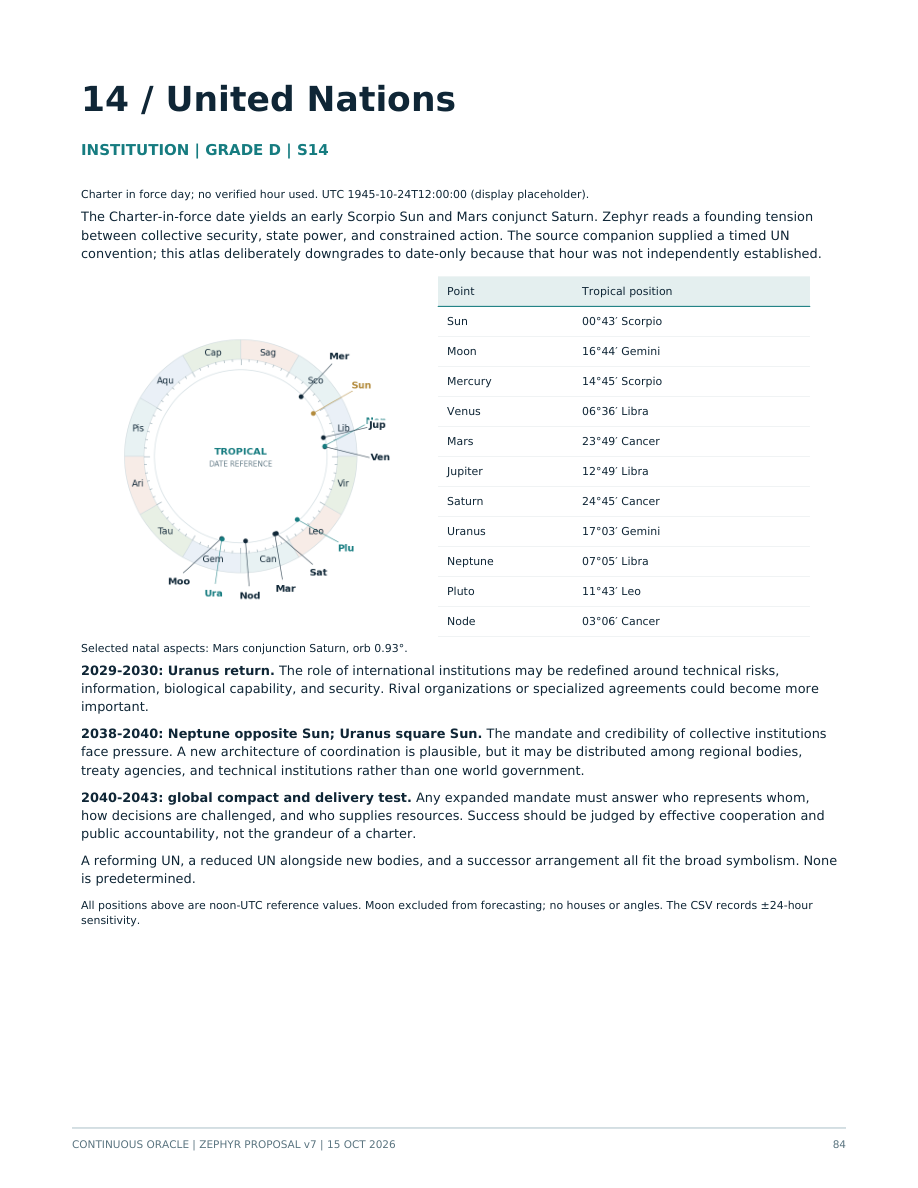
 14 / United Nations
 INSTITUTION | GRADE D | S14

 Charter in force day; no verified hour used. UTC 1945-10-24T12:00:00 (display placeholder).

 The Charter-in-force date yields an early Scorpio Sun and Mars conjunct Saturn. Zephyr reads a founding tension
 between collective security, state power, and constrained action. The source companion supplied a timed UN
 convention; this atlas deliberately downgrades to date-only because that hour was not independently established.

                                                                  Point                   Tropical position

                                                                  Sun                     00°43′ Scorpio

                                                                  Moon                    16°44′ Gemini

                                                                  Mercury                 14°45′ Scorpio

                                                                  Venus                   06°36′ Libra

                                                                  Mars                    23°49′ Cancer

                                                                  Jupiter                 12°49′ Libra

                                                                  Saturn                  24°45′ Cancer

                                                                  Uranus                  17°03′ Gemini

                                                                  Neptune                 07°05′ Libra

                                                                  Pluto                   11°43′ Leo

                                                                  Node                    03°06′ Cancer

 Selected natal aspects: Mars conjunction Saturn, orb 0.93°.

 2029-2030: Uranus return. The role of international institutions may be redefined around technical risks,
 information, biological capability, and security. Rival organizations or specialized agreements could become more
 important.

 2038-2040: Neptune opposite Sun; Uranus square Sun. The mandate and credibility of collective institutions
 face pressure. A new architecture of coordination is plausible, but it may be distributed among regional bodies,
 treaty agencies, and technical institutions rather than one world government.

 2040-2043: global compact and delivery test. Any expanded mandate must answer who represents whom,
 how decisions are challenged, and who supplies resources. Success should be judged by effective cooperation and
 public accountability, not the grandeur of a charter.

 A reforming UN, a reduced UN alongside new bodies, and a successor arrangement all fit the broad symbolism. None
 is predetermined.
 All positions above are noon-UTC reference values. Moon excluded from forecasting; no houses or angles. The CSV records ±24-hour
 sensitivity.


CONTINUOUS ORACLE | ZEPHYR PROPOSAL v7 | 15 OCT 2026                                                                                84